Across Africa, a new economic conversation is taking shape. The question is no longer whether the continent should trade more, but whether it can build the industrial capacity required to produce, compete and capture greater value from its own resources.
For decades, Africa’s economic story has been shaped by what it exports rather than what it manufactures. The continent has supplied the world with some of its most valuable resources, from coffee and cocoa to copper, cobalt, gold, oil and other critical minerals. Yet, too often, the greatest value has been created elsewhere, after these raw materials leave African shores.
A commodity grown, mined or extracted in Africa frequently returns as a finished product at a much higher cost. Coffee beans leave African farms and return as packaged consumer brands. Minerals leave as raw materials and return as machinery, technology components or industrial products. Agricultural produce is exported with limited processing, while African consumers import finished goods created from resources that originated on the continent.
This imbalance lies at the centre of Africa’s trade challenge. The next chapter of Africa’s economic transformation will not be written simply by trading more. It will be written by building more.
The ambition behind the African Continental Free Trade Area (AfCFTA) represents one of the most significant opportunities in Africa’s economic history. By creating a single continental market of more than 1.4 billion people, AfCFTA has the potential to reshape how African countries produce, trade and invest.
But a larger market alone does not guarantee economic transformation. Markets become powerful when they are supported by productive capacity. They require industries that manufacture goods, businesses that innovate, entrepreneurs who can scale and infrastructure that enables products to move efficiently across borders.
This is why investment and industrialisation have become central to Africa’s economic future. Institutions such as Afreximbank have been at the forefront of advancing this conversation, recognising that Africa’s trade transformation requires more than policy agreements. It requires financing, industrial development, stronger regional value chains and the ability for African businesses to compete within and beyond the continent.
The fundamental challenge is straightforward: Africa cannot trade what it does not produce. Africa’s natural resources represent one of its greatest economic opportunities, but the continent’s future prosperity will depend on moving beyond extraction and into value creation.
The opportunity is not only in what Africa possesses, but in what Africa can build around those resources. A continent rich in minerals should not only export raw materials. It should develop industries that process, manufacture and create finished products. A continent with vast agricultural potential should not only supply commodities. It should build competitive food processing industries, global brands and modern agricultural value chains.
The same principle applies across sectors including pharmaceuticals, renewable energy, technology, automotive manufacturing and creative industries.
Industrialisation is not simply about establishing factories. It is about creating ecosystems where skills, finance, technology, infrastructure and entrepreneurship come together to support sustainable economic growth.
The countries that succeed will be those that move from being suppliers of inputs to becoming creators of value. Africa’s opportunity does not lie in every country attempting to produce everything independently. It lies in creating interconnected regional economies where countries complement one another.
A product made in Africa should increasingly reflect the strength of multiple African economies working together. One country may provide agricultural inputs, another may process them, another may manufacture finished products, while others provide logistics, technology and access to markets.
This approach has driven industrial success in other regions of the world, where countries have built powerful supply chains by specialising while collaborating. Africa has the opportunity to do the same. The success of AfCFTA will ultimately depend on whether it creates a continent where businesses can participate in regional production networks, rather than simply expanding markets for imported goods.
Industrialisation requires capital. Factories, energy systems, transport networks, digital infrastructure and research capabilities cannot be developed without long-term investment.
This makes investment attraction one of Africa’s most important economic priorities. The global economy is undergoing significant change. Companies are reassessing supply chains, seeking new production locations and looking for markets with long-term growth potential. Africa, with its resources, youthful population and expanding consumer base, has an opportunity to position itself as a destination for the next generation of manufacturing and innovation.
However, investment follows confidence. Businesses require predictable policies, efficient regulation, reliable infrastructure and markets where they can operate across borders with reduced barriers.
This is where institutions such as Afreximbank play a critical role. By supporting trade finance, investment facilitation and industrial development, such institutions help bridge the gap between Africa’s economic potential and its productive reality.
For East Africa, this moment presents significant possibilities. The region’s strategic location, growing consumer market and expanding infrastructure networks provide a foundation for industrial growth. Countries such as Uganda, Kenya, Tanzania and Rwanda have opportunities to strengthen manufacturing and value addition across sectors including agro-processing, pharmaceuticals, construction materials, renewable energy and technology.
Uganda, in particular, has the potential to strengthen its position as a production and distribution hub within the wider East African market. Its agricultural base, central location and access to regional markets create opportunities to move further into value-added production.
But geography alone will not create competitiveness. The region must continue investing in skills development, energy security, innovation and efficient logistics systems that enable businesses to compete. The future belongs to economies that can transform resources into products, ideas into businesses and markets into opportunities.
For many years, Africa’s economic story has been dominated by challenges: commodity dependence, infrastructure gaps and limited industrial capacity.
Those challenges remain real. But another story is emerging. It is the story of entrepreneurs building companies, investors searching for opportunities, governments developing industrial corridors and institutions creating new models for financing Africa’s growth.
The continent’s greatest opportunity may not lie simply in what it exports to the world, but in what it can build for itself and for each other. As AfCFTA moves from ambition to implementation, the defining question will be whether Africa can turn its market size into industrial strength.
The answer will depend on whether the continent can create more factories, stronger businesses, smarter supply chains and deeper partnerships.
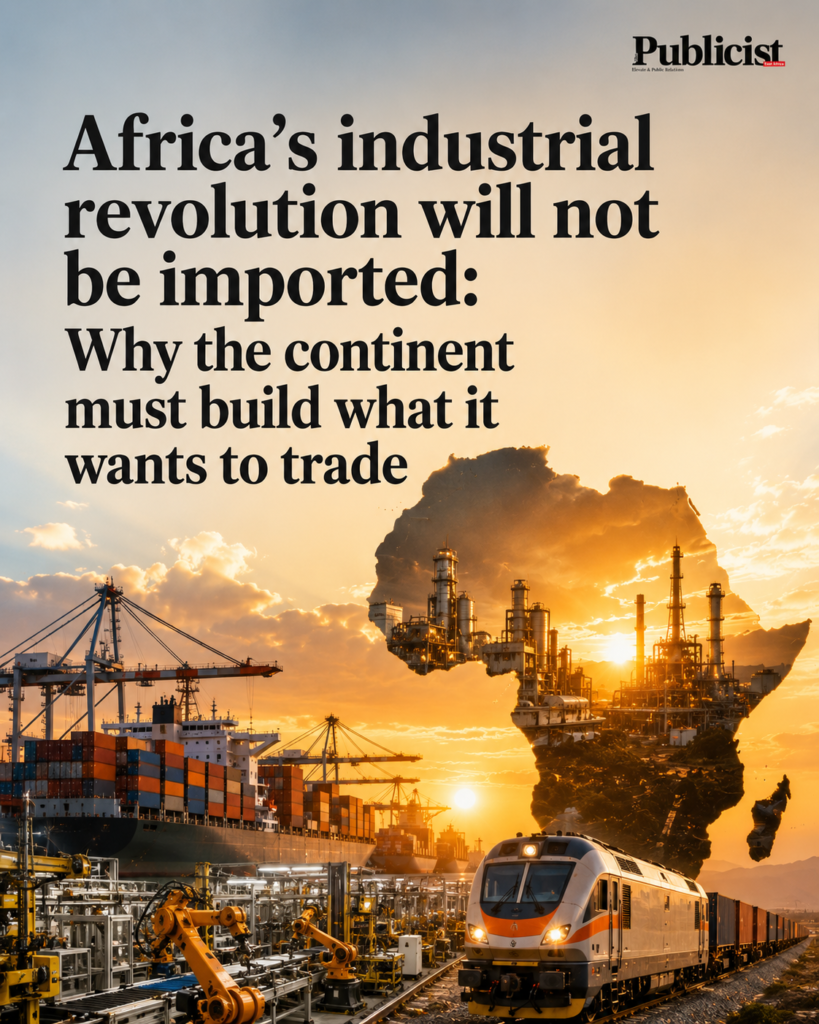
Africa’s industrial revolution will not be imported. It will be built through investment, innovation and collaboration, one industry and one value chain at a time.
Publicist East Africa will continue exploring the ideas, investments and leaders shaping Africa’s economic transformation.