For a business, the most important question about Uganda’s September–December 2026 rainfall season is not simply how much rain will fall. It is what happens to the business if a key road becomes impassable, a supplier cannot deliver, stock is damaged or customers cannot reach the premises.
Uganda’s national climate outlook points to near-normal to above-normal rainfall in several parts of the country, with enhanced rainfall expected particularly across central, northern and eastern areas. Regional forecasts from the IGAD Climate Prediction and Applications Centre also point to wetter-than-normal conditions across much of the Greater Horn of Africa during October–December.
The forecast does not mean that every business in these areas will flood or suffer losses. Rather, it highlights where businesses need to examine their exposure before heavy rainfall disrupts operations.
For Uganda’s businesses, four areas stand out: farms and food supply, roads and deliveries, physical premises and electricity.
Agriculture is the first point of exposure because production depends directly on weather. Rainfall can support crops and pasture, but excessive rain can create flooding, waterlogging and erosion, while disrupting harvesting, storage and the movement of produce. The consequences can then travel beyond the farm to traders, processors, wholesalers and food businesses that depend on agricultural supplies.
Uganda’s recent climate experience illustrates the scale of that exposure. The World Bank’s Uganda Country Climate and Development Report found that 84% of surveyed communities reported more frequent floods between 2015 and 2022. The report also documents significant effects of flooding on agricultural production.
These figures describe past exposure; they do not predict what will happen during the 2026 rainfall season.
For an agricultural business, however, the practical questions are immediate. Can harvested produce be moved if feeder roads become difficult to use? Is there adequate drainage around storage facilities? Can a processor continue operating if deliveries of raw materials are delayed?
The risk therefore extends across the food chain. A farm may remain physically intact while a trader loses access to the farm, a transporter faces delays or a processor receives raw materials late.
That makes storage, drainage, harvesting schedules and alternative routes part of business continuity rather than simply farm management.
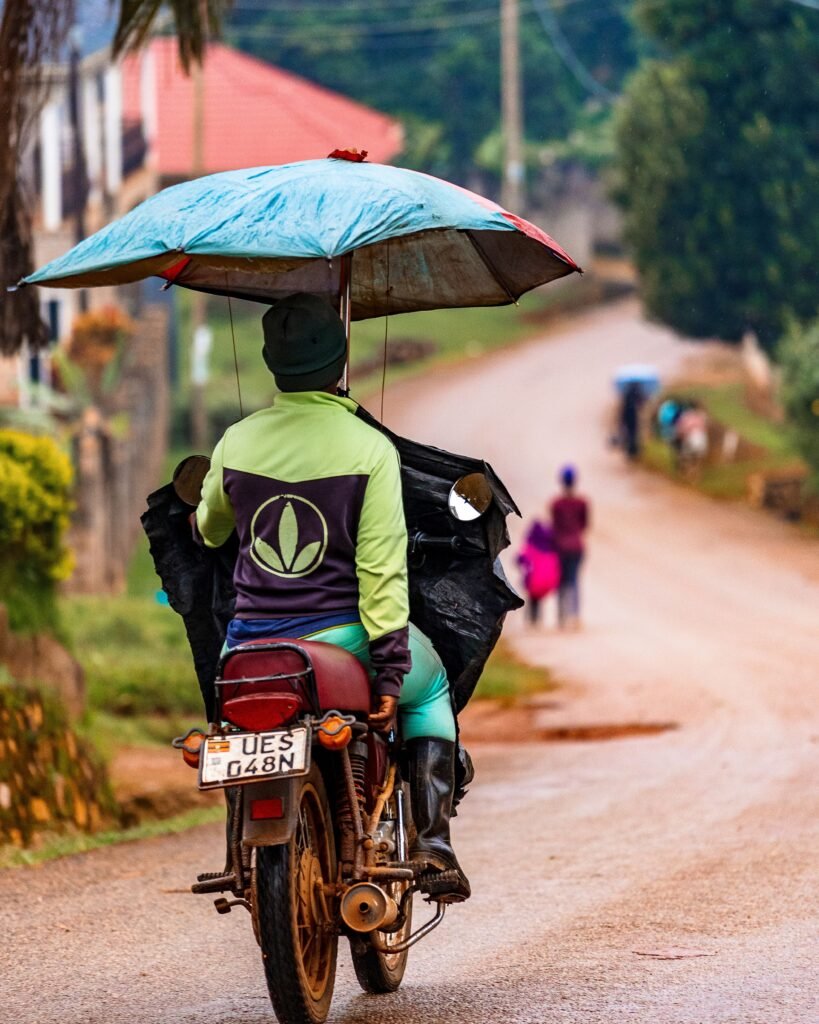
For businesses that move goods, rainfall becomes a commercial problem when roads stop functioning normally.
Flooding, landslides and damaged roads can increase travel times, force vehicles onto longer routes and delay deliveries. A business does not necessarily have to be located in a flood-prone area to feel the effect. If an important supplier, customer or distribution route is cut off, the disruption can move through the entire supply chain.
The World Bank’s latest Uganda climate assessment estimates that about 60% of the national road network and 45% of district roads are highly vulnerable to flooding. It also estimates that flood damage could add between $13.6 million and $26 million a year to road maintenance costs in the 2040s.
The significance for businesses is straightforward. A distributor may have stock ready but no reliable route to deliver it. A retailer may have customers but not receive replenishment. A manufacturer may have production capacity but be unable to receive a critical input.
Uganda’s dependence on road transport makes the issue particularly important. The World Bank has previously noted that roads carry about 95% of the country’s freight traffic. Businesses that rely on frequent deliveries therefore need to know which routes are critical to their operations and what alternatives exist if those routes are disrupted.
The third area is the business premises itself. Heavy rainfall can affect shops, warehouses, factories, offices and construction sites through flooding, drainage failures, water damage and restricted access. For a retailer, damaged stock can create an immediate loss. For a warehouse, even a building that remains structurally sound may become commercially unusable if trucks cannot reach it.
Kampala illustrates the challenge. Flooding has repeatedly affected roads and access within the city, while the World Bank has documented how flooding of critical road sections can create delays well beyond the areas directly affected by water.
The risk is particularly relevant for businesses operating from low-lying areas, wetlands or locations with limited drainage capacity.
The practical response is not necessarily to relocate every business. It is to understand the points at which rainfall can interrupt operations. Businesses can check drainage around their premises, protect vulnerable stock, review access for delivery vehicles and establish where critical equipment or inventory can be moved if water levels rise.
For construction companies and property owners, the same principle applies. Wet conditions can delay works, while saturated ground, flooding and landslides can increase risks at particular sites.
Even where a business is protected from flooding, it can still be affected when the infrastructure it depends on is disrupted.
The World Bank’s climate assessment identifies Uganda’s electricity network as another area of vulnerability. It estimates that 21% of the electricity network is threatened by climate-related risks, while its detailed assessment notes that more than half of the electricity transmission and distribution network is exposed to landslide and flood risk.
For manufacturers, cold-chain operators, food processors, retailers and other businesses that depend on continuous electricity, an outage can quickly become an operational problem.
A factory may have raw materials but be unable to run machinery. A supermarket may have stock but struggle to maintain refrigeration. A service business may have staff and customers but lose access to essential digital systems.
This makes backup power, equipment protection and clear procedures for outages relevant to rainfall-season planning.
The value of the climate forecast is that it gives businesses time to examine these weak points before they are tested. A logistics company can identify alternative routes before its usual road becomes difficult to use. A retailer can check whether stock is stored above potential flood levels. A manufacturer can identify suppliers whose deliveries depend on vulnerable roads and determine whether alternative suppliers or inventory buffers are necessary.
Agricultural businesses can inspect drainage, storage and post-harvest facilities, while property owners can check roofs, drainage channels and access points. Businesses that depend heavily on electricity can review backup-power arrangements and the equipment most vulnerable to outages.
Insurance also needs to be understood in practical terms. Businesses should know what their policies cover and, importantly, whether they cover the specific risks they face, including property damage, goods in transit or business interruption.
The broader economic case for preparation is already clear. The World Bank estimates that climate-related road damage alone costs Uganda up to $26 million annually, while its 2025 climate assessment warns that climate change could reduce Uganda’s economic growth by up to 3.1% by 2050 without stronger resilience measures.
Those are long-term climate risks, not a forecast of losses for this particular rainy season. But they show why infrastructure and business continuity matter as weather patterns become more disruptive.
For companies, the September–December rainfall outlook should therefore be treated as a planning signal rather than a prediction of disaster.
The businesses that need the closest attention are those whose operations depend on farms, roads, physical premises or uninterrupted power. Their vulnerability will differ by location and business model, but the underlying question is the same:
If heavy rainfall cuts off a key road, damages stock, interrupts power or prevents a critical supplier from delivering, how quickly can the business keep operating? That is where a weather forecast becomes a business-continuity tool.