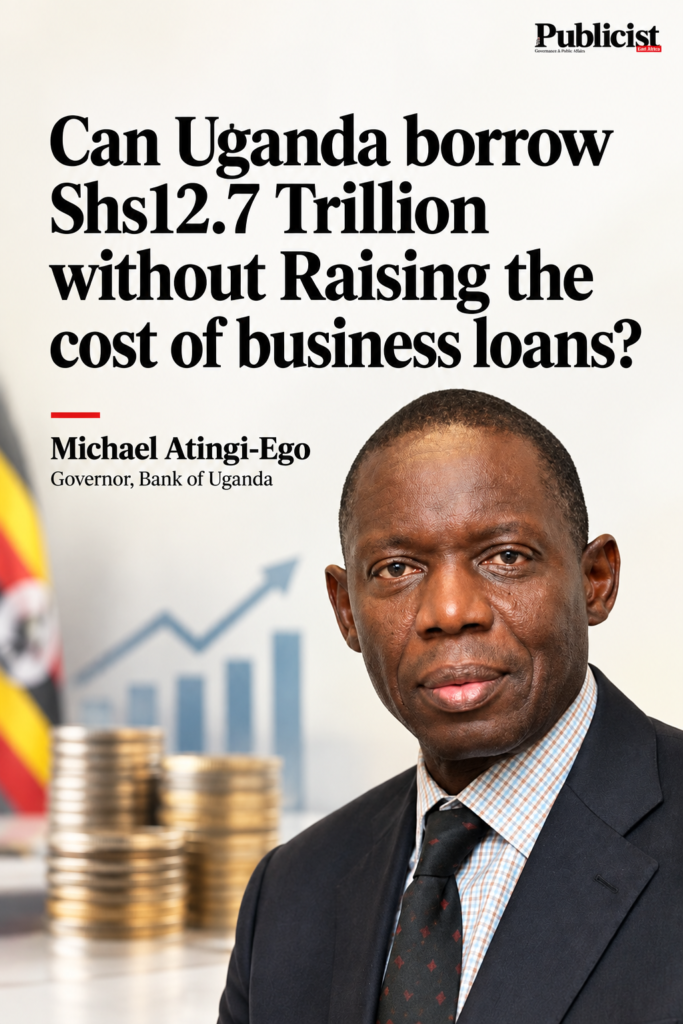
Uganda plans to raise about Shs12.7 trillion in net domestic financing in FY2026/27. For businesses, the important question is what that borrowing will do to the cost and availability of credit.
The Bank of Uganda says the domestic financial market has enough capacity to absorb the planned borrowing without disrupting private-sector financing. But Governor Michael Atingi-Ego warned Parliament’s Budget Committee on September 21 that borrowing beyond the projected level could push up interest rates and make it harder for businesses to access credit.
That warning comes as businesses are already borrowing more. Private-sector credit reached Shs28.09 trillion in July 2026, up 1.2% from June and 18.1% from July 2025. The Ministry of Finance attributed the increase to sustained demand and supply of credit as economic activity continued to expand.
The challenge is that government and businesses ultimately draw on the same domestic financial system. Commercial banks, pension funds, insurance companies and other investors allocate funds between government securities and private-sector lending.
When government increases its demand for domestic financing, the returns available on Treasury bills and bonds become an important part of that allocation decision. If government securities offer sufficiently attractive yields, financial institutions may have greater incentive to hold public debt rather than expand lending to businesses.
That is the mechanism behind the crowding-out concern.
The latest lending data do not show that government borrowing has already caused a broad increase in the cost of business loans.
The weighted average lending rate on shilling-denominated credit rose from 16.93% in June to 17.32% in July 2026. Foreign-currency lending rates also increased, from 6.93% to 7.76%. But the movement in lending rates by itself does not establish that government borrowing caused the increase.
There is, however, a wider regional gap. The East African Community’s Q2 2026 statistics bulletin put Uganda’s average lending rate at 16.9%, the highest among the reporting Partner States. In the same period, Tanzania’s 91-day Treasury bill rate was 3.6%, compared with 10.2% in Uganda. Uganda’s lending rate had fallen from 18.9% in the first quarter, but remained the highest among the reporting Partner States.
That raises a broader question: why is borrowing still so expensive when inflation is relatively low?
The answer is not simply government borrowing. Uganda’s lending rates were actually lower in July than a year earlier. The shilling lending rate fell from 19.65% in July 2025 to 17.32% in July 2026, while the foreign-currency rate declined from 8.35% to 7.76%.
The Ministry of Finance also reported that Treasury yields were generally declining. In July, yields on Treasury bills fell across all three tenors, with the 91-day, 182-day and 364-day rates reaching 10.4%, 10.7% and 11.5%, respectively. The Ministry attributed the decline to strong investor demand and reinvestment of proceeds from maturing government securities.
The August data showed the trend continuing, with yields on several Treasury instruments falling further. The Ministry said strong demand for government securities supported the decline.
This creates an important distinction: government can borrow heavily without immediately making private credit more expensive if market liquidity, investor demand and competition for funds remain favourable.
The risk emerges if government borrowing increases beyond the market’s capacity or if investors begin demanding higher returns to absorb additional government debt.
The International Monetary Fund has identified Uganda’s reliance on domestic financing as a vulnerability.
Its 2026 Debt Sustainability Analysis says Uganda’s borrowing costs remain high, with interest payments reaching 3.7% of GDP in FY2024/25, largely because of the growing stock of domestic debt and elevated domestic interest rates.
The IMF also points to the growing exposure of commercial banks to government securities. As of June 2025, commercial banks held about 28.6% of Uganda’s government debt, when Treasury bills and bonds are considered together. Pension and provident funds held about 31.5%.
The concern is not that government securities are inherently harmful to banks. Government debt remains an important asset for financial institutions.
The issue is concentration. The IMF says Uganda now ranks fourth among sub-Saharan African economies in banks’ exposure to sovereign debt and recommends monitoring the relationship between banks and government borrowing. It estimates that a one-percentage-point increase in domestic financing relative to GDP could add about 100 basis points to the interest rate on a one-year government bond.
That estimate applies to government bond yields, not directly to commercial-bank lending rates. But it shows how additional demand for domestic financing can affect the broader pricing environment in which banks operate.
If the return required on government securities rises, banks may reassess the returns required on private-sector loans, particularly for borrowers perceived as riskier.
The current data do not show a broad crowding-out of private-sector credit.
Private-sector credit increased from Shs27.75 trillion in June to Shs28.09 trillion in July, while year-on-year growth reached 18.1%. The Ministry said the increase reflected continued demand and supply of credit, supported by economic activity and reduced lender risk aversion.
The June lending data also show substantial credit flowing into productive sectors.
Credit approved for disbursement amounted to Shs2.08 trillion out of loan applications worth Shs3.29 trillion, an approval rate of 63.2%. Trade received Shs324.4 billion, agriculture Shs233.7 billion, business, community and social services Shs233.2 billion, while building, mortgage, construction and real estate received Shs210.7 billion.
These figures show that credit is flowing through the economy. They do not, however, reveal how many businesses failed to secure financing or whether smaller firms can afford loans at prevailing interest rates.
For an SME, the difference between getting a loan and getting a loan at a commercially viable rate can determine whether an investment goes ahead.
That is why the headline lending rate is only part of the story. The actual cost of credit also depends on the borrower’s risk profile, collateral, loan maturity, currency, sector and the pricing decisions of individual lenders.
There is also an important distinction in Uganda’s financing figures.
Governor Atingi-Ego referred to about Shs12.7 trillion in projected net domestic financing for FY2026/27 when appearing before Parliament’s Budget Committee. Parliament’s approved budget, meanwhile, provides for Shs11.97 trillion in domestic borrowing.
The figures should therefore be attributed separately rather than presented as interchangeable.
The approved budget also provides Shs13.97 trillion for domestic debt refinancing. That represents the rollover of maturing domestic obligations rather than new borrowing to finance additional expenditure.
Refinancing does not create the same additional demand for capital as new financing. But it still generates activity in the domestic securities market as government replaces maturing instruments with new ones.
This distinction matters because the pressure on the financial system depends not only on the headline amount of securities issued, but also on how much represents new financing and how much replaces debt that is already coming due.
Uganda’s FY2026/27 budget is about Shs84.3 trillion. Parliament estimates interest payments at Shs12.4 trillion, while total debt servicing, including principal repayments, is expected to reach about Shs33.4 trillion.
That means a substantial portion of government resources is already committed to debt obligations.
The IMF’s assessment adds another layer. It says Uganda’s public debt remains sustainable but that reliance on domestic financing creates vulnerabilities that require monitoring. The Fund also notes that the stock of domestic debt is projected to remain on an upward path under its baseline scenario.
That creates a difficult financing equation.
Government needs domestic financing to support its expenditure programme, while businesses need the same financial system to fund working capital, machinery, construction, expansion and new investment.
The more expensive government borrowing becomes, the greater the potential pressure on the rest of the market.
The immediate indicator is not simply how much government borrows. It is the price at which government borrows.
If Treasury yields remain contained and the banking system continues to have sufficient liquidity, government could increase domestic financing while private-sector credit continues to expand.
That is broadly consistent with the current data. Treasury yields have been easing, while private-sector credit grew by 18.1% year-on-year in July.
But the situation could change if government borrowing moves significantly above plan.
That is the risk highlighted by BoU. Atingi-Ego told Parliament that the market can accommodate the planned borrowing, but higher-than-projected domestic borrowing could place upward pressure on interest rates and crowd out private-sector borrowers.
For businesses, particularly manufacturers and SMEs, four indicators will therefore matter: government borrowing volumes, Treasury yields, commercial-bank lending rates and the amount of credit approved for the private sector.
Together, they will show whether Uganda’s domestic financial market is accommodating government financing without making capital more expensive for businesses.
The current evidence does not show a broad crowding-out of private-sector credit. Credit is expanding, Treasury yields have been easing and lending rates remain below their levels a year ago. But the IMF’s assessment and the central bank’s warning point to a potential pressure point if domestic borrowing rises beyond planned levels.
For Uganda’s businesses, therefore, the question is not simply whether government can borrow Shs12.7 trillion. It is whether it can do so without changing the price of money for everyone else.