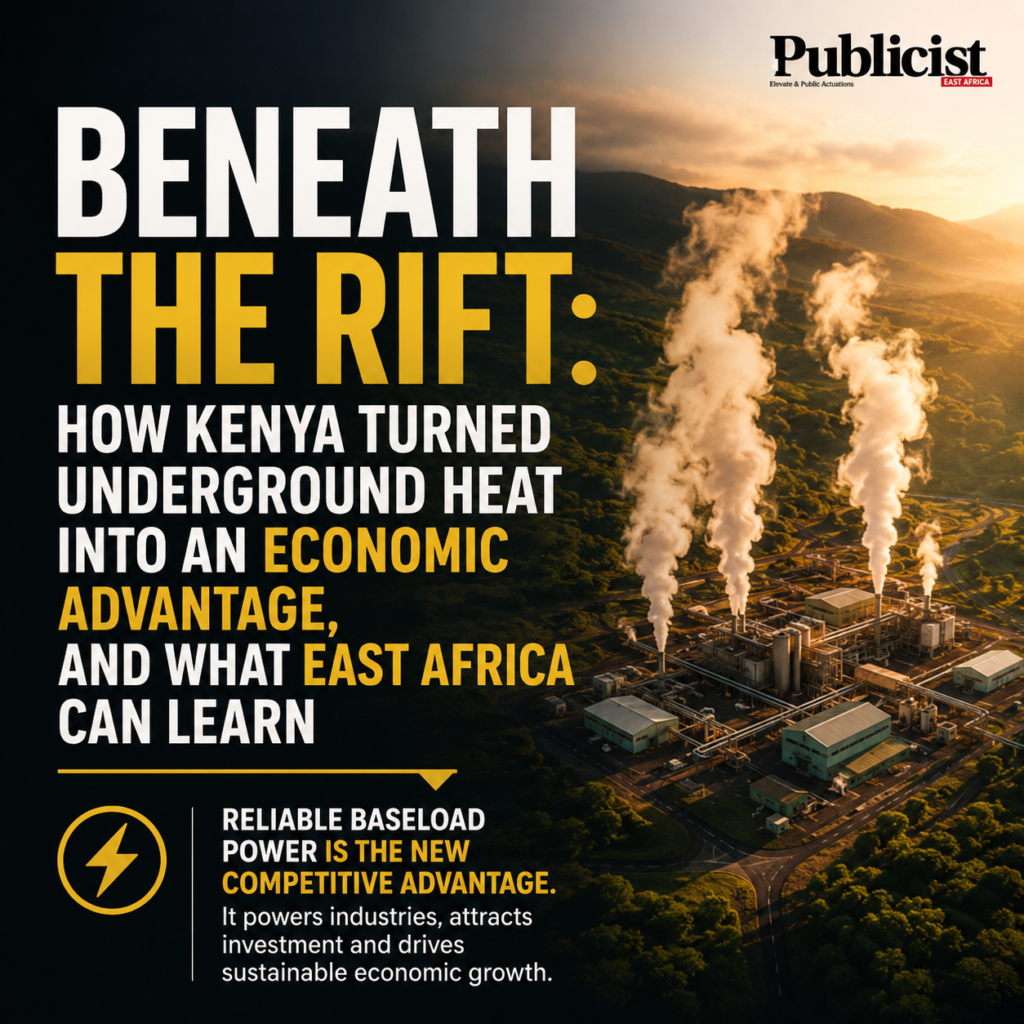
Every industrial revolution has had its defining source of energy. Britain’s factories were powered by coal. The Gulf transformed itself through oil. Norway built prosperity on hydropower. Kenya may have found its long-term competitive advantage in something far older than all three: the heat beneath the Great Rift Valley.
Around the world, history shows that economies do not rise on natural resources alone. They rise on how governments choose to develop those resources. Coal did not make Britain an industrial power by itself. Oil did not automatically make Gulf states prosperous. It took decades of investment, institutions, policy consistency and infrastructure to convert natural endowments into engines of economic growth. Kenya’s geothermal journey belongs in that same conversation.
Today, the country generates nearly half of its electricity from geothermal energy, making it Africa’s undisputed geothermal leader and one of the world’s largest producers of geothermal power. More importantly, it has demonstrated how energy policy can become industrial policy, positioning a country for long-term economic competitiveness in an era where reliable electricity is increasingly determining where factories are built, where technology companies invest and where industries flourish.
This is no longer simply an energy story. It is a story about economic strategy. Energy has become one of the most decisive factors shaping national competitiveness. Manufacturers require uninterrupted electricity to maintain production lines. Data centres that power artificial intelligence and cloud computing cannot tolerate power outages. Electric vehicle charging networks depend on reliable baseload power. Mineral processing plants consume enormous amounts of electricity, while cold-chain logistics, pharmaceutical manufacturing and advanced digital infrastructure all rely on stable energy supplies.
Increasingly, investors compare electricity costs and reliability as carefully as they compare tax incentives or labour markets. In many cases, the availability of dependable electricity determines whether a company establishes a factory in one country rather than another. Energy policy has therefore become a critical component of industrial policy.
Kenya recognised this reality long before many of its regional peers. Situated along the Great Rift Valley, one of the world’s richest geothermal belts, the country saw beneath its landscape an opportunity that extended far beyond electricity generation. Instead of viewing geothermal energy as a niche renewable resource, successive governments treated it as a strategic national asset capable of supporting industrialisation for generations.
According to the Kenya Energy and Petroleum Regulatory Authority (EPRA), geothermal energy now contributes between 44 and 47 percent of the country’s electricity generation, making it the single largest source of power on the national grid. The International Renewable Energy Agency (IRENA) reports that Kenya’s installed geothermal capacity reached approximately 985 megawatts by the end of 2024, while more recent government figures indicate that installed capacity has now surpassed 1,000 megawatts. This achievement makes Kenya Africa’s largest geothermal producer and the seventh-largest globally.
Equally significant is what this means for Kenya’s broader energy system. According to the International Energy Agency (IEA), approximately 90 percent of the country’s electricity is generated from renewable sources, including geothermal, hydropower, wind and solar. Yet geothermal occupies a uniquely strategic position within that mix. Unlike hydropower, it is unaffected by prolonged droughts or declining water levels. Unlike wind and solar, it operates around the clock regardless of weather conditions. It provides what energy planners call baseload power—continuous electricity available every hour of every day throughout the year.
That reliability has become one of Kenya’s greatest economic assets. The geothermal fields around Olkaria are often celebrated as engineering achievements, but their real significance lies elsewhere. They reflect decades of patient planning and institutional discipline. While many governments sought quicker political victories through diesel generation or delayed investments while awaiting oil discoveries, Kenya committed itself to the slower, more complex task of developing geothermal resources. It invested not only in drilling equipment and power stations but also in geological research, technical expertise and specialised institutions capable of sustaining the industry over the long term.
Perhaps Kenya’s most consequential decision was institutional rather than technological. Recognising that geothermal exploration involves significant financial risk, the government established the Geothermal Development Company (GDC), a specialised state agency responsible for undertaking exploration and drilling before private investors entered the market. By assuming much of the early-stage geological risk, Kenya fundamentally changed the economics of geothermal investment. Developers could focus on building and operating power plants rather than financing expensive exploratory drilling with uncertain outcomes.
That institutional innovation unlocked substantial international financing from partners including the World Bank, the African Development Bank, the Japan International Cooperation Agency (JICA) and the European Investment Bank. Over time, it also created confidence among private investors, demonstrating that consistent policy and capable public institutions can be just as valuable as natural resources themselves.
This distinction is important because countries rarely become prosperous simply because they possess valuable resources. Many nations rich in minerals, oil or fertile land continue to struggle economically. What separates successful economies is often the quality of their institutions and their willingness to pursue long-term investment strategies that extend well beyond political cycles.
Kenya’s geothermal sector illustrates precisely that principle. The benefits extend far beyond electricity generation. Stable and affordable baseload power lowers production costs for manufacturers, improves productivity and reduces dependence on costly backup generators. It supports digital infrastructure, attracts energy-intensive industries and strengthens investor confidence. In an increasingly competitive global economy, reliable electricity has become a strategic advantage comparable to efficient transport networks or modern ports.
This lesson carries implications far beyond Kenya’s borders. East Africa is entering a period of rapid economic transformation. Governments across the region are investing heavily in industrial parks, transport corridors, mineral beneficiation, digital economies and regional trade integration. Artificial intelligence infrastructure, cloud computing services, electric mobility and advanced manufacturing are expected to become major drivers of economic growth over the coming decades. All of these sectors depend on reliable electricity.
Without dependable baseload power, ambitions for industrialisation become significantly more difficult to achieve. Uganda presents an instructive comparison.
Over the past two decades, the country has made remarkable progress in expanding electricity generation. Investments in Bujagali, Isimba and the recently commissioned 600-megawatt Karuma Hydropower Plant have increased installed generation capacity to more than 2,050 megawatts, according to the Electricity Regulatory Authority (ERA). Hydropower now accounts for more than 80 percent of Uganda’s electricity generation and remains the foundation of the national grid.
These achievements have improved electricity access, strengthened industrial development and enhanced national infrastructure. Yet heavy dependence on a single source of generation also introduces risk.
Climate change is altering rainfall patterns across East Africa, bringing longer droughts, greater weather variability and increasing uncertainty over river flows. The International Energy Agency has repeatedly warned that hydro-dependent electricity systems across Sub-Saharan Africa face growing vulnerabilities as climate change intensifies. As electricity demand continues to rise, diversification becomes not merely desirable but economically prudent.
Ironically, Uganda possesses significant geothermal potential of its own. According to the Ministry of Energy and Mineral Development, geothermal prospects have been identified at Katwe-Kikorongo, Buranga, Kibiro, Panyimur and Kanangorok along the western branch of the East African Rift System. Preliminary geological assessments estimate Uganda’s geothermal potential at between 450 and 1,500 megawatts, although commercial development has yet to begin.
Should even a portion of this resource be developed, geothermal energy could significantly diversify Uganda’s electricity mix while strengthening resilience against climate-related disruptions. It would also enhance energy security as demand expands from manufacturing, mineral processing, electric transport, digital infrastructure and growing urban centres.
The economic implications extend well beyond the power sector. The World Bank estimates that unreliable electricity costs businesses across Sub-Saharan Africa between 6 and 8 percent of annual sales through production interruptions, equipment damage, expensive backup generators and delayed operations. Every hour without electricity reduces productivity, discourages investment and increases the cost of doing business.
Conversely, countries capable of providing stable, affordable and predictable electricity create conditions that attract long-term investment. Manufacturers value certainty. Technology companies require uninterrupted operations. Investors seek environments where infrastructure reduces rather than increases operational risk.
Kenya appears to have understood this relationship earlier than many of its neighbours. Today, geothermal energy forms part of a broader national development strategy. It supports manufacturing ambitions, strengthens export competitiveness and reinforces Kenya’s aspiration to become a regional hub for industry, logistics and technology. The country’s geothermal programme demonstrates that renewable energy can be more than an environmental initiative; it can serve as a cornerstone of industrial transformation.
This offers an important lesson for East Africa as a whole. The region is home to extraordinary natural assets, from geothermal reservoirs and hydropower potential to critical minerals, fertile agricultural land and expanding renewable energy resources. Yet these assets alone will not determine future prosperity. The decisive factor will be whether governments establish the institutions, financing mechanisms and policy frameworks capable of transforming natural advantages into enduring economic strength.
Kenya’s geothermal journey underscores the importance of thinking beyond electoral cycles. Developing geothermal resources required decades of geological exploration, infrastructure investment and institutional capacity building before delivering large-scale economic returns. It demanded patient capital and consistent political commitment—qualities that are often in short supply but essential for long-term development.
As East Africa competes to attract manufacturing, digital infrastructure and high-value investment, electricity will increasingly determine which economies emerge as regional leaders. Countries that build resilient, diversified and affordable energy systems today will be better positioned to capture the industries of tomorrow.
The Great Rift Valley does not recognise national borders. The same geological system that powers Kenya’s geothermal plants stretches into Uganda and across parts of Tanzania and Ethiopia. The underground heat exists across the region. What differs is not geology but the pace of investment, the strength of institutions and the consistency of policy.
Ultimately, Kenya’s success demonstrates that competitive advantage is rarely inherited. It is built through deliberate choices made over decades. Geothermal energy did not transform Kenya because it existed beneath the earth. It transformed Kenya because leaders recognised its strategic value, invested patiently and created institutions capable of unlocking it.
That may be the most valuable lesson of all. Across East Africa, the greatest resource is not simply what lies beneath the ground. It is the ability to convert natural potential into lasting economic prosperity through vision, discipline and long-term investment.