For years, mobile money in Africa was understood as a convenient alternative to cash: a way to send money home, pay a bill, receive money or withdraw funds without visiting a bank.
That description is becoming too narrow. Airtel Money has grown into something much larger, a financial-services platform built on the reach of Airtel Africa’s telecommunications network. Airtel Africa has confirmed London as its preferred venue for a planned 2026 listing of the business, with Bloomberg reporting that the unit could be valued at more than $10 billion. That figure is not a confirmed valuation; it is an indication of what the business could be worth when the market eventually puts a price on it.
And that is where the real story begins. The listing could provide one of the clearest market signals yet about how global investors value Africa’s mobile-finance businesses, and potentially encourage other telecom companies to unlock value from financial platforms that have grown inside their networks.
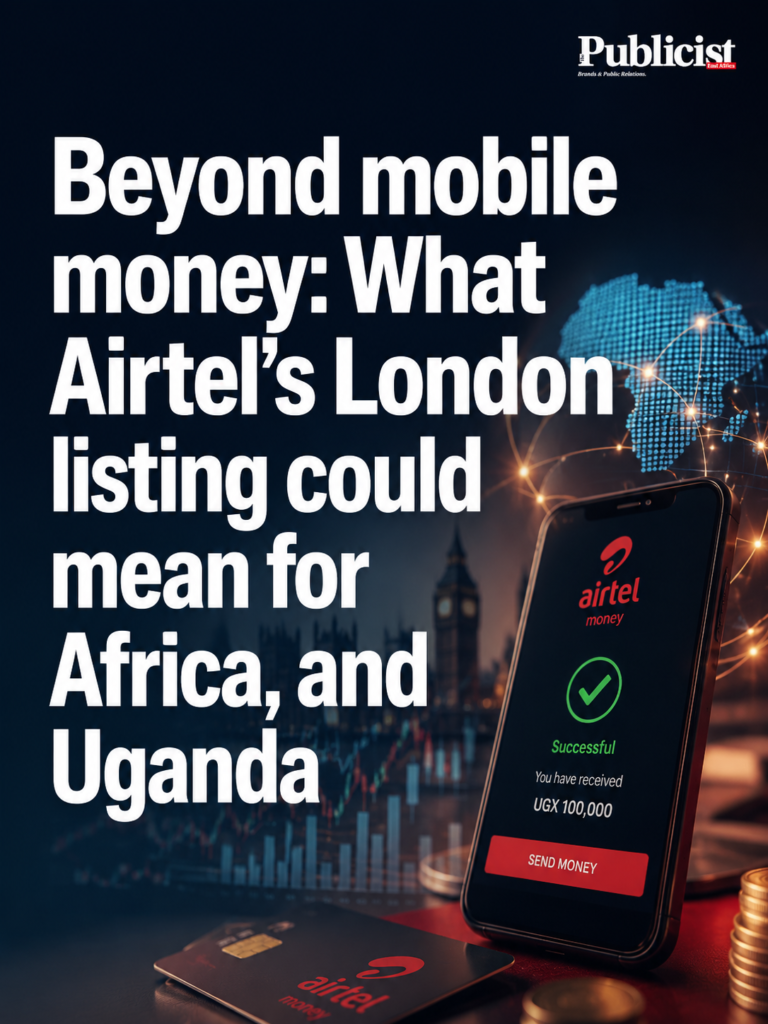
Airtel Money already has the scale to attract that attention. At the end of March 2026, it had 54.1 million customers, up 21.3% year-on-year. Transaction value reached about $196 billion, while revenue rose to $1.355 billion. The platform has also expanded beyond person-to-person transfers into merchant payments, lending, savings and international transfers.
That evolution mirrors what is happening across Africa’s mobile-money industry. The GSMA estimates that mobile money processed $2.1 trillion globally in 2025. More importantly, the industry is moving beyond basic payments. Mobile wallets are increasingly being used as distribution channels for credit, savings, insurance, merchant services and other financial products.
The significance for Uganda is that the country does not need to start this journey from scratch. Mobile money is already deeply embedded in everyday economic activity. The next challenge is turning that adoption into deeper and more productive financial services.
A small trader receiving daily payments digitally is creating a record of business activity. An SME collecting revenue through a mobile wallet could, with appropriate consent, safeguards and access to the data, potentially use those transaction flows to demonstrate cash-flow patterns to lenders. A farmer receiving digital payments has a potential pathway into other formal financial services.
The opportunity is therefore no longer simply to put money on people’s phones. It is to use the digital financial infrastructure already in place to help people access capital, savings, insurance and investment.
This is also why Airtel’s potential valuation matters beyond Airtel. If investors ultimately assign a substantial standalone value to Airtel Money, the transaction could establish an important benchmark for African telecom-fintech businesses. It would demonstrate that financial platforms built inside telecom companies can be valued as businesses in their own right rather than simply as supporting products for mobile subscribers.
MTN is already moving in that direction. MTN’s MoMo business had 67.4 million users across its markets in the first quarter of 2026 and processed $163 billion in transactions during the period. The group has also been separating its fintech operations from its traditional telecommunications business, reflecting its strategy of giving the financial-services business greater focus and scale.
In Uganda, MTN shareholders approved the separation of MoMo from the telecommunications business in 2025. Airtel’s listing could therefore sharpen competition across the continent. The question for telecom companies will increasingly be less about how many subscribers they have and more about how much financial value they can create from those relationships.
Safaricom’s M-PESA shows what that evolution can look like. What began as a mobile money-transfer service has developed into a broad financial ecosystem spanning payments and other financial services.
Airtel, MTN and Safaricom are therefore operating in a market where the competitive advantage increasingly lies in what can be built on top of the wallet.
For Uganda, that creates an opportunity. The country already has substantial mobile-money infrastructure on which a deeper digital-finance ecosystem can be built. But infrastructure alone does not create economic transformation. The next step is connecting digital transactions to productive activity.
That could mean better financial services for small businesses, more accessible savings and insurance products, new approaches to working-capital finance and greater use of digital payments in agriculture.
It could also contribute to East Africa’s wider economic integration.
A trader operating between Kampala and Nairobi, or a Ugandan business selling into Tanzania, should ideally be able to move money across borders with fewer costs and delays. Mobile-money platforms could help make that possible, but technology alone will not remove the barriers. Currency differences, regulation, settlement systems and interoperability still matter.
The GSMA has identified interoperability and cross-border harmonisation as important priorities for the industry’s next phase.
If those barriers are gradually reduced, mobile-money networks could become more than domestic payment systems. They could become part of the infrastructure supporting regional trade.
But the expansion of digital finance also raises the stakes. As more household and business transactions move through digital platforms, fraud, cybercrime, data protection and consumer protection become increasingly important. Financial inclusion cannot simply mean giving people access to a digital wallet; it must also mean ensuring that they can use that wallet safely, affordably and with confidence.
That will require regulators to strike a difficult balance: protecting consumers and their data without making digital financial services so costly or restrictive that innovation is discouraged.
Ultimately, the success of mobile money should not be measured only by how much money passes through the system.
The more important question is what those transactions enable. Can a small business use its digital transaction history, with appropriate safeguards, to improve access to working capital? Can farmers receive payments digitally and then access other financial services? Can insurance and savings reach people who have traditionally remained outside formal finance? Can a trader move money across an East African border without unnecessary friction?
Those are the questions that will define the next phase of Africa’s digital-finance economy. And that is why Airtel Money’s planned London listing deserves attention in Uganda.
The IPO itself is not particularly new. What matters is what the market eventually decides the business is worth.
If Airtel Money secures a strong valuation, it could send a powerful signal to investors, telecom companies and policymakers that Africa’s mobile-finance platforms have matured into valuable financial businesses. It could encourage other operators to unlock value from their fintech operations and attract more capital into Africa’s digital financial economy.
For Uganda, the lesson is not simply that mobile money is becoming more valuable. It is that the country already possesses an important piece of digital financial infrastructure. The bigger economic opportunity is to make that infrastructure work harder, by widening access to productive capital, strengthening SMEs, supporting farmers, expanding savings and insurance, and reducing the friction involved in regional commerce.
Africa’s mobile-money revolution may therefore be entering its second phase. The first was about putting money on the phone. The next is about what the phone can do with that money.