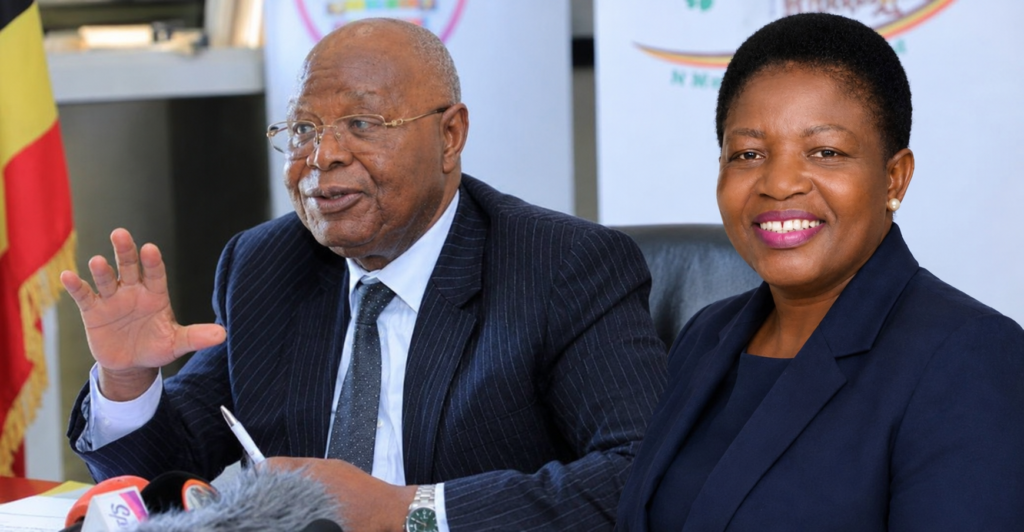

Pearl Bank, Executive Director, Andrew Kabeera (L) guiding Hajji Rashid Sekindi, UTOF President (R) on using the Wendi Mobile Wallet during the Wendi Ku Win campaign launch at Old Taxi Park today, 6th November 2026. Courtesy photo.
A fuel voucher, a smartphone or a cash prize could be enough to convince someone to make their next payment digitally. But for Pearl Bank, the bigger opportunity is turning that first transaction into a habit. Through its Wendi mobile wallet, the bank is betting that rewarding customers for everyday payments can encourage more Ugandans to embrace digital financial services.
The bank is testing this approach through Wendi Ku Win, a campaign launched on November 6 at Kampala’s Old Taxi Park in partnership with the Uganda Taxi Operators Federation (UTOF). Customers who make transactions exceeding UGX10,000 through the wallet stand a chance of winning prizes in weekly draws, including fuel vouchers worth UGX30,000, UGX50,000 and UGX100,000, smartphones, household appliances such as microwaves and blenders, and cash rewards worth UGX100,000.
The choice of rewards connects the campaign to everyday consumer needs. Fuel vouchers appeal to motorists and transport operators, while smartphones and household appliances offer incentives that households can appreciate. By linking these rewards to transactions, Pearl Bank wants customers to have more reasons to use Wendi when paying for goods and services, transferring money and managing their savings.
Andrew Kabeera, Executive Director at Pearl Bank, said the campaign is intended to encourage existing and prospective customers to explore the different services available through the wallet.
“We believe that during this campaign, both existing and new customers will be able to interact with the Wendi platform as they make fuel payments, pay bills, make money transfers, save, conduct merchant payments, government collections, and Western Union services transfers,” Kabeera said.
The campaign comes against a backdrop of significant growth in Uganda’s digital financial services market. Bank of Uganda figures reported in October 2026 show that mobile money transactions reached UGX263 trillion in the first seven months of 2026, representing approximately 72 per cent of the entire 2025 transaction value. The transactions numbered 5.8 billion.
Registered mobile money customers reached 59.8 million by July 2026, although approximately 38 million had conducted a transaction within the preceding 90 days. The distinction between registered and active customers is important. It shows that having access to a mobile money account does not necessarily mean someone uses it regularly.
The number of mobile money agents also increased to approximately 1.3 million, from 833,000 two years earlier. This expanding network has brought cash-in and cash-out services closer to communities, including areas where conventional banking infrastructure is limited.
However, the expansion of mobile money has not eliminated cash from Uganda’s economy. Visa executives have estimated that approximately 66 per cent of transactions in Uganda are still conducted in cash. This presents a considerable opportunity for financial institutions seeking to move more everyday payments onto digital platforms.
Economist Dr Fred Muhumuza has previously attributed cash dependence partly to the cost of digital transactions, unreliable networks and limited interoperability.
“Many Ugandans, especially small traders such as roadside tomato vendors, still prefer cash because mobile money charges remain high,” Muhumuza observed.
His observation highlights a challenge that campaigns such as Wendi Ku Win must contend with. A customer may be attracted by the possibility of winning a fuel voucher, but the decision to continue using a digital wallet will ultimately depend on whether transactions are affordable, convenient and reliable.
Research by Innovations for Poverty Action provides another perspective on the cost of using mobile money. Its transaction cost study found that 19 per cent of mobile money transactions in Uganda involved overcharging by agents. This raises questions about transparency and consumer confidence, particularly among people who depend on mobile money for frequent, low-value transactions.
A separate study by Uganda Christian University in October 2026, involving 323 respondents in Kampala’s informal sector, identified transaction costs, fraud concerns and limited convenience as barriers to adopting mobile merchant payments.
These challenges are particularly relevant to the informal economy, where businesses handle numerous small transactions and operate on relatively narrow margins. According to the United Nations Capital Development Fund, micro and small enterprises account for almost 90 per cent of private-sector firms in Uganda, employ more than 2.5 million people and contribute approximately 75 per cent of GDP.
For a market trader, taxi operator or small retailer, adopting digital payments must make economic sense. Transaction charges can reduce earnings, network interruptions can delay payments, while fraud concerns can discourage businesses from accepting electronic money. Digital payment providers therefore have to demonstrate that their services offer practical benefits beyond promotional rewards.
This is where Pearl Bank’s wider Wendi proposition becomes important. The wallet is designed to provide access to financial services without requiring customers to maintain a conventional bank account. It can be accessed through a smartphone application or by dialling *229# on a feature phone, providing an alternative for customers who do not own smartphones.
Since its launch in November 2023, Wendi has onboarded more than one million subscribers and established a network of over 13,000 agents across the country, according to Pearl Bank. These figures demonstrate the platform’s reach, although the number of active customers and the frequency of their transactions would provide a clearer picture of actual usage.
Pearl Bank’s 2025 financial results offer another indication of the platform’s growth. Deposits held in Wendi wallets increased from UGX45.5 billion in 2024 to approximately UGX240.5 billion in 2025, representing growth of about 428 per cent.
The growth in wallet deposits is particularly relevant because it suggests that customers are using the platform to hold money, rather than simply registering and making occasional transactions. The opportunity for the bank is to build on this activity by encouraging customers to use more of the services available through Wendi.
Its savings proposition offers a stated annual interest rate of 12.5 per cent, with different savings plans intended to accommodate customers’ financial goals. The wallet also hosts a SACCO management system through which groups can make digital contributions and monitor their savings in real time.
For small businesses and savings groups, digital records can improve the visibility of financial activity and make it easier to monitor contributions and balances. For individuals, combining payments and savings within one platform could make managing money more convenient.
Wendi has also supported government-related financial programmes. Pearl Bank says the platform has facilitated the payment of Parish Development Model funds to beneficiaries and the disbursement of relief funds to victims of the Bududa landslides, among other initiatives. These applications demonstrate how digital wallets can support financial service delivery beyond ordinary consumer payments.
The wider development of Uganda’s payment infrastructure is equally important. On November 5, the Bank of Uganda temporarily suspended its Real-Time Gross Settlement (RTGS) and Automated Clearing House (ACH) services to upgrade the systems, with operations scheduled to resume on November 9. RTGS processed 215,831 transactions worth UGX79.6 trillion in May 2026, while ACH handled 1.45 million transactions valued at UGX6.7 trillion in August.
The upgrade is intended to improve reliability, resilience and interoperability within the country’s payment infrastructure. For consumers and businesses, interoperability matters because digital payments should work smoothly across different financial institutions and payment networks. A customer should not have to struggle to make a payment simply because the recipient uses a different financial service provider.
Uganda’s National Financial Inclusion Strategy for 2023–2028 also recognises the importance of affordable and quality financial services in reducing poverty and supporting economic growth. The country’s cashless ambitions will th