
The 13th CPA Economic Forum, hosted by the Institute of Certified Public Accountants of Uganda (ICPAU), has turned into a pivotal gathering for shaping Uganda’s economic trajectory.
Far from being just a professional meeting, this three-day Forum, going on at Imperial Resort Hotel, Entebbe till Friday, July 1015, cemented its role as a vital policy think tank, focusing intensely on sustainability, economic transformation, and the evolving role of the accountancy profession in propelling Uganda towards ambitious growth targets.
The forum commenced with the distinguished presence of CPA Alfred Kabuchu, the newly elected Vice President of ICPAU, who chaired the opening sessions, bringing both experience and vision to the critical discussions.
New Era Under CPA Timothy Ediomu’s Leadership
The 13th CPA Economic Forum marked a significant milestone as CPA Ediomu, the newly inaugurated President of ICPAU, delivered his inaugural address to Uganda’s accountancy fraternity.
Filled with pride and gratitude, CPA Ediomu articulated his vision, emphasising the profession’s significant contribution to Uganda’s economic transformation.
“Today, I stand before Uganda’s accountancy fraternity for the first time as President of ICPAU,” CPA Ediomu declared.
“I was filled with pride and gratitude, not just for the trust placed in me, but for the opportunity to lead a profession that contributes so significantly to Uganda’s economic transformation,” he added
He reiterated the forum’s call to action, noting that “Together, let us drive sustainable economic growth by transforming today and thriving tomorrow.”
This statement underscores the understanding that accountants are not just number-keepers but are at the very heart of Uganda’s economic progress.
Ediomu lauded government milestones, including Uganda’s recent achievement of middle-income status, the implementation of new tax reforms, and the development of educational frameworks designed to foster local enterprise.
He specifically highlighted Uganda’s leadership in sustainability, proudly noting that Uganda champions the IFRS Sustainability Disclosure Standards and is one of only 17 countries globally recognised for its leadership in this crucial area.
He concluded his address by calling upon government and private sector partners to join accountants in collaboratively leading Uganda’s progress.
Building a Sustainable Future
At the forum, Ediomu made a passionate appeal for a future Uganda where professional accountants are empowered, sustainability is deeply embedded in national planning, and growth is genuinely inclusive. He stressed the need for fair remuneration for public accountants and the full implementation of International Public Sector Accounting Standards (IPSAS) and International Financial Reporting Standards (IFRS), which are critical for transparency and accountability.
He also reiterated the ICPAU Council’s call for Ministry support in completing ICPAU’s new headquarters, envisioning it as a future hub for innovation, accountability, and excellence within the profession.
“This was about more than policy; it was about building the nation,” he concluded, emphasising the broader societal impact of their work.
Earlier, CPA Derick Nkajja, the CEO of ICPAU, officially welcomed participants to the forum, setting the stage for discussions focused on economic resilience and the future of the profession.
He stressed the Institute’s commitment to driving conversations that shape policy, practice, and purpose, urging that “the insights flow, and the impact begin!”
P.S. Ramathan Ggoobi’s Economic Blueprint
The Permanent Secretary of the Ministry of Finance and Secretary to the Treasury (PSST), Ramathan Ggoobi, unequivocally stated that Uganda’s economic growth is intentional.
He reinforced the government’s ambitious projections to return to 7% GDP growth by Fiscal Year 2025/26 and achieve double-digit growth by 2030.
This ambitious trajectory, he noted, is firmly anchored in bold policy decisions and strategic planning.
Ggoobi emphasised that this transformation extends beyond mere statistics: “It’s about preparing our people, institutions, and infrastructure for global competitiveness.”
Greening the Economy with Purpose
A significant theme highlighted by Ggoobi was the imperative for “Growth must be green.”
He stressed that Uganda’s infrastructure, cities, and industries must align with stringent sustainability targets.
He urged the nation to strategically harness its natural and urban systems, from land use planning to the development of commodity-based development zones, to power climate-resilient, inclusive growth. “We’ve laid the foundation. Now let’s scale with impact,” he challenged the gathering.
Housing, Cities, and Human Capital
Ggoobi further highlighted less conventional, yet powerful, drivers of economic growth, which include:
Housing and Construction
He stated that housing construction and rentals contributed a significant 11% of Uganda’s GDP in 2018, pointing out that the real estate sector accounts for 40% of greenhouse gas emissions.
He presented a compelling vision for how the housing value chain can become a catalyst for export, innovation, and sustainability, advocating for green, affordable housing solutions to build Uganda’s economic future.
Rethinking Cities as Engines of Growth
With Uganda’s urbanisation rate rising rapidly at 5.6% annually, yet only 27% of the population resides in urban areas, Ggoobi urged for structured urban planning, continued focus on affordable housing, and real estate greening.
These, he argued, are critical drivers of sustainable economic growth. “The time to plan our cities for resilience and innovation is now,” he noted.
Unlocking Human Capital
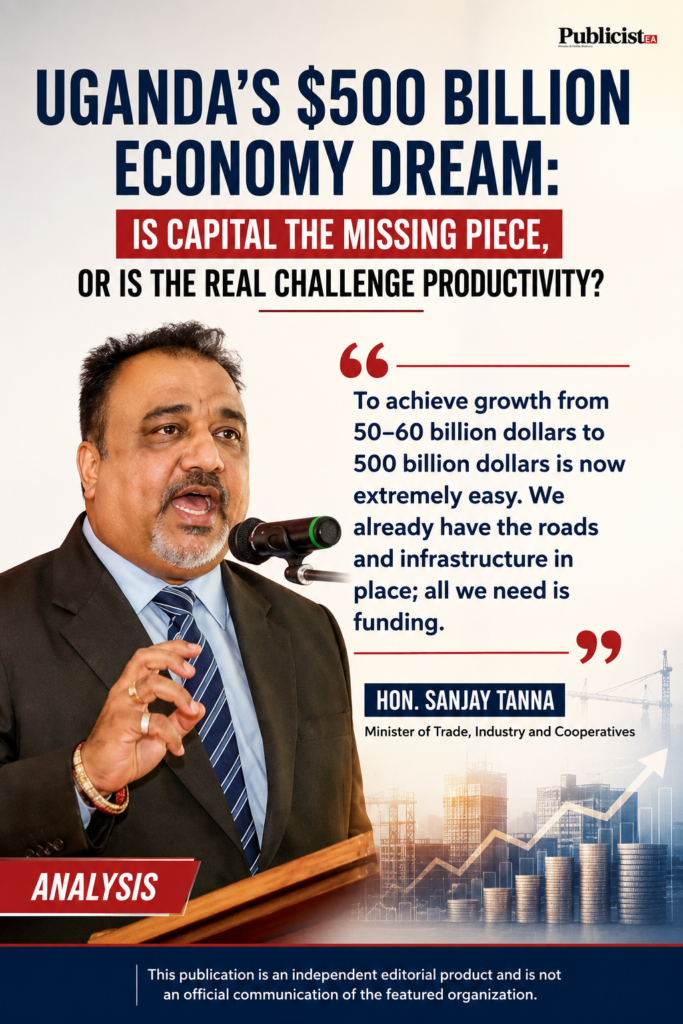
In a powerful revelation, Ggoobi stated that one-third of Uganda’s projected USD 500 billion economic potential lies in unlocking human capital.
He challenged the forum to rethink health and education not merely as social services but as fundamental economic investments.
He revealed that nearly 70% of deaths in health facilities are preventable, representing a massive loss of lives and productivity that the nation must actively protect.
Mobilising Green Capital
The forum also addressed the crucial link between policy and implementation, particularly concerning green initiatives.
Dr. Patricia Ojangole, the MD, Uganda Development Bank (UDB), delivered a sharp reminder on this, saying that, “Policies Without Finance Are Promises Without Progress.”
She lauded Uganda’s significant strides in green policy frameworks, including the National Climate Change Act (2021), Uganda Green Growth Development Strategy, Climate Change Policy (2015), and Environment Act (2019).
However, she cautioned about their implementation, saying, “These policies will remain on paper unless we mobilise climate finance and deploy it where it matters most.”
She noted that with green finance guidelines, carbon market regulations, and a National Climate Finance Strategy currently under development, the foundations are being laid.
The responsibility, Dr. Ojangole emphasised, is now on the financial sector, especially accountants, lenders, and regulators, to rise to the occasion and meet this critical financial moment.
While the forum championed the future, the government also took the opportunity to address current agricultural concerns, reassuring farmers that the recent drop in coffee prices was not government-induced.
Senior presidential advisor on agribusiness and value addition, Dr. Hillary Emmanuel Musoke, encouraged farmers to remain resilient, focus on quality, and embrace cooperative farming as key drivers for transforming the agriculture sector.
The 13th CPA Economic Forum has undeniably set a clear agenda, with Uganda’s accountants at the forefront of driving economic transformation, green growth, and strategic investments in human capital, all underpinned by robust policy and sustainable financial flows.