Uganda is getting closer to a point the country has spent years preparing for: the transition from building its oil infrastructure to operating it.
The East African Crude Oil Pipeline (EACOP) is about 93% complete by October 2026, with first oil expected in early 2027. The 1,443-kilometre pipeline will transport crude from Uganda’s oil fields in the Albertine Graben to the export terminal at Tanga in Tanzania.
Behind the steel, pumps and kilometres of buried pipe is another asset Uganda will need long after construction crews leave: people with the technical skills to operate, inspect, maintain and manage the infrastructure.
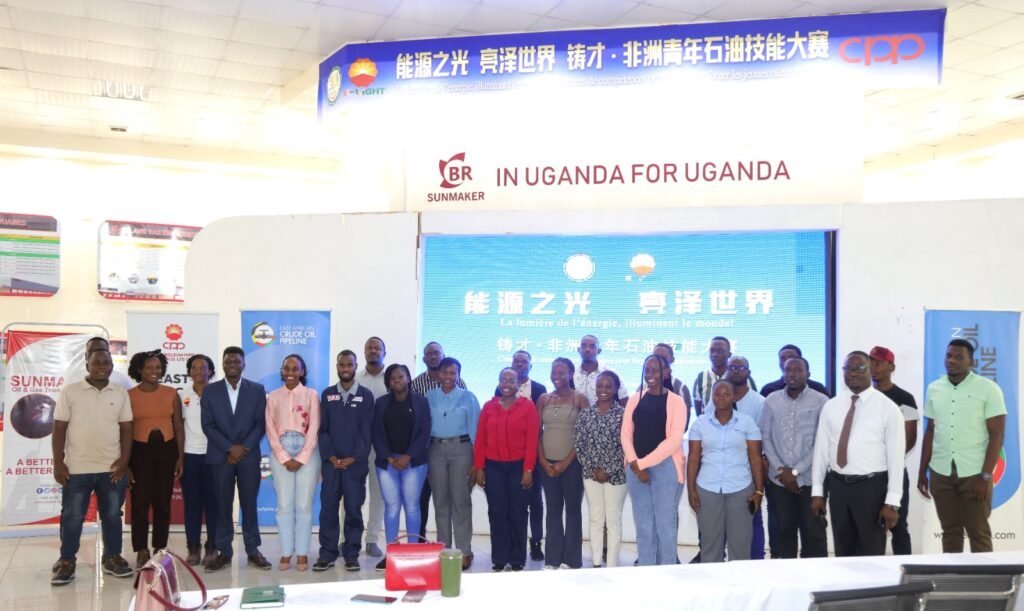
That is where the latest training of 20 Ugandan professionals by China Petroleum Pipeline Engineering Co. Ltd. (CPP), EACOP’s main construction contractor, becomes more significant than a routine certification exercise.
Under its National Content Plan, CPP sponsored 10 professionals for the NEBOSH International General Certificate in Occupational Health and Safety and another 10 for Level II Non-Destructive Testing. The NDT training covered ultrasonic, radiographic, magnetic particle and penetrant testing, techniques used to identify defects in materials and welds without damaging the components being examined.
For CPP National Content Manager Zhang Haitao, the value of the programme extends beyond the remaining construction work.
“Even as we approach the completion of construction activities, our commitment to Uganda remains strong,” Zhang said at the certification ceremony, arguing that internationally certified professionals could continue contributing to the sector after EACOP construction is complete.
That transition is becoming increasingly important. EACOP reported in September that more than 12,000 people had been directly employed across the project, including more than 4,000 Ugandans, while more than 20,000 indirect employment opportunities had been supported.
Those numbers illustrate the scale of the construction economy Uganda has built around the pipeline. But they also point to a difficult question: what happens to those skills and workers when the construction boom gives way to a much smaller operational workforce?
The answer will determine whether national content becomes a temporary employment story or a lasting industrial legacy.
EACOP itself says the pipeline’s operational phase is expected to last about 20 years once oil starts flowing.
That creates a different demand for skills. Construction requires large numbers of workers across civil works, welding, logistics, installation and related activities. Operations require people capable of maintaining equipment, monitoring systems, managing safety, inspecting infrastructure and responding to technical problems over the life of the asset.
The skills being developed now therefore matter because they can potentially bridge those two phases.
The NDT professionals trained through CPP’s programme are one example. Pipeline integrity depends on the ability to identify weaknesses before they become failures. Occupational health and safety professionals provide another layer, ensuring that work around complex industrial facilities is managed against hazards and risks.
For Monge Samuel, a site civil engineer at Fulcrum who completed the NDT training, the programme strengthened his understanding of inspection and quality control.
“The skills gained will help me contribute to maintaining the integrity and reliability of infrastructure in the oil and gas sector,” he said.
Nahebwa Lincoln, a permits coordinator at CPP who completed the NEBOSH programme, similarly said the training had strengthened his ability to understand hazard identification, risk assessment and workplace safety management.
These are skills that do not disappear when one project ends. Their potential value lies in whether they can be carried into the next project, the next company and eventually other industrial sectors.
Uganda’s petroleum policy has always attached significant expectations to local participation.
The Ministry of Energy and Mineral Development says the wider petroleum sector is expected to generate about 14,000 direct jobs, 45,000 indirect jobs through contractors and 105,000 induced jobs through services associated with the sector. It also estimates that 57% of direct employment could go to Ugandans.
The challenge is turning those opportunities into capabilities that remain in the economy.
EACOP’s own national and local content programme explicitly includes internships, knowledge and technology transfer, mentorship, scholarships and training, with the stated objective of supporting succession to Ugandan and Tanzanian citizens after the project.
That is an important distinction. A worker being employed on an oil project is one outcome. A Ugandan professional gaining a recognised technical qualification, experience and the ability to compete for work elsewhere is a deeper form of local content.
The country’s third Oil & Gas Skills Expo in May 2026 captured this broader ambition. Held under the theme “From Oil and Gas to the Wider Economy: Transferable Skills Driving Sustainable Growth,” the event brought together government, industry, universities, students and professionals to discuss how petroleum-sector skills could contribute to industries beyond oil and gas.
EACOP said its Academy had trained 141 students, alongside internships, graduate trainee opportunities, specialised technical training and international placements.
That is the direction Uganda will need to pursue if the country’s oil investment is to leave behind more than physical infrastructure.
There is a natural temptation to measure Uganda’s oil-sector success through barrels produced, pipelines completed and revenues generated.
But there is another measure that will take longer to see: how much technical capability remains in Uganda when the major construction contracts have ended.
A certified NDT technician can potentially work on infrastructure beyond a crude oil pipeline. Health and safety expertise can be applied across construction, manufacturing, energy and other industrial workplaces. Welding and inspection competencies can support infrastructure projects long after EACOP.
This is where the skills story becomes an industrialisation story.
If Ugandans trained through major petroleum projects move into other infrastructure and manufacturing projects, start specialist companies, train others or take their expertise into regional markets, the value of the original investment multiplies.
If those skills disappear when individual contracts end, national content will have captured only part of the opportunity.
The distinction matters because EACOP is not simply a construction project. The pipeline is designed to operate for about two decades, while the wider oil developments will create demand for technical, operational and support services across a much longer investment cycle.
Uganda therefore has a window to turn today’s project workforce into tomorrow’s industrial workforce.
The 20 professionals trained by CPP are a small number against the scale of the country’s petroleum ambitions. Their importance is not their number, but what they represent.
The pipeline will eventually be completed. Construction crews will move on. Contracts will expire. The question for Uganda is whether the knowledge acquired along the way will move with them, or remain in the economy as a permanent skills base.