Pearl Bank Uganda has a good problem on its hands. Wendi, the digital wallet launched by the then PostBank Uganda, is growing at a pace that makes it increasingly difficult to regard it as simply another payments product.
Balances held on Wendi increased from Shs45.5 billion in 2024 to Shs240.5 billion at the end of 2025, according to figures provided by Pearl Bank. That is more than five times the previous year’s level.
The platform has also onboarded close to 11,000 SACCOs, become a channel for government financial inclusion programmes and built an agent network that Pearl Bank says now exceeds 13,000 agents across 8,030 parishes.
Pearl Bank’s Wendi wallet has grown more than fivefold in a year, extending its reach into SACCOs, government programmes and communities far beyond conventional banking. Now comes the harder test: can that growth in financial access translate into credit, opportunity and greater economic mobility for the Ugandans it was built to serve?
Those are impressive numbers. But they also bring Wendi to an important point in its evolution.
The first test was whether Pearl Bank could use technology to bring more Ugandans into the formal financial system. The next is whether being inside that system gives them greater economic opportunity.
Pearl Bank Chief Retail Officer Ibrahim Kato says the Bank does not measure Wendi’s success simply by the amount of money sitting on the platform.
“The real measure of success is whether Wendi is enabling more Ugandans to enter, participate in and benefit from the formal financial system,” Kato told Publicist East Africa.
Pearl Bank says it looks at customer activity, savings mobilisation, transaction volumes, payments, digital credit, remittances, agent reach and participation by organised groups such as SACCOs.
The SACCO component is particularly significant. Close to 11,000 SACCOs have been onboarded onto Wendi, according to the Bank, alongside financial literacy support aimed at strengthening savings and financial data management.
Wendi has also become a channel for government programmes including the Parish Development Model, Presidential Industrial Hubs and cattle-restocking initiatives, pushing its relevance beyond conventional retail banking.
But the rapid mobilisation of deposits raises another question: how much of that increased financial participation eventually translates into productive finance?
Pearl Bank’s overall customer deposits increased 43 percent, from Shs990 billion in 2024 to Shs1.417 trillion in 2025. Its loan book, over the same period, increased from Shs719 billion to Shs749 billion.
That is approximately Shs427 billion in additional deposits against Shs30 billion in additional loans.
The comparison does not mean Wendi deposits should automatically translate into Wendi loans, nor that the additional deposits were simply available for lending. Banks have to manage liquidity, capital, credit risk and other regulatory requirements.
Still, for an institution whose strategy is closely associated with financial inclusion, the gap raises a legitimate question about what should come after successful deposit mobilisation.
Pearl Bank says the difference must be understood in the context of responsible banking.
“The difference in the pace of deposit and loan growth needs to be understood in the context of responsible banking,” Kato says.
“Deposits cannot automatically be converted into loans at the same rate. Lending must be based on customer affordability, creditworthiness, the purpose of borrowing, portfolio risk, capital requirements and the Bank’s overall liquidity position.”
For Pearl Bank, financial inclusion should therefore not be judged simply by how quickly its loan book grows.
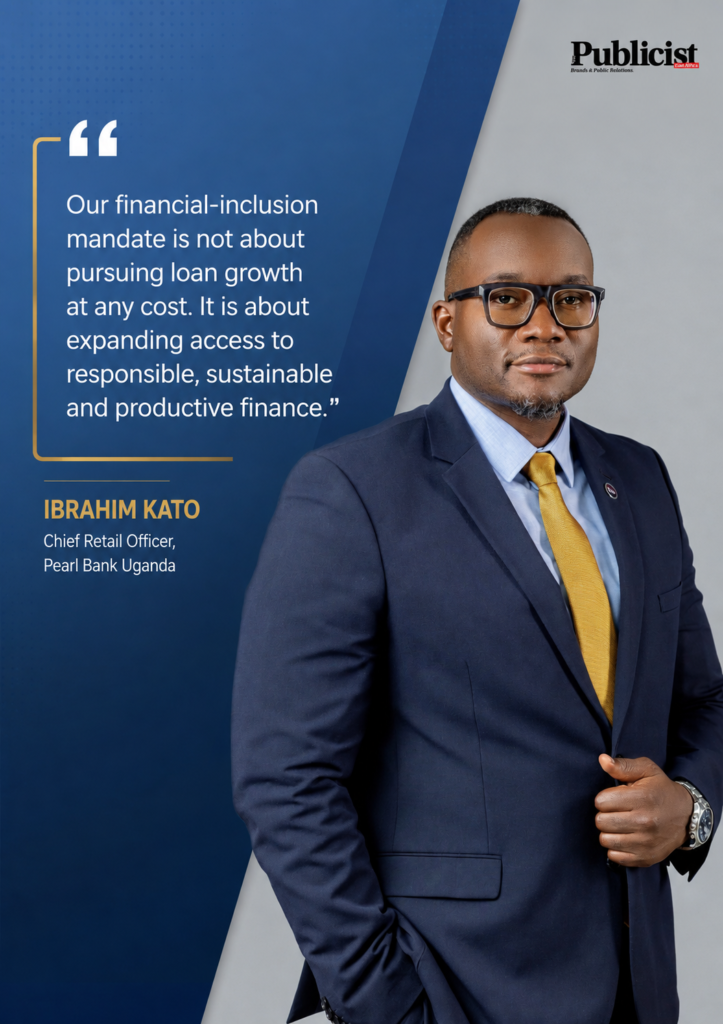
“Our financial-inclusion mandate is not about pursuing loan growth at any cost. It is about expanding access to responsible, sustainable and productive finance,” Kato says.
That distinction matters. Aggressively turning newly mobilised deposits into poorly underwritten loans would hardly constitute financial inclusion.
But it also points to perhaps the biggest opportunity sitting inside Wendi.
Can digital behaviour unlock credit?
One of the difficulties facing millions of potential borrowers is not necessarily an inability to repay a loan. It is proving to a formal financial institution that they can.
A small trader may have regular daily cash flow but no payslip. A farmer may run a viable enterprise without the conventional collateral a bank requires. A SACCO member may demonstrate years of savings discipline without possessing a traditional credit history.
A platform such as Wendi could begin changing that equation.
Pearl Bank says its 2025 audited results show that more than one million Ugandans accessed credit through mobile phones. The Bank did not provide Publicist East Africa with the total value of credit specifically disbursed through Wendi, but says digital lending is an important part of the platform’s evolution.
More interesting is what the financial activity taking place on Wendi could eventually make possible.
“Wendi gives Pearl Bank an opportunity to understand customers through their savings, transaction and payment behaviour,” Kato says.
Over time, Pearl Bank believes this information could support the development of more appropriate products for customers historically underserved by conventional financial institutions.
With customer consent and subject to regulatory requirements and the Bank’s credit policies, transaction and savings histories could help Pearl Bank understand cash flows, savings patterns and a customer’s ability to manage financial commitments.
For someone with little or no conventional credit history, that could matter enormously.
It means the value of Wendi may eventually lie not only in moving money, but in helping previously difficult-to-assess customers establish a financial track record.
There is, however, a physical reality that even the best digital platforms cannot escape. Uganda remains a heavily cash-dependent economy. For many customers, particularly in rural communities, a digital wallet is only as useful as the nearest reliable place to deposit or withdraw money.
Concerns have previously been raised about Wendi agent availability in some areas, particularly around the implementation of the Parish Development Model.
Pearl Bank acknowledges that agent coverage is fundamental to the platform’s success.
“Agent availability is fundamental to the success of a digital wallet, particularly in rural communities where customers may still depend on cash-in and cash-out services,” Kato says.
The Bank says it had more than 9,000 Wendi agents in 2025, while its more recent figures put the network at more than 13,000 agents operating across 8,030 parishes.
Pearl Bank says it continues to use customer demand and transaction activity to identify areas requiring additional agents while also improving the reliability of existing access points.
The challenge is not simply putting a digital wallet on someone’s phone. If accessing the money still requires travelling a significant distance or incurring additional costs, digital access has not necessarily produced practical access.
Affordability presents a similar test. Cash deposits into Wendi are free, while transfers and other services attract different charges depending on the transaction. Pearl Bank says it continually reviews its tariffs as customer usage and operating conditions change.
“For customers making small transactions, even modest charges matter,” Kato says.
The Bank says it must balance affordability against the cost of maintaining the technology, security systems, customer support and agent infrastructure required to run the platform.
“Our financial-inclusion mandate is not about pursuing loan growth at any cost. It is about expanding access to responsible, sustainable and productive finance,” Kato says.
That tension is not unique to Wendi. It sits at the heart of digital finance across Africa: how do providers sustainably serve customers making relatively small transactions without allowing the cost of accessing financial services to undermine the inclusion they are trying to create?
Wendi’s growing scale means Pearl Bank will increasingly have to answer that question.
Pearl Bank’s ambition for Wendi over the next three to five years suggests it already sees the platform moving beyond the traditional definition of a mobile wallet.
The Bank wants Wendi to become a broader financial-services platform, enabling customers not only to receive and move money but to save, build financial histories and, where eligible, access credit and other financial services.
That is a considerably bigger proposition. Uganda’s financial inclusion conversation has for years focused heavily on access: how many people have accounts, how many use mobile money, how many transactions are digital and how many communities have agents.
Those remain important measures.
But as Wendi and other digital platforms mature, the more important question may become what happens after access.
Can the farmer finance another acre? Can a trader with a consistent digital transaction history obtain affordable working capital? Can a well-run SACCO access better financing? Can someone who has been largely invisible to conventional banking establish enough of a financial track record to become creditworthy?
Those are harder outcomes to deliver and harder to measure than wallet registrations or transaction volumes.
Wendi’s rise from Shs45.5 billion to Shs240.5 billion shows that Pearl Bank has demonstrated a formidable ability to bring people and money onto a digital platform.
Its growing agent network and reach into thousands of parishes show how quickly the infrastructure around that platform is expanding.
Now comes the more consequential test: whether that financial activity can translate into greater economic agency for the people generating it.
Kato puts the challenge succinctly.
“The next phase of Wendi is about moving from access to meaningful financial participation.”
That may ultimately be the measure that matters most. Because the success of financial inclusion should not only be judged by how many Ugandans enter the financial system. It should also be judged by how much further they are able to go once they are inside it.