trading digital assets informally, receiving international payments, participating in
gaming economies, and monetizing digital content globally. Yet many still remain
excluded from formal international payment systems.
Rwanda’s recent decision to formally regulate cryptocurrencies and virtual assets may
prove to be one of the most significant digital finance policy shifts East Africa has
seen in years.
For a region long defined by caution, warnings, and regulatory uncertainty around
crypto-assets, Kigali’s move signals something much bigger. East Africa is beginning to
recognize that digital assets are no longer a fringe conversation. They are steadily
becoming part of the continent’s future financial architecture. The question is no longer whether digital assets exist.
The real question is whether Uganda intends to help shape the future of digital
finance or simply react after others have already moved ahead. Rwanda’s Parliament recently approved a draft law governing virtual assets and cryptocurrency trading, introducing a framework for licensing operators, strengthening investor protection, enforcing anti-money laundering controls, and establishing regulatory oversight for the emerging sector.
Importantly, Rwanda is not positioning itself as a “crypto free-for-all.” The proposed
framework remains strict in several areas, including penalties for illegal operators and
restrictions on unauthorized financial activities.
That balance is precisely what makes Rwanda’s approach noteworthy. Rather than resisting digital assets entirely, Kigali appears to be building what many governments around the world are now trying to create: a controlled bridge between innovation and regulation.
According to Rwanda’s Parliament, the law seeks to establish “a secure and reliable
regulatory framework” that allows citizens and investors to benefit from digital
finance while protecting them from fraud and financial loss.
This marks a significant shift from earlier years, when many regional regulators
primarily issued warnings against cryptocurrencies and distanced themselves from the
sector altogether.
Uganda now finds itself at an important crossroads, the country already possesses many of the ingredients necessary for a thriving digital finance ecosystem. Uganda has widespread mobile money adoption, a youthful and increasingly digital population, growing smartphone penetration, expanding fintech start-ups, a strong diaspora remittance market, and a rapidly growing creator and freelance economy.
At the same time, Uganda still lacks a clear and comprehensive framework governing
cryptocurrencies and virtual assets.
The Government of Uganda and the Bank of Uganda have historically taken a cautious
approach toward crypto-assets, repeatedly warning citizens about potential risks and
clarifying that cryptocurrencies are not legal tender.
Yet despite this caution, digital asset activity has continued to grow informally across
Africa, including Uganda.
A 2025 report by the Daily Monitor noted that crypto adoption in Uganda continued to
rise even as regulators remained largely silent on the sector’s long-term direction.
That reality reflects a broader continental trend: Africa’s digital economy is moving
faster than regulation.
Uganda was once celebrated as one of Africa’s mobile money success stories. Today,
however, a new global financial transformation is emerging around blockchain
infrastructure, stablecoins, tokenized payments, decentralized finance, and digital
asset ecosystems.
The transition may feel disruptive, but experts increasingly argue that regulation,
rather than outright prohibition, is becoming the smarter path forward.
Lerato Lamola, writing on Africa’s evolving virtual asset landscape, observed that the
continent is entering “a defining period for virtual asset regulation” as governments
attempt to balance innovation, remittance demand, and financial oversight.
That observation is highly relevant to Uganda.
The conversation becomes even more important because Uganda’s economy is already
deeply digitized through telecom-led financial systems. In 2025, MTN Uganda
announced plans to spin off its fintech business into a standalone entity, highlighting
the growing importance of digital financial services within the country’s economic
future.
The broader signal is becoming difficult to ignore. Digital finance is no longer
peripheral to Africa’s economy. It is becoming central to it.
Perhaps one of the most overlooked aspects of the digital asset conversation is its
connection to Africa’s youth economy.
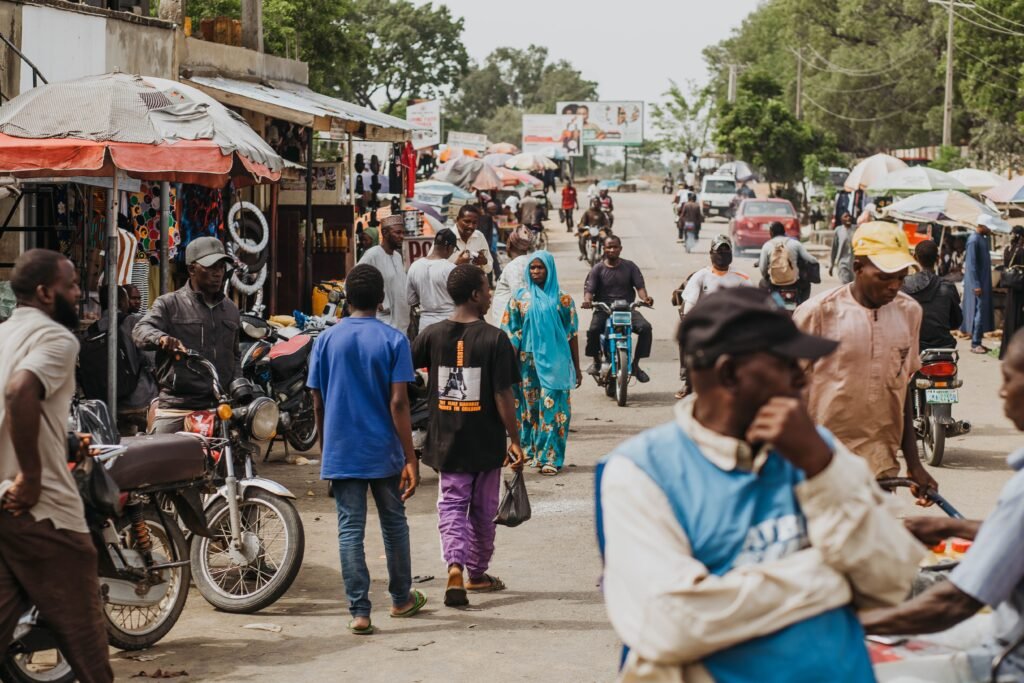
Across Uganda, many young people are already freelancing online, working remotely,
trading digital assets informally, receiving international payments, participating in
gaming economies, and monetizing digital content globally. Yet many still remain
excluded from formal international payment systems.
This creates an important policy debate: could regulated digital asset frameworks
eventually support a new generation of African digital entrepreneurs?
The creator economy alone is beginning to reshape employment models across the
continent. As Uganda continues advancing conversations around innovation, youth
employment, digital skilling, and the knowledge economy, policymakers may
increasingly find it difficult to separate those ambitions from broader discussions
about digital finance infrastructure.
One of the strongest arguments for regulated virtual asset systems globally is their
potential impact on remittances and cross-border payments.
Africa remains one of the most expensive regions in the world for sending money.
Reporting around Rwanda’s proposed law suggests that regulated virtual asset transfer
systems could eventually help lower remittance costs and improve cross-border
financial efficiency.
For Uganda, a country heavily supported by diaspora inflows, this conversation
matters enormously.
If properly regulated, digital assets and blockchain payment systems could
complement existing financial systems by improving speed, affordability, and
financial access. This is no longer merely a crypto discussion. Increasingly, it is
becoming a conversation about economic competitiveness.
Still, the risks remain real.
Global crypto markets continue to face concerns around scams, pyramid schemes,
fraud, cybercrime, market manipulation, and speculative bubbles. Uganda itself has
already witnessed questionable online investment schemes disguised as digital finance
opportunities.
That is why Rwanda’s approach is attracting attention.
The emphasis is not simply on embracing crypto. The emphasis is on regulating it
responsibly.
Rwanda’s proposed framework prioritizes licensing, oversight, consumer protection,
and anti-money laundering compliance. That may ultimately become the more
sustainable African model: controlled innovation rather than unrestricted speculation.
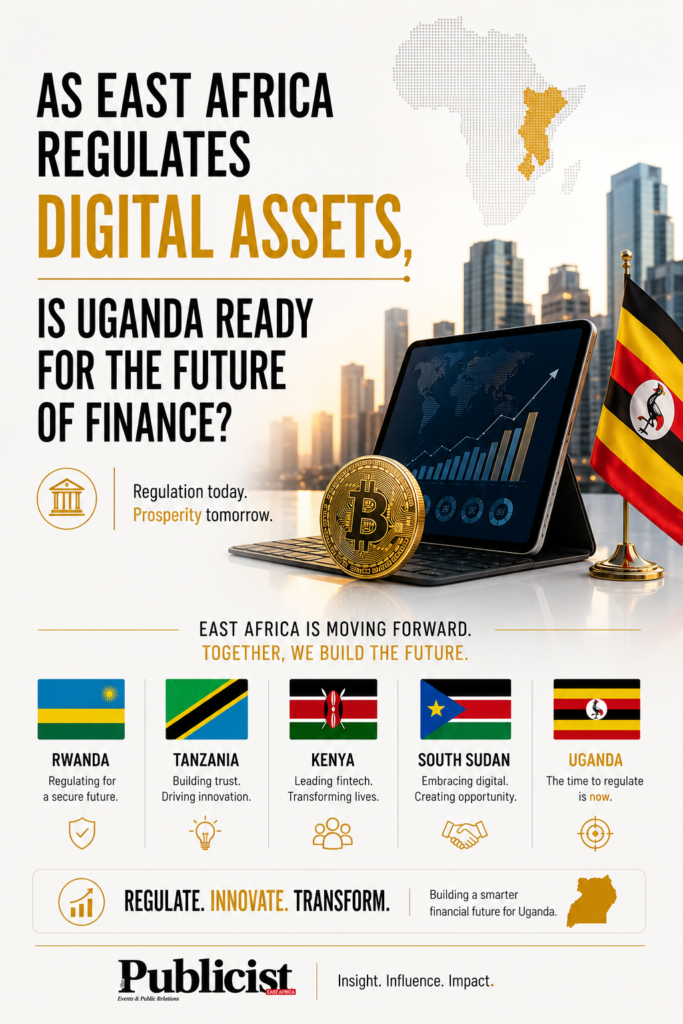
East Africa may now be approaching a defining digital finance moment.
Rwanda is moving toward regulation. Kenya already possesses deep fintech
penetration. Nigeria has increasingly structured conversations around digital assets,
while South Africa continues expanding its regulatory frameworks.
The pressure is gradually shifting toward the rest of the region.
For Uganda, the opportunity may not necessarily lie in becoming a “crypto nation.”
The bigger opportunity may lie in positioning itself as a smart fintech hub, a center
for regulated innovation, a regional digital payments player, and a leader in balancing
financial innovation with public trust.
That requires vision. But it also requires urgency.
Because while governments debate, technology continues to move.
The future of African finance may no longer be shaped only by banks and telecom
companies, but by the countries that successfully build trust between regulation,
innovation, and digital opportunity.
Rwanda has made its move.
The bigger question now is whether Uganda intends to help shape East Africa’s digital
financial future or wait to adapt after the region has already evolved.