
Uganda’s aviation sector is entering one of its most strategically sensitive periods in recent years balancing global geopolitical disruptions, rising diplomatic significance, increasing passenger movements, and mounting pressure on Entebbe International Airport as the country’s primary international gateway.
While aviation is often viewed through the lens of travel and tourism, the latest industry developments reveal a much broader reality: aviation is increasingly becoming a central pillar of Uganda’s economic resilience, regional connectivity, trade facilitation, and international positioning.
At a media briefing held at the Uganda Media Centre on Friday, Uganda Civil Aviation Authority (UCAA) Director General Fred K. Bamwesigye outlined the sector’s current state, operational preparedness, and the growing complexities shaping the industry.
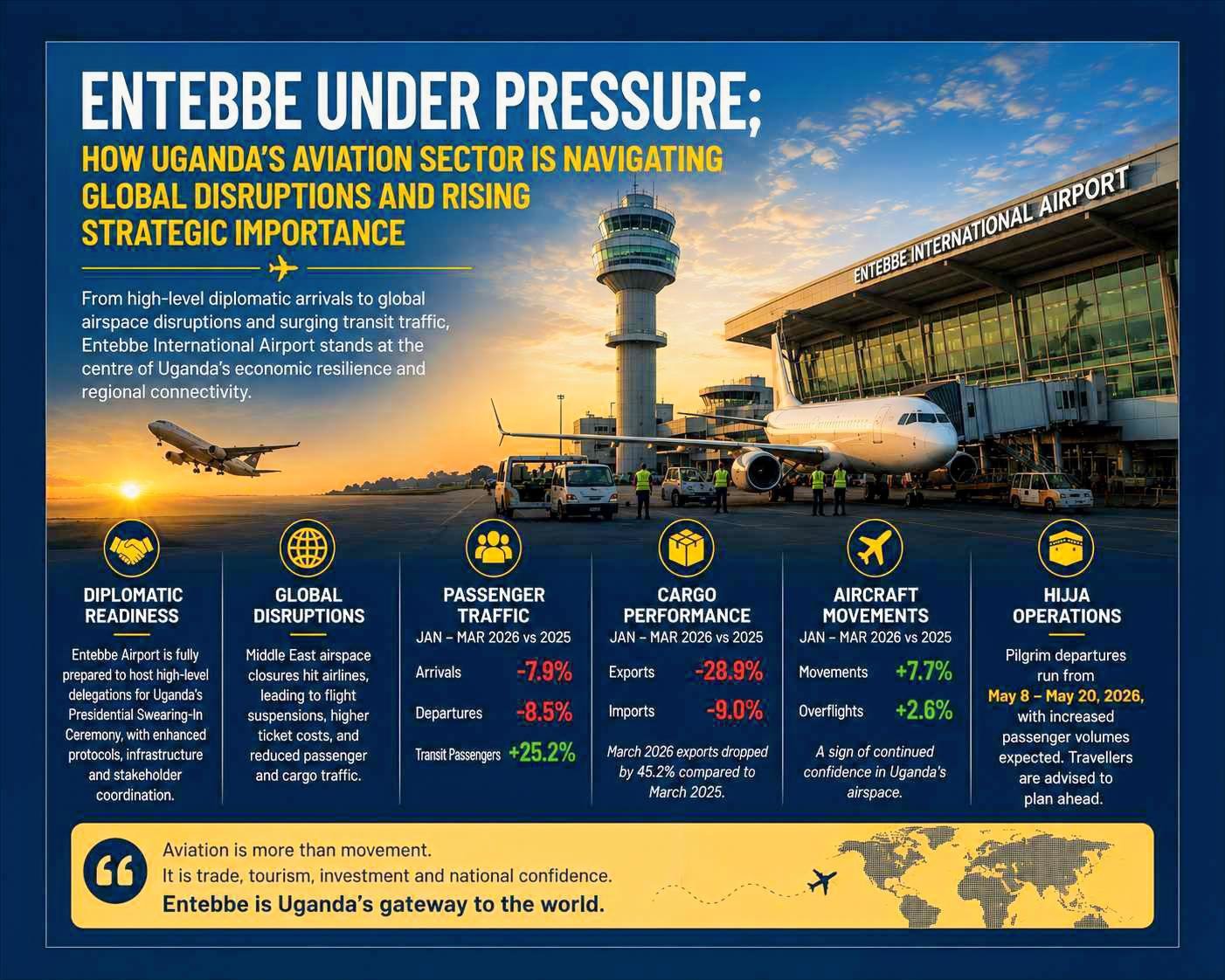
With Uganda preparing for the forthcoming presidential swearing-in ceremony, Entebbe International Airport is expected to receive high-level delegations, Heads of State, diplomats, and international guests arriving in the country. The airport’s role in facilitating these arrivals places Uganda’s aviation infrastructure directly at the centre of the country’s diplomatic and international image management efforts.
According to UCAA, the airport has already implemented extensive operational preparedness measures under a coordinated national framework involving multiple government agencies. These include validated operational dry runs, enhanced VVIP reception facilities, additional aircraft parking capacity, and intensified coordination involving airlines, immigration, customs, security agencies, and fuel operators.
In many ways, the preparations reflect how aviation infrastructure is increasingly becoming intertwined with national reputation, state protocol management, and Uganda’s broader geopolitical visibility.
Beyond domestic operations, Uganda’s aviation sector has also been grappling with the ripple effects of wider global instability. According to UCAA, disruptions arising from temporary airspace closures in parts of the Middle East significantly affected several international airlines operating routes into Entebbe, including Emirates, Fly Dubai, Air Arabia, Qatar Airways, and Uganda Airlines.
The impact was immediate flight suspensions, schedule adjustments, rising ticket prices, reduced cargo volumes, and declining passenger traffic. For a country like Uganda that relies heavily on international connectivity for trade, tourism, labour export, imports, and business travel, such disruptions demonstrate how vulnerable regional economies remain to external geopolitical shocks.
The aviation figures released by UCAA paint a mixed but revealing picture of the industry’s current trajectory. Between January and March 2026, international arrivals declined by 7.9 per cent, while international departures dropped by 8.5 per cent. Cargo exports also fell sharply by 28.9 per cent during the same period.
March 2026 proved particularly difficult, with cargo exports dropping by more than 45 per cent compared to the same period in 2025. The decline is significant because aviation cargo remains critical to Uganda’s export economy, particularly for high-value and time-sensitive exports such as fresh produce, flowers, pharmaceuticals, and fish products.
Yet despite the broader decline in passenger and cargo traffic, one statistic stood out positively. Transit passenger traffic grew by 25.2 per cent, while aircraft movements and overflights also registered growth.
That trend may indicate that Uganda’s airspace and airport infrastructure continue to retain regional strategic relevance even during periods of global disruption. As African aviation markets continue to evolve, countries with relatively stable airspace, improving airport infrastructure, and coordinated aviation systems could increasingly position themselves as regional transit and connectivity hubs.
Entebbe International Airport’s continued rise in transit traffic may therefore signal growing confidence in Uganda’s positioning within regional air connectivity networks at a time when East Africa is intensifying investments in trade, tourism, cargo logistics, and cross-border business mobility.
The sector is no longer simply about moving passengers from one destination to another. Aviation is increasingly becoming intertwined with investment attractiveness, export competitiveness, tourism growth, and national economic resilience.
At the same time, Entebbe International Airport is also preparing for increased passenger volumes linked to Uganda’s annual Hijja pilgrimage operations. UCAA announced that pilgrim departures to Mecca commenced on May 8 and will continue until May 20, 2026, involving multiple international airlines and charter operations.
The pilgrimage period traditionally places additional operational pressure on airport infrastructure due to higher passenger traffic and accompanying family movements. Travelers have been advised to arrive earlier and prepare for possible traffic management adjustments around the airport.
Ultimately, what emerges from UCAA’s latest industry update is a broader reality extending far beyond aviation itself. Uganda’s aviation sector is increasingly sitting at the intersection of diplomacy, economic growth, regional trade, tourism, infrastructure development, and geopolitical stability.
As global disruptions continue reshaping international travel and logistics, countries that strengthen operational coordination, infrastructure resilience, and strategic aviation positioning may ultimately secure significant long-term economic advantages.
For Uganda, Entebbe International Airport is no longer merely an airport. It is rapidly becoming one of the country’s most strategic national assets