For years, Ugandan manufacturers have battled an uncomfortable question in international trade circles; Can locally manufactured products truly compete at global standards?
That question is now being answered not through promises or policy speeches but through certification, compliance, exports, and global market acceptance.
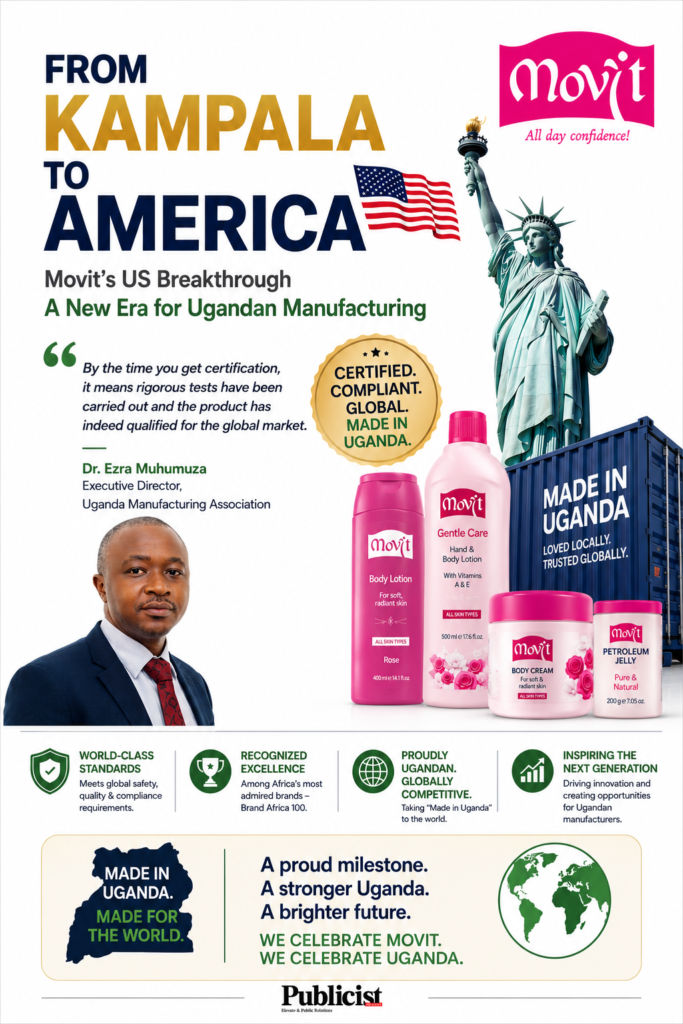
Last week, Movit Products strengthened Uganda’s growing industrial confidence after successfully reaching one of the world’s most demanding consumer markets, the United States, with its body care products.
According to Dr. Ezra Muhumuza, Executive Director, Uganda Manufacturing Association, the achievement is far bigger than many people may realize.
“At international standards, body care products are very sensitive products. By the time you get certification, it means rigorous tests have been carried out and the product has indeed qualified for the global market,” Dr. Muhumuza said.
“We want to say thank you to Movit for reaching this milestone of exporting to one of the most sensitive markets, which is the US market. I want to congratulate Movit for making us proud as a country,”he adds.
Those remarks capture the weight of what this milestone represents not just for one company, but for Uganda’s wider industrial ambitions.
Globally, body care and cosmetic products rank among the most highly regulated consumer products. Before entering markets such as the United States, manufacturers must pass extensive scrutiny around product formulation, hygiene systems, packaging standards, ingredient safety, labeling requirements, and consumer protection regulations.
Many companies never make it through that process. That is why Movit’s breakthrough matters.
It signals a gradual but important transition in Uganda’s manufacturing sector from producing primarily for domestic and regional consumption to building brands capable of surviving rigorous international compliance systems.
What makes Movit’s story even more remarkable is that the company has consistently emerged among Uganda’s most admired local brands at the annual Brand Africa 100 rankings, competing against some of the continent’s biggest multinational names.
Its repeated recognition at the Brand Africa rankings reflects something deeper: consumer trust.
And in modern manufacturing, trust is currency. Industry analysts say the achievement sends a powerful message about the evolution of “Made in Uganda.”
For decades, Uganda has pushed conversations around industrialization, value addition, and export-led growth. Yet one major obstacle has remained the issue of international trust and competitiveness.
The global market does not reward sympathy.
It rewards standards, consistency, quality assurance, and credibility.
This is where certification becomes more than paperwork. It becomes economic validation.
And increasingly, Ugandan manufacturers are beginning to understand that the future of industrial growth will not only depend on production capacity, but on the ability to meet strict international expectations.
Movit’s success could now inspire more Ugandan manufacturers to invest heavily in research, product development, packaging, compliance systems, and export readiness.
More importantly, it reshapes perceptions around Ugandan manufacturing.
For years, African economies have largely exported raw materials while importing finished products at premium prices. Governments across the continent are now aggressively pushing industrialization and value addition as pathways to job creation, economic resilience, and long-term growth.
But industrialization alone is not enough.
The real test is whether African-made products can earn trust in markets where regulators are unforgiving and consumers have endless alternatives.
That is why Movit’s US market entry carries symbolic significance beyond cosmetics or body care products.
It represents a growing confidence that Ugandan brands can increasingly compete on the global stage not merely as African products, but as products that meet world-class standards.
And perhaps that is the bigger story Uganda should pay attention to.
Because in today’s economy, nations do not only compete on resources.
They compete on trust.