Uganda’s agricultural sector presents one of the country’s most enduring contradictions. It employs the majority of the population, contributes significantly to export earnings, occupies a central place in government policy and is frequently described as the backbone of the economy. Yet despite its size and importance, agriculture continues to attract far less capital than its potential would suggest.
The explanation most often offered is productivity. Farmers need better seeds. Irrigation coverage must expand. Mechanisation should increase. Extension services must improve. These arguments are not wrong, but they no longer tell the full story. Across the country, farmers continue to plant, harvest and sell. Coffee exports continue to grow. Grain moves across borders every day. Agro-processors continue to emerge. Agricultural activity is not absent. What remains absent is the scale of investment one would expect from a sector that sits at the heart of the economy.
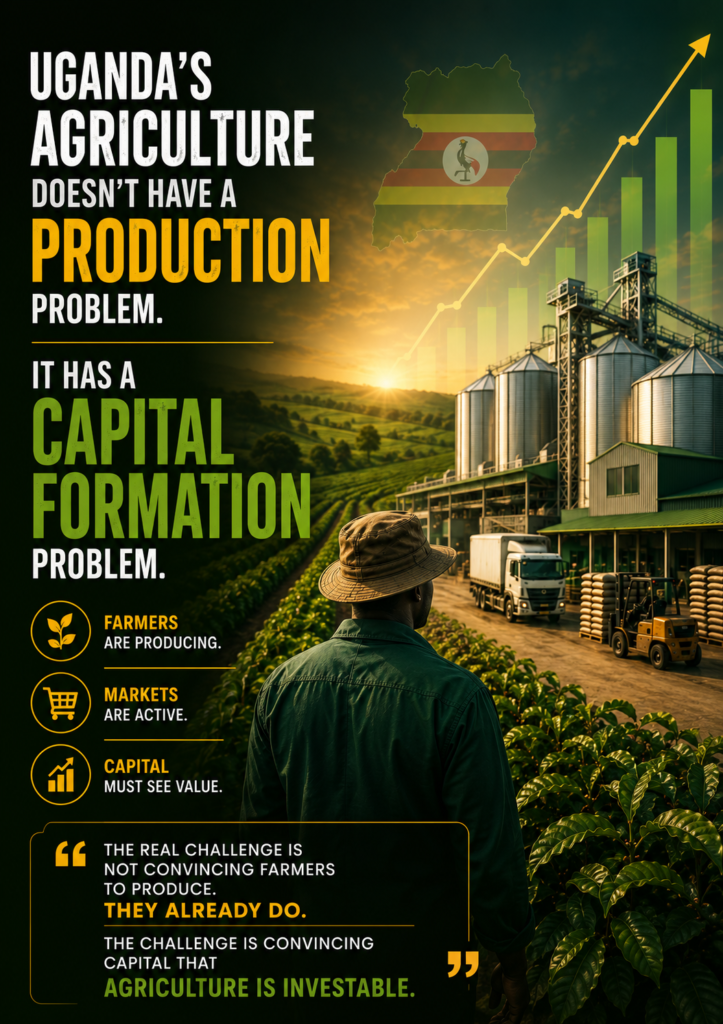
The more one examines the challenge, the more it becomes apparent that Uganda’s agricultural problem is not primarily a production problem. It is increasingly a capital formation problem.
For decades, the national conversation has focused on how to produce more. Far less attention has been paid to how agricultural production is organised, structured and transformed into assets capable of attracting long-term investment. Yet this distinction may explain why so many interventions have struggled to generate the transformation policymakers seek. Production creates output. Capital formation creates investable systems. The two are related, but they are not the same thing.
A useful way to understand the challenge is to view agriculture not as a collection of farms and crops, but as an asset class. Seen through that lens, a striking reality emerges. Agriculture may well be Uganda’s largest unstructured asset class.
The sector generates enormous economic activity, but much of that activity remains fragmented, informal and difficult to finance at scale. A farmer may produce successfully, but the surrounding systems often remain weak. Volumes fluctuate. Quality standards vary. Storage infrastructure is inadequate. Market information is uneven. Supply chains are fragmented. Transactions frequently take place beyond formal systems. The result is a sector that produces significant value but struggles to organise that value into forms that institutions can engage with confidently.
This matters because capital is not attracted by production alone. It is attracted by predictability. Investors look for organised markets, reliable cash flows, scalable structures and manageable risk. The issue is rarely the absence of opportunity. More often, it is the absence of investability.
This helps explain why discussions about agricultural finance often become frustrated. The common narrative is that banks do not lend enough to agriculture. Yet banks are not in the business of financing crops. They are in the business of assessing risk. Where supply chains are fragmented, cash flows uncertain and markets poorly organised, risk becomes difficult to price. The challenge is therefore larger than agricultural lending. It is a question of whether the sector has developed the structures required to absorb capital efficiently.
The sectors that attract the most investment are not necessarily the most productive. More often, they are the most organised. Investors are drawn towards environments where volumes are predictable, governance is clear, information is available and market systems function consistently. Agriculture’s challenge is not that it lacks opportunity. It is that too much of that opportunity remains locked inside systems that are difficult to scale.
This is why some of the most important developments taking place in Uganda today are not occurring on farms at all. They are taking place around market organisation, value addition, aggregation, logistics, processing and industrialisation. The emergence of initiatives such as the National Marketing Company (NAMCo), the growing role of development finance institutions in productive sectors and renewed attention towards agro-industrialisation all point towards a subtle but important shift in thinking. The conversation is beginning to move away from how to increase production and towards how to organise production into investable systems.
Whether these initiatives ultimately succeed remains to be seen. What matters is the recognition that agricultural transformation is not simply a matter of helping farmers produce more. It is equally a matter of building the institutions, infrastructure and market architecture capable of converting production into wealth.
For years, agricultural success has largely been measured through acreage planted, yields achieved and export volumes recorded. These indicators remain important, but they tell only part of the story. The more important question for the next decade may be whether Uganda can build the structures that allow capital to participate meaningfully in the sector. Can agricultural value chains become organised enough to attract pension funds, development finance institutions, private investors and commercial lenders at scale? Can production be transformed into investable opportunity?
The answer to those questions may ultimately determine whether agriculture fulfils its promise as a driver of national prosperity.
The real challenge is not convincing farmers to produce. They already do. The real challenge is convincing capital that agriculture is investable. Until that happens, Uganda risks continuing to produce crops without fully producing wealth. And until agriculture evolves from an economic activity into a structured asset class, one of the country’s greatest economic opportunities will remain only partially realised.
Editor’s Note: This article is part of the I Am An Agripreneur series, a Publicist East Africa initiative exploring the intersection of agriculture, capital, markets and industrialisation in Uganda.