Across global climate finance circles, carbon has become a currency of urgency, traded, priced, verified, and bundled into corporate sustainability strategies worth billions. But in Africa, where vast forests, wetlands, and grasslands are now being measured as carbon sinks, a deeper question is emerging: is the continent building a new green economy, or quietly entering a new phase of resource extraction?
At the centre of this shift is the rapid expansion of voluntary carbon markets, which allow companies to offset emissions by financing projects elsewhere. The Africa Carbon Markets Initiative (ACMI) wants to produce 300 million new carbon credits annually by 2030, comparable to total global voluntary market issuance in 2021. Several countries, Kenya, Ghana, Mozambique, and South Africa among them, have moved to build favourable regulatory frameworks. The appeal is obvious, carbon credits monetise existing ecosystems without large upfront capital, and proponents say Africa is finally being compensated for ecological value long left unpriced. But the promise fractures quickly on closer inspection.
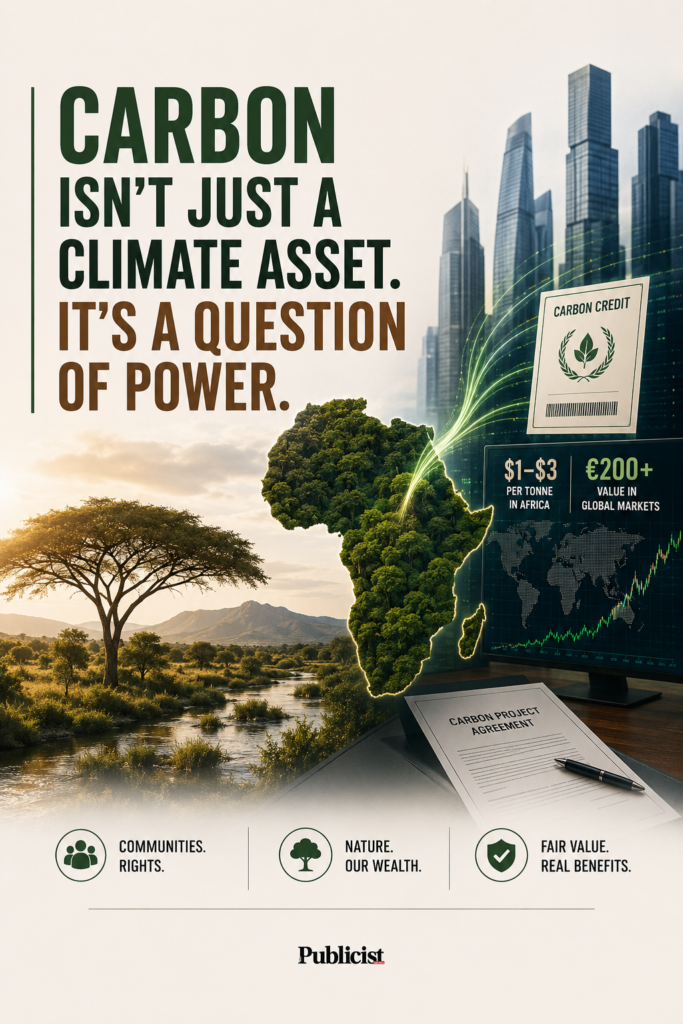
The central problem is who actually controls the carbon embedded in Africa’s land. In many projects, carbon rights are legally separated from land rights through agreements poorly understood at the community level. Communities receive small annual payments while developers retain ownership of the credits and control over global sales. The African Development Bank has documented that foreign companies pay as little as $1–$3 per tonne sourced from Africa, while the same tonne trades at over €200 in EU compliance markets.
The consequences have been severe. The Ogiek community was evicted from Kenya’s Mau Forest. Families were removed in the DRC for a TotalEnergies offset project. A Euronews investigation found Dubai-based firm Blue Carbon had secured control over vast swaths of land across Kenya, Liberia, Tanzania, and Zambia through opaque agreements, in some cases without consulting communities at all.
The markets themselves are under serious scientific strain. A landmark investigation by The Guardian, Zeit Online, and SourceMaterial found that over 90 percent of Verra-certified rainforest credits examined were effectively phantom reductions. Verra subsequently revised its standards, retroactively reducing the credited value of projects already in use. The concept of “non-additionality”, credits issued for conservation that would have happened anyway, remains the market’s deepest unresolved flaw.
The geopolitical stakes cut even deeper. Corporate buyers in Europe, North America, and Asia purchase African credits to offset emissions they continue to produce, transferring the climate mitigation burden to regions that contributed least to historical emissions. Critics frame this as carbon colonialism: Africa paid to restrain development while wealthier economies carry on consuming. Where the continent once exported coffee, minerals, and timber while capturing a fraction of the value, it now exports atmospheric accounting units, an invisible commodity verified through complex systems controlled almost entirely by others.
But the sharpest challenge is structural. Unlike manufacturing, agro-processing, or energy infrastructure, carbon credits do not create jobs, skills, supply chains, or productive capacity. A factory generates employment, trains workers, and builds local capability over time. A carbon offset generates a payment. Carbon market income does not by itself build the industrial base or energy independence that long-term economic transformation requires. This is not an argument against carbon markets. It is an argument for not mistaking them for a development strategy.
Kenya’s 2024 Carbon Markets Regulations, mandating a minimum 40 percent revenue share for communities, are an implicit admission that earlier projects failed. But regulation without enforcement becomes another checkbox. What would actually shift the balance: sovereign carbon exchanges where African governments control pricing and verification; domestic registries that reduce dependence on international certification bodies whose standards have proven unreliable; enforceable land protections with genuine community consent as a legal prerequisite. And more ambitiously, carbon revenues ring-fenced for productive investment, clean energy, climate adaptation, agricultural processing, so that the market becomes a bridge to structural transformation rather than an end in itself.
The challenge is not whether carbon markets should exist, but who governs them and on whose terms. With the right guardrails, carbon trading could become meaningful climate finance for regions suffering most from a crisis they did least to create. Without them, Africa risks becoming the world’s most important carbon supplier without ever gaining control over the rules of the game. Because in this new economy, carbon is not just a metric of pollution. It is a measure of power.