Uganda’s ambition to build a US$500 billion economy by 2040 will not be determined solely by oil production, industrial parks or major infrastructure projects. It will also depend on whether millions of women running small businesses can access the capital, skills and markets needed to grow from surviving enterprises into productive businesses that create jobs, generate wealth and expand the country’s formal economy.
That reality was evident in Gulu this week, where Stanbic Uganda Holdings Limited, through Stanbic Bank Uganda and the Stanbic Business Incubator, launched the Women Economic Empowerment (WEE) Programme and the Albertine Agribusiness Development Programme (ADP). While the announcement centred on supporting more than 10,000 low-income women entrepreneurs and 100 horticulture farmers across Northern Uganda, the broader significance lies in what it says about Uganda’s economic transformation.
The programmes, supported by the Gates Foundation and the Uganda National Oil Company (UNOC), form part of Stanbic’s Positive Impact Agenda for Women, Youth and Farmers. Through this agenda, the bank has committed to mobilise up to UGX 1 trillion by 2028 through strategic partnerships to expand livelihoods, strengthen enterprise development and accelerate inclusive economic growth.
More importantly, the initiative is deliberately aligned with the government’s Aspirational Target for Market-led Socio-Economic Transformation (ATMS), which seeks to grow Uganda’s economy from approximately US$50 billion today to US$500 billion by 2040. Achieving that ambition will require increasing productivity among the millions of small enterprises that already drive Uganda’s economy but remain largely informal.
Women are central to that equation. Across Uganda, they dominate much of the country’s micro and small business sector, operating retail shops, processing agricultural produce, trading in local markets and providing services that sustain households and communities. Yet many remain excluded from affordable finance because they lack collateral, formal business records or established credit histories.
The result is an economy where entrepreneurial potential exists but is unable to scale.
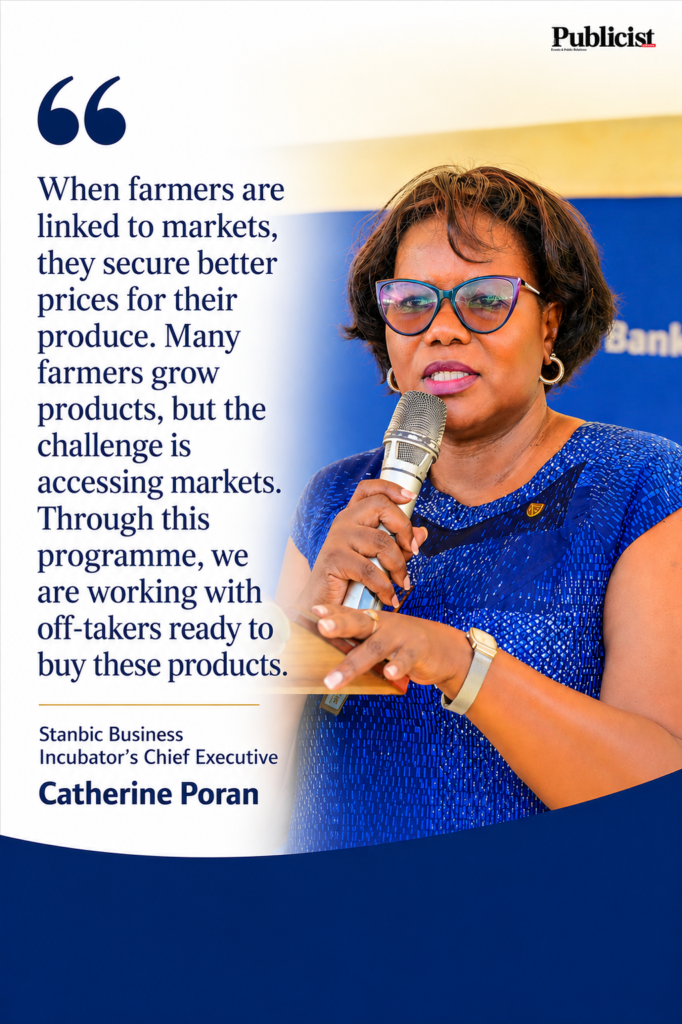
Speaking at the launch, Catherine Poran, Chief Executive of the Stanbic Business Incubator Limited, said the programmes represent more than corporate social responsibility.
“This is what we mean when we say our purpose is to drive Uganda’s growth.” she said.
Her remarks reflected an important shift in development thinking. Rather than simply providing loans, the WEE programme combines entrepreneurship training, financial literacy, digital skills, mentorship, insurance, savings solutions and market linkages. The objective is to build businesses that are bankable, competitive and resilient.
Poran also acknowledged one of the biggest barriers facing women entrepreneurs.
“Many women struggle to access credit due to lack of collateral.” she adds
Instead of encouraging borrowing alone, she challenged women to begin building formal credit histories through structured financial services, creating a pathway into Uganda’s formal banking system.
The same philosophy extends to agriculture. While Uganda often celebrates increased production, farmers continue to lose income because they struggle to reach reliable markets. The Albertine Agribusiness Development Programme seeks to address that gap by combining agronomic training with structured market access.
As Poran explained:
“When farmers are linked to markets, they secure better prices for their produce. Many farmers grow products, but the challenge is accessing markets. Through this programme, we are working with off-takers ready to buy these products.” she said.
Her observation echoes a wider challenge facing Uganda’s agricultural economy. Production alone does not create prosperity. Farmers require functioning value chains, predictable buyers and access to finance if agriculture is to become a true commercial enterprise.
The programme also embraces a multiplier approach to agricultural extension.
“We want each supported farmer to help at least 15 others adopt good agricultural practices.”
That model recognises that lasting transformation depends not only on individual beneficiaries but on knowledge spreading across farming communities.
Government leaders welcomed the initiative as a practical contribution to economic inclusion.
Launching the programme, Gulu Resident City Commissioner Ambrose Onoria urged beneficiaries to seize the opportunity.
“With this programme offering a 10% interest rate, no one should accept being poor or left behind.” he said
His comments underscore an important policy debate. Affordable finance remains one of the greatest constraints facing Uganda’s small businesses, particularly women entrepreneurs who are often forced to rely on expensive informal lenders.
Gulu City Mayor Labeja Julius Acire said structured financial programmes could help reverse that trend.
“This programme provides structured financing and helps combat unscrupulous loan sharks who have been giving our women a tough time. It is not only about finance; it includes training, which is essential.” he said.
His remarks highlight another important lesson. Financial inclusion cannot be measured simply by the number of loans issued. It should be measured by whether entrepreneurs develop stronger businesses capable of creating employment, increasing productivity and building household wealth.
UNOC National Content Specialist Jessica Kyeyune emphasised that financial education is equally important.
“Sometimes people spend all they earn without distinguishing between profit and cash flow. Learning these skills helps them understand whether their business is growing or simply consuming resources.” she said.
That distinction may appear technical, but it speaks directly to enterprise sustainability. Business growth depends not only on access to capital but also on understanding how to manage it.
Increasingly, Uganda’s economic transformation is being driven through partnerships that combine commercial finance, development expertise and public investment. Stanbic, the Gates Foundation and UNOC are demonstrating how collaborative financing can support national development priorities while expanding participation in the formal economy.
The country’s ambition to become a US$500 billion economy will ultimately depend on more than large-scale investments. It will require millions of entrepreneurs to become more productive, more competitive and more integrated into formal markets.
Women entrepreneurs should therefore not be viewed as beneficiaries of economic development. They are among its most important drivers.
If Uganda succeeds in unlocking their productive potential, the country’s economic transformation will not simply be built in industrial parks or oil fields. It will be built in markets, farms, workshops and small businesses across the country, one woman entrepreneur at a time.