For most consumers, a bottle of beer begins on a supermarket shelf or behind the counter of a bar. In reality, it begins much earlier. It starts on farms where barley and sorghum are grown. It moves through packaging manufacturers, transport companies, warehouses, distributors and retailers before finally reaching restaurants, hotels and entertainment venues. Along the way, thousands of people earn a living from a product many never manufacture themselves.
That is why the real story behind Uganda Breweries Limited’s (UBL) 80th anniversary is not about beer. It is about industrial ecosystems.
As Uganda seeks to accelerate industrialisation, diversify exports and create more productive jobs, one lesson stands out: the country’s most valuable manufacturers are not simply producers of goods. They are platforms that enable entire economic networks to grow around them. UBL offers one of Uganda’s clearest examples of this model.
Registered in 1946 and producing its first Bell Lager in 1950, the company emerged when Uganda’s industrial sector was still in its infancy. Over the following eight decades, it evolved from a brewery into one of the country’s longest-standing manufacturing enterprises, creating linkages that extend far beyond its factory in Luzira.
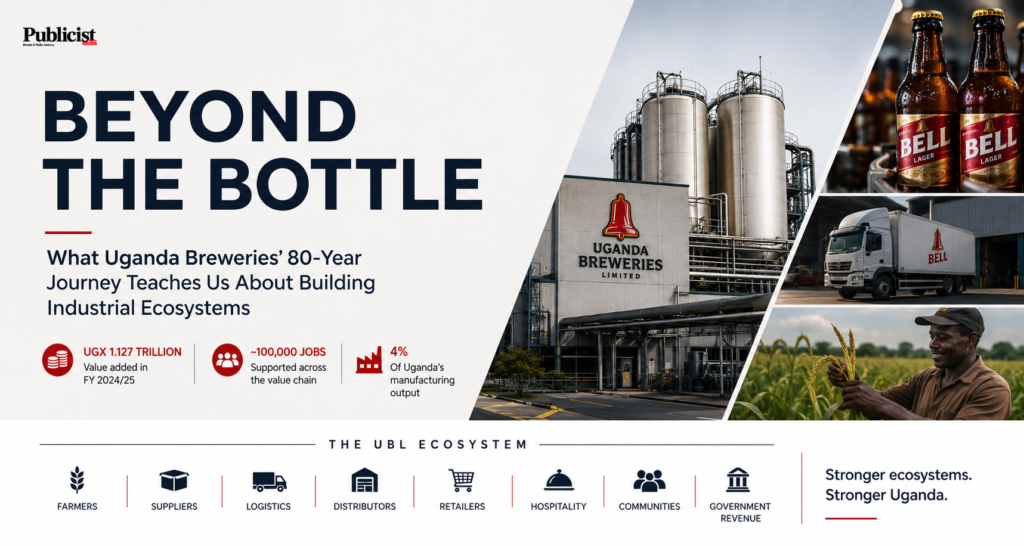
Recent analysis illustrates the scale of those linkages. During the 2024/25 financial year, UBL’s value chain contributed an estimated UGX 1.127 trillion to Uganda’s Gross Value Added, equivalent to around four per cent of the country’s manufacturing output. More significantly, the wider ecosystem surrounding the business is estimated to support approximately 100,000 jobs across farming, logistics, distribution, retail, hospitality and related services.
These figures reveal something policymakers often overlook. The true economic value of manufacturing is rarely confined to the production line.
Every successful factory creates demand elsewhere in the economy. Farmers produce raw materials. Packaging companies manufacture bottles, cartons and labels. Transport operators move inputs and finished products. Warehouses store inventory. Retailers generate sales. Restaurants, hotels and entertainment venues rely on consistent supply to serve customers. Advertising agencies, event organisers, media companies and creative professionals build businesses around established consumer brands.
The factory may employ hundreds, but the ecosystem it sustains can employ tens of thousands. This multiplier effect is what makes anchor manufacturers strategically important to national development.
UBL’s own history demonstrates how resilient these ecosystems can become.
The company endured nationalisation during the 1970s, shortages of imported inputs and years of economic instability. Yet as Uganda liberalised its economy and private investment returned, UBL rebuilt its production capacity alongside the country’s broader industrial recovery.
Industrial policy should not focus solely on attracting new factories. It should focus on developing industrial ecosystems that deepen local sourcing, strengthen supplier networks, improve logistics, encourage innovation and create stronger linkages between manufacturing and agriculture.
By 2016, daily beer production had increased to approximately 30,000 crates compared with around 500 crates in 1987, reflecting not only the recovery of one business but also the restoration of an entire supply network that had been weakened by years of economic disruption.
The lesson is that industrial recovery is never simply about reopening factories. It is about rebuilding relationships between producers, suppliers, distributors and consumers.
Agriculture perhaps demonstrates this relationship most clearly. Large manufacturers provide farmers with something every agricultural economy needs: reliable markets.
When farmers have predictable buyers, they invest more confidently in production. Higher production stimulates demand for improved seed, fertiliser, mechanisation and financial services. Rural incomes rise, strengthening local economies while giving manufacturers dependable domestic supply chains.
Manufacturing and agriculture therefore reinforce one another rather than compete for economic importance. This interconnected model also explains why governments continue to prioritise formal manufacturing despite ongoing debates around specific industries.
Companies such as UBL contribute through corporate taxes, excise duties, VAT, payroll taxes and formal employment. Yet their broader contribution is even more significant. By supporting thousands of businesses operating within regulated value chains, they expand the country’s taxable economy while reducing dependence on imports and strengthening domestic production.
The wider economic ecosystem often generates far greater value than the factory alone.
There are equally important lessons for businesses.
Over the years, UBL has expanded beyond Bell Lager into spirits and premium beverage brands including Uganda Waragi, Guinness and Smirnoff. This diversification has created opportunities not only for the company itself but also for Uganda’s hospitality, tourism, entertainment and creative industries.
Brands become economic assets when they create commercial activity beyond their original products.
For policymakers, the implications are equally important. Industrial policy should not focus solely on attracting new factories. It should focus on developing industrial ecosystems that deepen local sourcing, strengthen supplier networks, improve logistics, encourage innovation and create stronger linkages between manufacturing and agriculture.
The question should not simply be how many factories Uganda builds.It should be how many businesses each factory enables. That is ultimately the enduring lesson from Uganda Breweries’ 80-year journey.
Its greatest legacy is not measured by the millions of bottles produced since 1950. It is measured by the farmers supplying raw materials, the transporters moving goods across the country, the distributors expanding markets, the retailers serving customers, the hospitality businesses creating experiences and the livelihoods sustained through one interconnected value chain.
Beyond the bottle lies something much larger. It is a reminder that industrialisation is not built one factory at a time. It is built by creating ecosystems where businesses of every size grow together.
As Uganda pursues its ambition of becoming a more industrial and middle-income economy, that may be the most valuable lesson manufacturers like UBL have to offer.