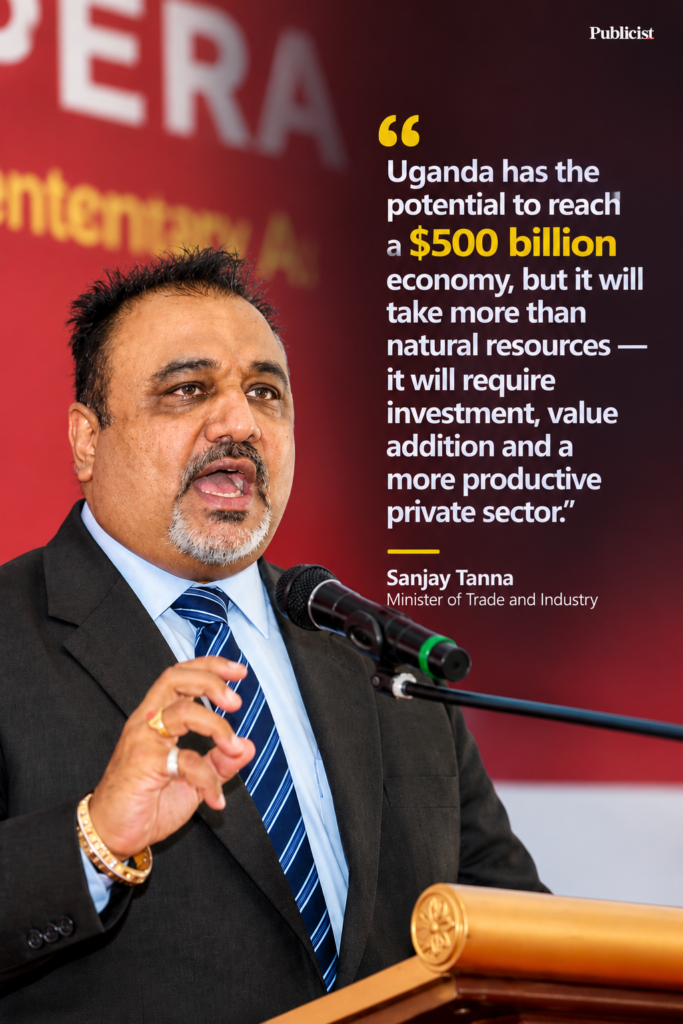
Uganda has moved closer to one of its most ambitious economic targets. The economy, according to Trade and Industry Minister Sanjay Tanna, has grown from roughly $50 billion when the government set out its $500 billion ambition to about $69 billion today. That means Uganda is no longer starting from the base from which the target was conceived.
But the numbers also reveal the scale of what remains. At $69 billion, Uganda would need to expand its economy by about 7.25 times to reach $500 billion. In absolute terms, that leaves roughly $431 billion to be created.
The question is therefore no longer whether Uganda has economic potential. It is whether the country can attract enough productive investment, raise productivity and move further up the value chain to generate an economy more than seven times its current size. That is a considerably harder task than simply growing output.
Tanna made the case for that transformation at the Equity Uganda Trade and Investment Roadshow in Kampala, where more than 150 business leaders, investors, policymakers and private-sector players from 10 countries gathered to explore investment opportunities in Uganda.
His pitch was centred on a familiar problem in Uganda’s economy: the country produces significant quantities of agricultural and mineral commodities, but captures too little of the value created after those commodities leave the country.
The proposed solution is investment in agro-processing, manufacturing, mineral processing, pharmaceuticals, textiles, leather, construction materials, tourism and technology.
That matters because reaching $500 billion cannot simply mean producing more raw materials. It means building businesses and industries around those resources that employ more people, generate more exports and retain more value inside Uganda.
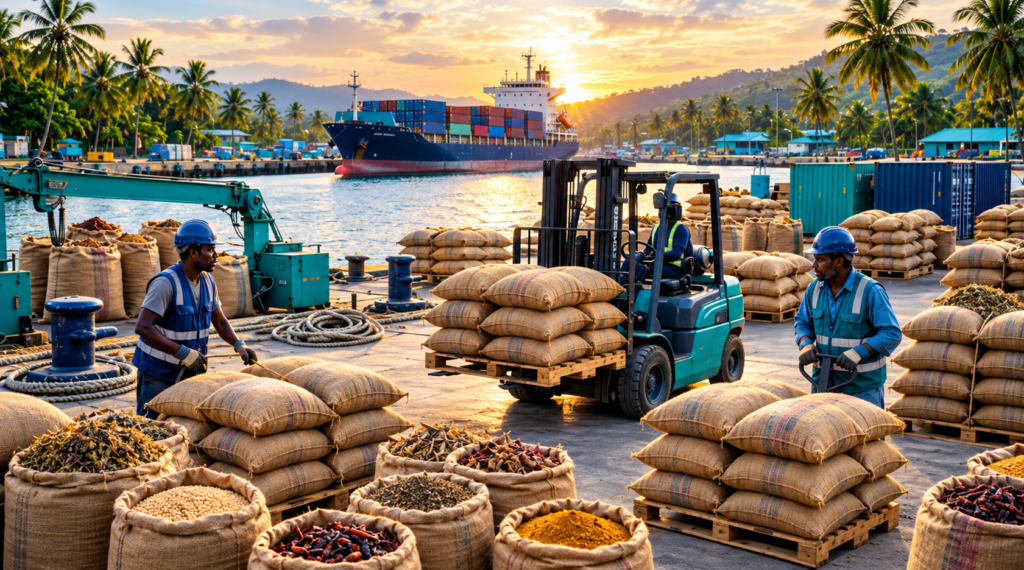
Coffee provides one of the clearest examples. Uganda is already a major coffee producer and exporter, but more than 90% of its coffee is exported, with much of it leaving the country in green or minimally processed form.
The opportunity is therefore not only to grow more coffee. It is to build more of the businesses around it: processing, specialty coffee, roasting, packaging, branding, logistics, quality assurance and international distribution.
The same logic applies to other commodities. Uganda has deposits of copper, cobalt, iron ore and phosphates. The economic opportunity lies in moving from extraction towards processing and manufacturing wherever commercially viable.
That is the difference between an economy that sells resources and one that builds industries around them.
There is another major factor that cannot be left out of Uganda’s $500 billion calculation: oil. Uganda is approaching commercial oil production through the Tilenga and Kingfisher developments, linked to the 1,443-kilometre East African Crude Oil Pipeline to Tanzania.
EACOP reported in September that the pipeline was about 92% complete. The two upstream projects are expected to reach combined peak production of approximately 230,000 barrels of crude oil per day.
Oil will introduce a substantial new source of export earnings, government revenue and investment activity. It could also generate demand for transport, engineering, logistics, construction, financial services and other businesses around the petroleum sector.
But oil alone cannot take Uganda to $500 billion. A finite resource cannot substitute for a broad productive economy. The larger opportunity is to use oil revenues and investment associated with the sector to strengthen infrastructure, skills, manufacturing and other productive sectors rather than allowing petroleum to become an isolated enclave in the economy.
The government’s own petroleum strategy increasingly frames first oil as a starting point for wider economic transformation rather than an endpoint.
Agriculture will remain central because Uganda already has a large production base. The challenge is to increase the value generated from that production. That means moving beyond the farm gate into storage, processing, packaging, cold chains, logistics, quality certification and export marketing.
It also means solving the financing problem facing businesses that want to make that transition.
Tanna called for financial institutions to support productive sectors and highlighted the need to reduce barriers and the cost of capital.
That is an important distinction. A factory cannot operate on cheap credit alone if its electricity is unreliable, transport is expensive, its inputs are difficult to source and its potential customers are inaccessible. Investment therefore has to work as a system.
Uganda has made substantial investments in roads, electricity, aviation, industrial parks and digital infrastructure. But the next stage of growth will require infrastructure that reduces the cost of doing business rather than simply increasing the amount of infrastructure on paper.
Digital connectivity illustrates both the progress and the remaining gap. The National Backbone Infrastructure has expanded fibre connectivity across the country and to several border points. NITA-U says its current last-mile project is extending the backbone by another 732 kilometres to 700 sites.
But connectivity is not the same as a digital economy. Uganda still needs businesses that use that infrastructure to export software, business-process services, data services and other digitally delivered products.
The same principle applies to roads, rail, air and water transport. Infrastructure creates economic value when it makes it cheaper and faster for businesses to produce and reach customers.
Uganda’s population gives businesses a substantial domestic consumer base, but the $500 billion ambition will require companies to think beyond Uganda.
Membership in the East African Community, COMESA and the African Continental Free Trade Area gives Ugandan businesses access to much larger regional and continental markets. That changes the investment proposition.
A factory established in Uganda does not necessarily need to be designed only for Ugandan consumers. It can potentially serve markets across East Africa and beyond. But regional market access only matters if Ugandan businesses are competitive enough to use it.
That brings the discussion back to productivity. Uganda needs firms that can produce at sufficient scale, meet international standards, access finance, adopt technology and deliver products competitively.
Uganda’s recent growth provides a useful starting point. The IMF says real GDP growth reached 6.3% in FY2024/25 and remained strong into FY2025/26, while its medium-term projections anticipate particularly strong growth as oil production comes on stream. But reaching $500 billion requires more than maintaining headline growth. The composition of growth matters.
If the economy expands because of consumption, imports and higher commodity prices, the gains will be different from an expansion driven by manufacturing, exports, productivity, technology and investment.
The $500 billion target therefore needs to be understood as an industrialisation and productivity challenge.
Uganda needs more capital going into businesses that increase productive capacity. It needs firms capable of scaling. It needs workers with skills that match the industries being built. It needs reliable infrastructure and competitive financing. And it needs policies that make long-term investment easier.
The country’s natural resources provide a foundation. They do not provide the finished economy.
The arithmetic is simple. Uganda is being presented as a roughly $69 billion economy. The target is $500 billion. That is a 7.25-fold increase, or about $431 billion in additional economic output.
Oil can provide an important acceleration. Agriculture can supply raw materials and export earnings. Minerals can support new industrial value chains. Tourism can generate foreign exchange and services activity. Technology can create new export industries that are less constrained by physical distance.
But none of these sectors can carry the entire burden. The real opportunity is in how they connect.
A stronger agricultural sector supplies processors. Processors create manufacturing jobs. Manufacturing creates demand for logistics, finance, energy and technology. Digital infrastructure enables services to be exported. Oil finances infrastructure and creates industrial demand. Regional markets allow successful businesses to scale beyond Uganda.
That is how the next $431 billion could be built: not from one giant sector, but from a larger and more productive network of businesses operating across the economy.
Tanna’s message to investors was that Uganda is ready for business. The more important question for the country is whether it can turn that investment interest into productive capital, productive capital into competitive businesses, and competitive businesses into sustained increases in productivity.
The journey from $69 billion to $500 billion is therefore not simply a bigger investment story. It is a test of whether Uganda can turn its resources, people, markets and infrastructure into an economy that captures substantially more value from what it already has.