
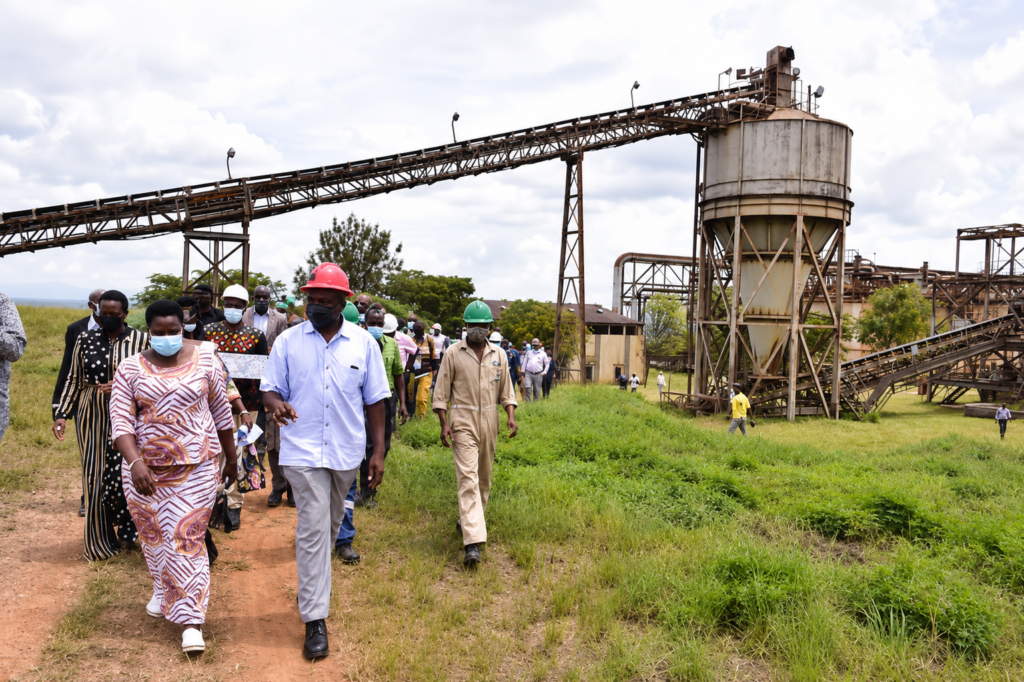
After decades of failed revival attempts, Uganda has put Kilembe Mines under a new ownership and production-sharing model. The government has a direct 15% stake and copper production is targeted for 2029. But the real test is no longer whether Uganda can sign another agreement. It is whether it can turn the agreement into a functioning mine.
More than four decades after production stopped, Uganda is once again trying to revive Kilembe Mines. This time, the government says it has a different model.
In March 2025, Uganda signed its first Mineral Production Sharing Agreement for the redevelopment of Kilembe Mines, bringing together Sarrai Group Limited and Nile Fibreboard Limited, with the Uganda National Mining Company (UNMC) later taking a 15% stake as the state’s commercial partner.
The investors emerged from a competitive process involving 14 companies, and government formally handed over the mine’s assets to the new developers in May 2025. The target is ambitious but clear: copper production by 2029.
For Kilembe, however, a deadline matters precisely because the mine has seen several revival promises before. This time, Uganda needs to be judged not by the agreement it has signed, but by what happens between the signing ceremony and the first commercial shipment of copper.
Kilembe’s significance is rooted in what it once represented. Commercial mining began in the 1950s, helping support a copper smelter in Jinja, hydropower infrastructure and railway connectivity to Kasese. The government eventually took control of the mine in the 1970s, before production stopped in 1982 amid deteriorating equipment, economic instability and insecurity.
The Ministry of Energy and Mineral Development estimates more than 6.5 million tonnes of ore grading about 1.77% copper, alongside approximately 5.5 million tonnes grading 0.17% cobalt.
The strategic value of those minerals has also changed. Copper is fundamental to electricity networks, renewable energy, electric vehicles, construction and industrial equipment. Cobalt remains important to parts of the battery supply chain.
That gives Kilembe relevance beyond Kasese. Uganda is trying to move further into mineral processing and value addition, and Kilembe could become one of the projects through which that ambition is tested.
Energy and Mineral Development Minister Ruth Nankabirwa has described the project in those terms, saying it is expected to produce copper cathodes and cobalt metal while supporting industrialisation, employment and opportunities for Ugandan suppliers.
The bigger question, therefore, is not simply how much ore Kilembe can extract. It is how much value Uganda can capture from the minerals it produces.
The most important change may be the structure of the new deal. Uganda’s first Mineral Production Sharing Agreement brings a model more commonly associated with petroleum into the mining sector. Instead of government participating mainly as regulator and tax and royalty collector, UNMC gives the state a direct commercial position.
UNMC, incorporated in April 2024 under the Mining and Minerals Act to manage Uganda’s commercial interests in mining, owns 15% of the Kilembe venture.
That creates an important test. If the project succeeds, the state could benefit through both its normal fiscal regime and its commercial participation.
But state participation also creates another responsibility. Government must demonstrate that its role as shareholder does not compromise the commercial discipline needed to build and operate a mine.
UNMC Chief Executive Officer Dr Banage Baingi has described Kilembe as a benchmark for Uganda’s mining sector, while indicating that the partners also intend to explore for additional resources that could extend the mine’s life.
In that sense, Kilembe is becoming a test case for something larger: can Uganda participate directly in strategic mineral projects while still attracting private capital, maintaining good governance and delivering commercial returns?
The optimism surrounding the new project cannot be separated from Kilembe’s recent history. In 2013, government awarded Tibet-Hima Mining Company Limited a 25-year concession to revive and operate the mine. The concession was terminated in 2017 after government alleged that the company had failed to meet obligations relating to guarantees and concession fees.
But Parliament’s later investigation presented a more complicated picture. In November 2024, Parliament adopted a report by its Committee on Environment and Natural Resources that found serious failures in government’s management of the concession.
The committee said Tibet-Hima had invested more than US$56 million in the project, including spending on infrastructure, employee wages, Kilembe Mines Limited debts and operating costs. It described the termination as “hasty and unjustified” and found that government institutions had themselves failed to meet some obligations, including timely site handover and licensing.
The lesson is important. Kilembe’s previous failure was not simply an investor problem. It was also an institutional problem.
For a mining project requiring hundreds of millions of dollars, uncertainty over licences, government obligations, concession terms and institutional decision-making can become as damaging as geology or commodity prices.
The new arrangement will therefore be judged partly by whether government has learned from the failures of the previous one.
The transition has also exposed the financial residue of previous arrangements. On August 12, 2026, the Ministry of Energy and Mineral Development sought parliamentary approval to write off UGX2.6 billion in unpaid annual mineral rents associated with Kilembe Mines Limited, the government-owned company being wound up as the new structure takes over.
The Auditor General had flagged the arrears. Agnes Alaba, Commissioner for Geological Survey and Minerals, told Parliament’s Finance Committee that the relevant exploration licences had expired in 2022 but the mineral-rent arrears remained an obligation of Kilembe Mines Limited.
The request raised questions among legislators about the winding-up process, employee interests and the management of the transition.
There is also the physical reality of operating in Kilembe. Flooding has repeatedly affected the area, including the River Nyamwamba and surrounding communities. For an underground mine, drainage and infrastructure resilience are not peripheral concerns. They are part of the project’s economics.
A mine that cannot reliably manage water, power, access and underground infrastructure is not commercially viable.
The production-sharing agreement is only the beginning. Kilembe needs major investment before it can generate significant revenue: underground rehabilitation, geological work, equipment, processing facilities, power, environmental management and supporting infrastructure.
When the assets were handed over in 2025, rehabilitation requirements were estimated at between US$230 million and US$250 million. Government’s latest update indicates that the developers are still dealing with preliminary requirements, including licensing and mobilisation of financing, while the mine remains under care and maintenance.
That leaves a relatively narrow window to 2029. The investors have been selected. The agreement has been signed. The state has taken its stake. The assets have been handed over. Now comes the difficult part: execution.
The temptation will be to celebrate milestones as they arrive: licences, financing announcements, equipment deliveries, rehabilitation contracts and construction ceremonies.
Those milestones matter. But they are not the final measure. Uganda should be asking harder questions. Has the required capital actually been secured? Is rehabilitation progressing? Are the reserves sufficiently defined? Are licences and legacy obligations being resolved on schedule? How will flooding and other environmental risks be managed? What proportion of processing will happen in Uganda? How much procurement will go to Ugandan businesses? How many skilled jobs will be created locally?
And ultimately: Will Kilembe produce commercial copper by 2029?
Those questions go to the heart of Uganda’s mineral strategy. If Kilembe succeeds, it could become an economic anchor for Kasese and the wider Rwenzori region, creating jobs, supporting local suppliers and strengthening Uganda’s mineral-processing ambitions. It could also provide an early demonstration of whether UNMC’s direct commercial participation model can work.
If it fails again, the consequences will extend beyond one mine. It would raise difficult questions about Uganda’s ability to convert mineral resources into investable, productive assets.
Kilembe has already survived colonial-era mining, nationalisation, economic collapse, decades of dormancy, a failed concession and multiple attempts at revival. The latest model is different. The state has a direct commercial stake. The project has a production-sharing agreement. Copper and cobalt have become strategically more important in a world increasingly shaped by electrification and energy transition.
But none of that guarantees success. The real opportunity is to turn Kilembe from a dormant asset into a productive industrial ecosystem, one that creates value beyond the mine itself.
That means copper production, processing, jobs, local suppliers, infrastructure and eventually a stronger mineral value chain in Uganda. The deadline is 2029. By then, the most important announcement will not be another agreement. It will be the first copper coming out of Kilembe.