
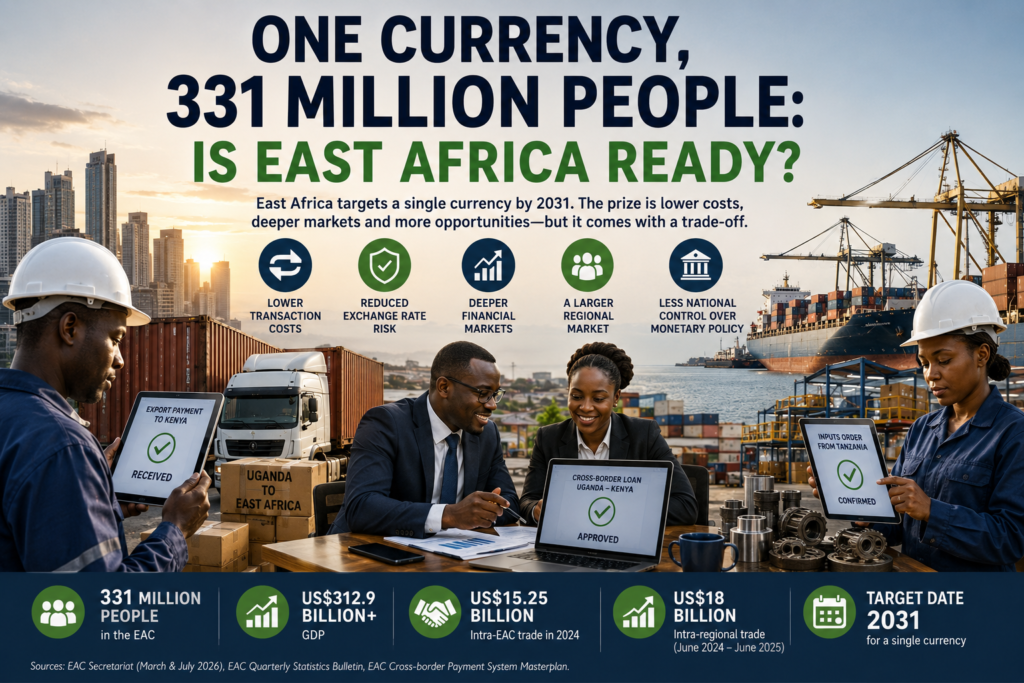
For a Ugandan exporter selling to Kenya, a Kenyan bank financing a business in Uganda or a Tanzanian manufacturer buying regional inputs, doing business across East Africa currently means dealing with different currencies, exchange-rate movements and cross-border payment systems. A single currency could remove much of that friction.
The East African Community now brings together eight countries with about 331 million people and GDP of more than US$312.9 billion. Intra-EAC trade reached US$15.25 billion in 2024, with more recent EAC figures putting regional trade at about US$18 billion between June 2024 and June 2025.
As the regional market grows, the cost of currency fragmentation becomes more important. For businesses, the attraction is straightforward. A Ugandan exporter would not have to worry about the shilling moving against the currency used by a Kenyan buyer between the time a contract is signed and payment is received. A manufacturer sourcing inputs across several EAC markets could price and settle transactions in one currency. Banks could lend across borders without the same degree of currency exposure, while fintechs and payment companies could build products for a much larger market.
But the economic prize comes with a significant trade-off. Today, the Bank of Uganda can adjust monetary policy in response to Uganda’s economic conditions. Kenya and Tanzania can do the same. Under monetary union, those decisions would increasingly be made at the regional level.
East Africa is targeting 2031 for a single currency. But for businesses and investors, the bigger question is not when the currency arrives. It is what changes when it does.
That creates a difficult question: what happens when economies move in different directions?
If Uganda is experiencing inflation while Kenya is dealing with weak economic growth, Uganda could favour higher interest rates while Kenya might prefer lower rates. One regional monetary policy cannot perfectly satisfy both.
This is why the real test of the 2031 target is not whether East Africa can create a common currency. It is whether its economies can converge enough to make that currency work.
The EAC’s monetary-union framework sets targets including inflation of no more than 8%, a fiscal deficit of no more than 3% of GDP, public debt below 50% of GDP in net present value terms and foreign-exchange reserves covering at least 4.5 months of imports.
The gap between economies shows why this remains difficult. In March 2026, headline inflation stood at 2.8% in Uganda, 3.2% in Tanzania and 4.4% in Kenya. But it was 10.6% in Burundi and 27.9% in South Sudan. The differences are not simply statistical. They represent very different economic conditions and policy challenges.
The EAC itself acknowledged in July 2026 that progress towards monetary convergence remains uneven, particularly on fiscal deficits, reserves and public debt.
There is also a question of power. A regional currency would require institutions capable of making monetary decisions for economies of very different sizes. Who gets the strongest voice? How are voting rights determined? How are regional reserves managed? And how does the system ensure that smaller economies are not effectively subject to the priorities of the largest ones?
These questions may determine whether monetary union strengthens East Africa or creates new tensions. Yet businesses may not have to wait until 2031 to see some of the benefits.
The EAC is already working on regional payment integration. Its Cross-border Payment System Masterplan is intended to make regional payments faster, safer and more interoperable while supporting digital trade and financial inclusion.
That means some of the benefits associated with a common currency, easier payments, lower transaction friction and greater financial integration, can begin before a single currency exists.
For banks, fintechs, insurers and investors, this could ultimately be more important than the currency itself. A genuinely integrated monetary market would create opportunities for financial institutions that can operate regionally rather than treating each EAC country as a separate market.
For Uganda, Kenya and Tanzania, the opportunity may be particularly significant because of their relatively large economies and established regional commercial networks. But smaller economies could also benefit from lower transaction costs and easier access to regional markets, provided they can maintain sufficient economic stability.
That is why the single currency should not be presented as automatically good or bad. Its promise is clear: lower currency costs, reduced exchange-rate risk, deeper financial markets and a larger regional market. Its price is equally clear: less national control over monetary policy.
The EAC therefore has a bigger challenge than designing a banknote. It must build the institutions, fiscal discipline and economic convergence needed to make one monetary policy work across very different economies.
By 2031, the important question will not simply be whether East Africa has one currency. It will be whether the region has become integrated enough for one currency to make economic sense.
And the biggest winners may not necessarily be the countries with the largest economies. They may be the businesses, banks and investors that prepare early for an East African market in which borders still exist, but currency is no longer one of the biggest barriers to doing business.