Uganda’s shilling has come under renewed pressure in September, with the currency moving towards the Shs4,000-per-dollar mark as businesses increase their demand for foreign currency amid higher energy costs, import requirements and uncertainty in global markets.
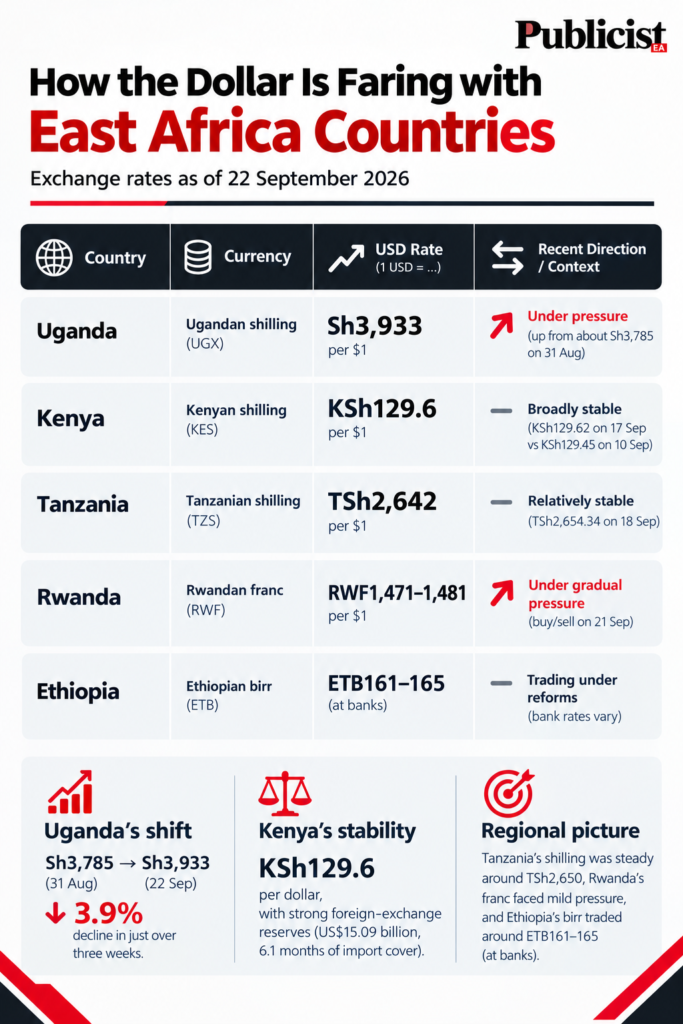
On September 17, commercial banks were quoting the shilling at about Shs3,925–3,935 to the US dollar, compared with Shs3,860–3,870 a week earlier, according to Reuters. A week earlier, the currency had already broken through the Shs3,900 level.
The movement represents a sharp change from the relative stability seen at the end of August. On August 31, Kampala forex bureaus were buying dollars at a median of Shs3,740 and selling at Shs3,780, according to Daily Monitor. By September 15, the rate had reached about Shs3,920–3,930.
The immediate pressure has several sources. Rising global oil prices are one of them. Brent crude rose to $109.36 a barrel on September 14, its highest level in four months at the time, amid disruptions and uncertainty linked to the conflict in the Middle East. For Uganda, which imports virtually all of its petroleum products, more expensive crude translates into a larger dollar bill for fuel importers.
But oil is only part of the story. Adam Mugume, Bank of Uganda’s executive director for research and policy, said demand for dollars from manufacturers and energy-sector companies remained strong. He also pointed to businesses making forward purchases of foreign currency to lock in exchange rates because of uncertainty over how long the Middle East conflict could last.
That combination creates pressure even when Uganda is still receiving substantial foreign-currency inflows.
Uganda’s external trade figures show why demand for dollars can rise quickly. In June 2026, merchandise imports reached $1.88 billion, up 33.2 percent from $1.41 billion in June 2025, according to the Ministry of Finance. Petroleum imports alone rose to $306.15 million, a 66 percent increase from a year earlier. Imports of non-oil products also increased, including machinery, equipment, vehicles, chemicals and other industrial inputs.
Exports increased as well, reaching $1.28 billion in June, up 11 percent from $1.16 billion a year earlier. But the increase was not enough to offset the faster growth in imports. Uganda’s merchandise trade deficit more than doubled to $597.93 million from $256.43 million in June 2025.
The figures matter because the exchange rate ultimately reflects the interaction between demand for and supply of foreign currency.
When manufacturers need dollars to pay for machinery and raw materials, fuel companies need dollars for petroleum imports, and other businesses increase their foreign-currency purchases as a precaution, demand can rise faster than dollars are entering the market at that particular moment. This does not mean Uganda has run out of foreign currency.
Uganda continues to generate foreign exchange through exports, remittances, investment and other inflows. Gold is particularly significant in the headline export figures.
Gold exports were worth about $5.8 billion in 2025, according to figures reported by the Bank of Uganda and cited by Daily Monitor. But that number needs an important qualification: a substantial share of Uganda’s reported gold exports consists of gold imported into the country, refined and subsequently re-exported.
The Ministry of Finance’s half-year fiscal report makes the distinction clear. In the first half of FY2025/26, gold exports were worth $3.95 billion, but net gold earnings after accounting for gold imports were approximately $495 million.
That distinction changes how the country’s foreign-exchange position should be understood. Large gross export numbers do not necessarily translate into an equivalent amount of foreign currency being retained in Uganda.
The same broader issue applies to the economy as a whole: the country can record strong export earnings while still experiencing periods in which demand for dollars outpaces available supply.
Uganda’s dependence on imported petroleum makes movements in global energy prices particularly important.
When oil prices rise sharply, fuel importers need more dollars to purchase the same volume of petroleum. Those additional dollar requirements then enter the foreign-exchange market alongside demand from manufacturers, telecommunications companies, traders and other businesses.
The June trade figures show the scale of this exposure. Petroleum imports were $306.15 million that month, compared with $184.38 million in June 2025.
The pressure also comes at a time when Uganda’s export markets remain concentrated. The Ministry of Finance reported that the Middle East accounted for 49.8 percent of Uganda’s exports in June, with 98.9 percent of those Middle Eastern exports going to the United Arab Emirates. That concentration creates additional exposure to disruptions in a region that is already experiencing geopolitical instability.
The regional comparison illustrates the point. On September 17, Reuters reported that traders expected Kenya’s shilling to remain broadly stable over the following week, while Uganda’s currency was expected to remain under pressure. Kenya’s commercial banks were quoting about Sh129.50–129.70 per dollar, compared with Sh129.30–129.50 a week earlier.
The difference does not mean Uganda is uniquely vulnerable to every external shock, but it shows how different import structures, foreign-exchange flows and market conditions can produce different currency responses within East Africa.
The Bank of Uganda is responding partly by tightening liquidity. The Cash Reserve Requirement for commercial banks is being raised to 13.5 percent effective September 24, from 11 percent. The Central Bank Rate, meanwhile, remains at 9.75 percent.
The CRR requires commercial banks to hold a larger share of their deposits at the central bank rather than making those funds available for lending or investment. Increasing it therefore removes shilling liquidity from the banking system.
That can help contain excess liquidity and reduce some of the pressure that can feed into inflation and exchange-rate movements. But it also carries a trade-off: banks have less money immediately available to lend, potentially tightening credit conditions for businesses and households.
The Bank of Uganda has previously described the CRR as a tool for managing structural liquidity and reducing exchange-rate pass-through risks. Its May monetary policy report also noted that higher reserve requirements can raise banks’ effective cost of funds and affect lending plans and pricing.
The central bank is therefore trying to manage the currency pressure without relying solely on the policy rate.
The exchange rate matters beyond the foreign-exchange market. Uganda’s annual headline inflation reached 4.1 percent in August, up from 4.0 percent in July, according to the Uganda Bureau of Statistics.
Energy, Fuel and Utilities inflation was considerably higher at 14.9 percent, reflecting the combined effect of higher global petroleum prices and earlier currency weakness. The Bank of Uganda kept the Central Bank Rate at 9.75 percent in August while monitoring these pressures.
A weaker shilling raises the local-currency cost of imported fuel, machinery, vehicles, technology and industrial inputs. Businesses that depend on imports may eventually pass part of those higher costs on to consumers, particularly if the depreciation persists.
For exporters, however, the effect can be different. Coffee, gold and other exporters receive dollars and therefore obtain more shillings when converting their earnings at a weaker exchange rate. The benefit depends on the proportion of their costs that are also denominated in foreign currency.
The current episode points to a deeper feature of Uganda’s economy. Uganda’s demand for foreign currency is growing alongside economic activity. A larger economy requires more fuel, machinery, technology, industrial materials and other imported inputs. That means periods of rapid import growth can create substantial demand for dollars even when exports and other foreign-currency inflows are also growing.
The timing of those flows matters. Uganda can earn significant foreign exchange from coffee, gold, remittances and investment, but those inflows do not necessarily arrive at the same time or in the same amounts as importers need dollars. A sudden increase in oil prices can therefore create a temporary imbalance even without a fundamental collapse in the country’s external position.
That timing problem is particularly visible in the oil sector. Uganda is preparing to become an oil producer, but it remains a major importer of petroleum products today. First commercial oil production is now targeted for June 2027, while the East African Crude Oil Pipeline is expected to be ready to receive crude before then.
Future oil production could eventually provide a major source of foreign exchange. But those revenues cannot finance today’s fuel imports.
For now, Uganda’s currency remains exposed to the gap between when the economy needs dollars and when sustainable foreign-currency earnings arrive. The September depreciation is therefore about more than the price of oil or a temporary bout of market uncertainty. It reflects the growing foreign-exchange demands of an economy that is importing more as it expands, while its major sources of dollar earnings remain uneven in timing and composition.