
For decades, getting a formal loan in East Africa depended on a familiar set of questions: Does the borrower have a salary? A bank account? A credit history? Collateral? For millions of people working outside formal employment or running small businesses, the answer to several of these questions has often been no, even when they have a regular income and a demonstrated ability to repay. That has left a large part of the region’s economic activity difficult for conventional financial institutions to see.
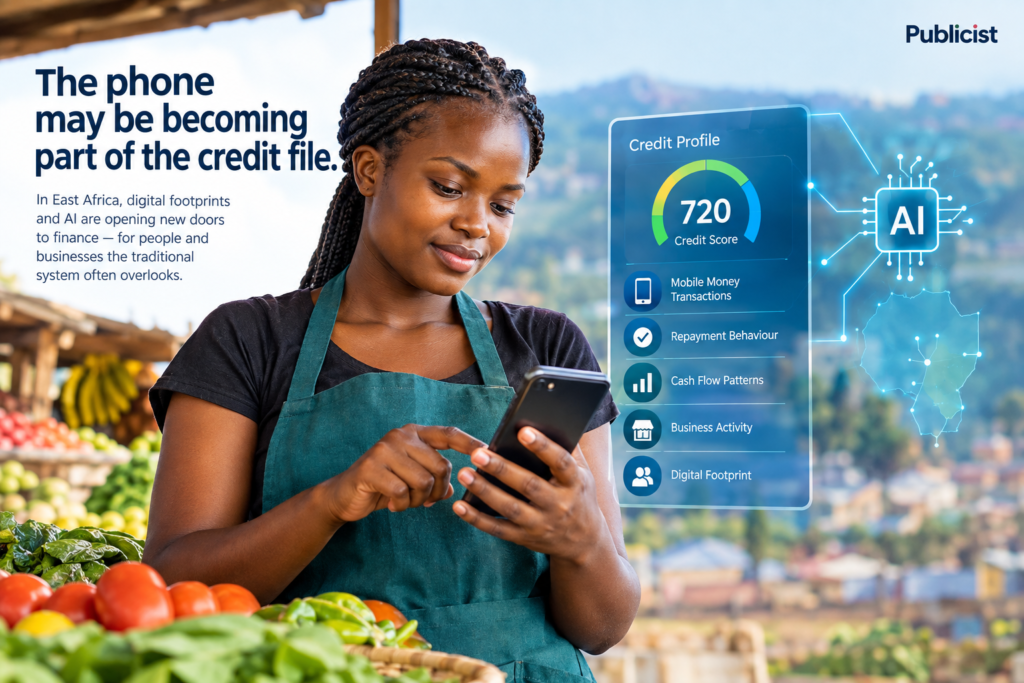
That is beginning to change. As mobile money and digital payments become embedded in everyday economic life, people who have little conventional credit history are increasingly leaving behind another kind of financial record. Their transactions, repayment behaviour and cash-flow patterns can reveal how they manage money even when they have no payslip, audited accounts or traditional banking history. Artificial intelligence and other automated analytical tools are making it possible for lenders to process this information at a scale and speed that traditional credit assessment could not.
The significance of this shift is particularly clear in Uganda, where mobile money has become a major part of the financial system while access to formal bank credit remains limited for many individuals and small businesses. Financial Sector Deepening Uganda has highlighted the potential of alternative credit scoring to use financial behaviour captured through digital channels to assess customers who have traditionally been underserved by formal finance. Its work has included supporting institutions such as Opportunity Bank, BrightLife and FINCA Uganda to develop or test alternative credit-scoring approaches for low-income customers and smallholder farmers.
The underlying idea is relatively simple. A small trader may not have audited financial statements, but may receive and make payments consistently through mobile money. A farmer may not earn a fixed monthly salary, but may demonstrate regular economic activity through digital transactions. A first-time borrower may have no conventional credit history, yet may have a record of repaying previous digital loans. Such information does not automatically make someone creditworthy, but it can give a lender a more complete picture of the person’s financial behaviour.
This is where AI becomes important. Instead of relying entirely on a loan officer to examine a limited set of documents, automated systems can process large volumes of financial information and identify patterns that may help predict repayment risk. The result is a potential shift from a static assessment based largely on what a borrower owns and what their previous borrowing record looks like, towards a more dynamic assessment of how they actually manage money.
Uganda’s growing digital-finance market provides the infrastructure for that transition. The IMF reported in 2025 that Uganda had about 250 fintechs, with microcredit and digital lending accounting for a significant share of the sector. Mobile subscriptions and mobile-money registrations had also reached tens of millions, while digital lending had expanded considerably in relation to the size of the economy. The growth does not mean that every Ugandan bank is already using AI to determine who receives a loan. It does, however, show that the financial system is generating an increasingly large pool of digital information that lenders can potentially use to understand customers.
The regional picture reinforces the direction of travel. Kenya has developed one of Africa’s most mature digital-credit markets, with the Central Bank of Kenya licensing dozens of digital credit providers. The country’s banking sector is also increasingly experimenting with artificial intelligence, including in areas such as credit-risk assessment. Tanzania is moving in a similar direction, with mobile money deeply integrated into its financial system and the Bank of Tanzania reporting the growing use of alternative credit scoring and AI-based models by financial institutions.
East Africa therefore finds itself in an unusual position. The region has spent years expanding mobile-money and digital-payment infrastructure, creating financial records for people who may previously have been largely invisible to formal institutions. The next step is to determine how much of that information should become part of the lending decision.
For banks and fintechs, the opportunity is substantial. Alternative data could allow financial institutions to reach customers who have traditionally been rejected because they lacked collateral, formal employment or a sufficiently long borrowing history. It could also help lenders assess small businesses whose economic activity is real but poorly captured by conventional financial statements. In principle, a borrower could enter the formal financial system with a small facility, demonstrate responsible repayment and gradually qualify for larger amounts as their financial profile develops.
That could make credit more responsive to actual economic behaviour. A business owner whose cash flows are growing should not necessarily remain permanently constrained simply because they cannot produce the documents demanded by a conventional credit process. Likewise, someone who has never borrowed from a bank should not automatically be treated as someone who cannot repay.
But the same technology that could make credit more inclusive can also create a new form of exclusion.
The critical question is no longer simply whether lenders have enough information. It is whether they have the right information, whether customers understand how it is being used and whether automated decisions can be challenged.
There is an important distinction between using financial information that is directly relevant to creditworthiness and treating someone’s wider digital life as a source of credit intelligence. A mobile-money transaction history is fundamentally different from accessing a person’s contacts, private messages, location or photographs. Yet the rapid expansion of digital lending has demonstrated how much personal information can become commercially valuable.
That creates a difficult balance for regulators and financial institutions. A lender may be able to collect enormous amounts of data, but collection alone does not establish that every piece of information should influence a person’s access to credit. Customers need meaningful consent, secure handling of personal information and clear explanations of how significant decisions about them are reached.
Artificial intelligence makes that challenge more urgent because an algorithm can make a decision without making its reasoning obvious to the person affected. A customer who is denied a loan may know the outcome but have little understanding of whether it was driven by irregular cash flows, previous repayment behaviour, inaccurate information or another pattern identified by the model.
There is also the question of bias. A model trained on historical financial behaviour can reproduce weaknesses contained in that data. If certain groups have historically had less access to formal finance, their limited credit histories could be interpreted as evidence of greater risk rather than evidence of exclusion from the system. An algorithm can therefore appear objective while still producing unequal outcomes.
This is why the development of AI-driven credit assessment should not be judged only by how quickly lenders can approve loans. Regulators and financial institutions will increasingly have to consider whether credit models are tested for bias, whether customers can understand the factors influencing decisions, whether inaccurate data can be corrected and whether there is meaningful human accountability when automated systems make mistakes.
For Uganda and the wider East African financial sector, this is becoming one of the defining questions of the next phase of digital finance. The region has already built much of the infrastructure required to make financial activity visible through mobile phones. What happens next will determine whether those digital footprints become a bridge into formal finance or another barrier standing between people and the capital they need.
The promise of alternative data and AI is not simply that banks can know more about their customers. Its real promise is that financial institutions can recognise economic activity that traditional credit systems have struggled to see.
A farmer without a payslip can still be a reliable borrower. A trader without audited accounts can still run a viable business. A young worker without a conventional credit history can still demonstrate responsible financial behaviour.
Technology can help make that reality visible. But if the new credit score is going to become a gateway to finance, borrowers must be able to trust the system behind it. The future of lending in East Africa will therefore depend not only on how much data financial institutions can process, but on whether they can turn that data into decisions that are accurate, explainable and fair.
The phone may be becoming part of the credit file. The bigger question is who controls that file, what goes into it, and whether the person whose financial future depends on it gets a say.