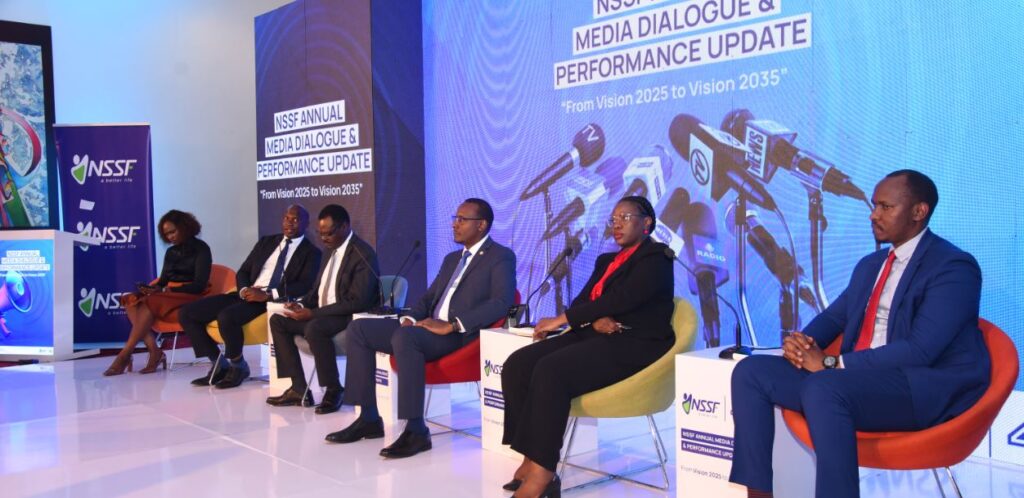
The National Social Security Fund (NSSF) has once again cemented its role as a key driver of Uganda’s economy, announcing record-breaking earnings and contributions for the Financial Year ending June 30, 2025.
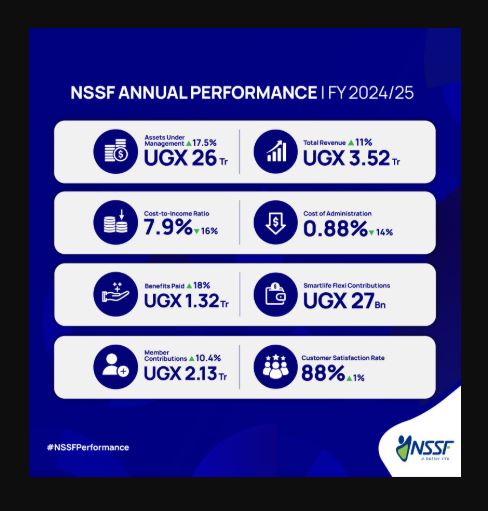
With earnings soaring to Shs3.52 trillion, an 11% increase from the previous year, the Fund’s impressive performance is not just a win for its members but a powerful testament to its contribution to national development.
Under the leadership of Managing Director Patrick Michael Ayota, NSSF’s strategic investments are becoming a cornerstone of Uganda’s economic resilience.
“For the second year running, we saw a significant increase in revenue in our real estate income, interest income, as well as dividend income,” Ayota said.
The Engine of Capital Formation
At its core, NSSF is a national engine of domestic capital formation. By collecting mandatory and voluntary savings from millions of Ugandans, the Fund pools together vast sums of money that are then channelled into critical sectors of the economy.
This pool of savings, which has grown to an impressive Shs26.0 trillion in Assets Under Management, reduces the country’s reliance on foreign borrowing for development projects.
As NSSF MD Ayota has previously noted, a country’s long-term domestic savings to GDP must rise to at least 25% to truly accelerate economic development, a target NSSF is actively working towards.
Healthy Investment Portfolio
Mr. Ayota noted that the Fund’s investment portfolio is a direct reflection of its commitment to both generating returns for members and stimulating the local economy.
“The Fund’s performance is powered by a diverse asset mix, with significant gains in fixed income, equities, and real estate investments,” he added.
He noted that the numbers speak for themselves as he explained below:
Interest Income
Grew from Shs2.34 trillion to Shs2.88 trillion, showcasing the Fund’s substantial investment in government and corporate bonds, which are crucial for financing national development and corporate expansion.
Dividend Income
Increased from Shs175 billion to Shs238.14 billion. This income stream, according to Mr. Ayota, highlights NSSF’s role as a major shareholder in some of East Africa’s largest companies, including MTN Uganda, Airtel, Vodacom, Safaricom, Stanbic Bank, Umeme, Equity Bank, among others.
Important to note is that these investments not only provide returns but also offer stability and confidence in the regional stock market, attracting more institutional investors.
Real Estate
He revealed that the NSSF income from real estate investments rose from Shs13.24 billion to Shs16.64 billion. Ayota explained that NSSF’s real estate projects, such as the Workers’ House in Kampala and the upcoming Temangalo housing project, not only provide returns but also directly create jobs in the construction sector and help address Uganda’s housing deficit.
Fueling the Private Sector and Beyond
The media dialogue also highlighted that the impact of NSSF’s investments extends well beyond financial returns.
Mr. Stevens Mwanje, the Chief Financial Officer at NSSF, explained that through its strategic portfolio, the Fund directly contributes to:
Job Creation
He explained that a report by KPMG revealed that NSSF’s activities have not only impacted Uganda’s economy by contributing to a tune of Shs32 trillion to the 2024/2025 financial budget but also created millions of jobs, both directly and indirectly, through the ripple effect of its investments in government and corporate paper.
Deepening the Financial Sector
Mr. Mwanje also revealed that NSSF is a leading player in Uganda’s financial system, owning a significant portion of listed equities and government securities. He added that its participation provides liquidity and confidence in the Uganda Securities Exchange (USE), which is vital for the growth of local businesses.
Supporting Corporate Growth
According to Mr. Mwanje, the Fund’s investment in companies like MTN Uganda, Airtel Uganda, Stanbic Bank, and others provides them with the capital needed for expansion, innovation, and service delivery, which in turn benefits consumers and the wider economy and enables them to operate sustainably.
The Fund’s impressive performance comes despite a challenging economic environment, including volatility in the regional stock market and a strengthening Ugandan shilling. This demonstrates NSSF’s prudent investment strategy and its ability to deliver value consistently.
A Vision for a More Inclusive Future
Looking ahead, the NSSF’s Vision 2035 strategic plan outlines an even more ambitious role in national development.
The plan aims to grow the Fund to Shs50 trillion, significantly increasing its capacity to invest in national infrastructure and projects.
It also seeks to expand NSSF coverage to 50% of the working population, a crucial step toward ensuring social security and financial inclusion for all Ugandans, including those in the informal sector.
While the Fund’s compliance rate saw a slight dip following a change in the law to include all employers, NSSF has already embarked on sensitisation campaigns to address the issue.
The success of its voluntary savings product, Smartlife Flexi, which has attracted Shs27 billion in contributions, proves that NSSF’s innovative approach is resonating with a broader segment of the population.
By consistently generating impressive returns and strategically investing members’ savings, NSSF is not only safeguarding the future of its members but also acting as a central pillar of Uganda’s economic prosperity and development.