
Africa has sunshine, wind, forests, minerals, agricultural land and one of the world’s youngest populations. It also has an expanding pipeline of opportunities in renewable energy, climate smart agriculture, clean cooking, electric mobility and carbon markets. What it does not have is enough affordable money to build them.
That may be one of the biggest contradictions in Africa’s climate transition. The continent attracted an average $43.7 billion a year in climate finance in 2021 and 2022, according to Climate Policy Initiative, up from $29.5 billion in 2019 and 2020. That sounds encouraging until it is placed against what Africa actually needs. CPI estimates that African countries require roughly $190 billion every year to implement their current national climate commitments and meet their 2030 goals. At current levels, only about 23 percent of that requirement is being financed.
But Africa’s problem is not simply that too little money is arriving. The money can also be unusually expensive when it does. The International Energy Agency estimates that the cost of capital for utility scale clean energy projects in Africa can be at least two to three times higher than in advanced economies and China. The technology may be proven, the sunshine abundant and the demand for electricity obvious, yet a project can still struggle because investors attach a higher price to African risk.
That changes the economics of the transition. Renewable energy projects tend to require substantial investment upfront, meaning the cost of financing can have a major effect on the eventual cost of the energy produced. Africa can therefore possess some of the world’s best solar resources and still struggle to turn that natural advantage into affordable electricity.

The imbalance becomes clearer when the distribution of climate finance is examined. Africa accounts for around 20 percent of the world’s population but attracts less than 3 percent of global energy investment. Ten African countries received 46 percent of total climate finance in 2021 and 2022, while the ten countries considered most vulnerable to climate change received just 11 percent. Private capital is even more concentrated, with ten countries attracting 76 percent of Africa’s private climate finance.
The countries that may need climate investment most are therefore not necessarily the places where investors are most willing to put their money. Investors are not charities and capital naturally moves towards acceptable risk adjusted returns. Political uncertainty, currency volatility, regulatory risk, weak project pipelines, the creditworthiness of electricity buyers and underdeveloped domestic financial markets can all increase the premium investors demand. Some of that risk is real and some is perceived, but for an African entrepreneur or project developer trying to raise capital, the distinction may matter less than the cost attached to the money.
The consequences extend far beyond renewable energy. A farmer trying to invest in irrigation because rainfall has become less predictable needs capital. So does a clean cooking company trying to put affordable technology into thousands of homes, a developer financing a solar mini grid, an entrepreneur building a business around carbon markets or a manufacturer trying to reduce energy costs by installing solar power. Each may have a viable solution to a real African problem, but a good idea does not become a sustainable business until somebody finances it.
This is why Africa’s climate finance debate needs to move beyond counting the dollars pledged at international conferences. The more consequential questions are what the money costs, who can access it, what it finances, who owns the businesses it creates and where the resulting value ultimately remains.
Those questions matter because Africa could attract billions of dollars in climate investment and still capture surprisingly little of the economic value created by the transition. A solar farm can stand on African soil while much of its equipment is manufactured elsewhere, its capital is raised overseas and part of its financial return eventually leaves the continent. African forests and farms can generate carbon credits while much of the higher value financing, brokerage and trading takes place elsewhere. The continent can supply minerals needed for batteries and electric vehicles while the manufacturing, intellectual property and higher paying jobs remain thousands of kilometres away.
In each case, Africa participates in the green economy. The harder question is where in the value chain it participates.
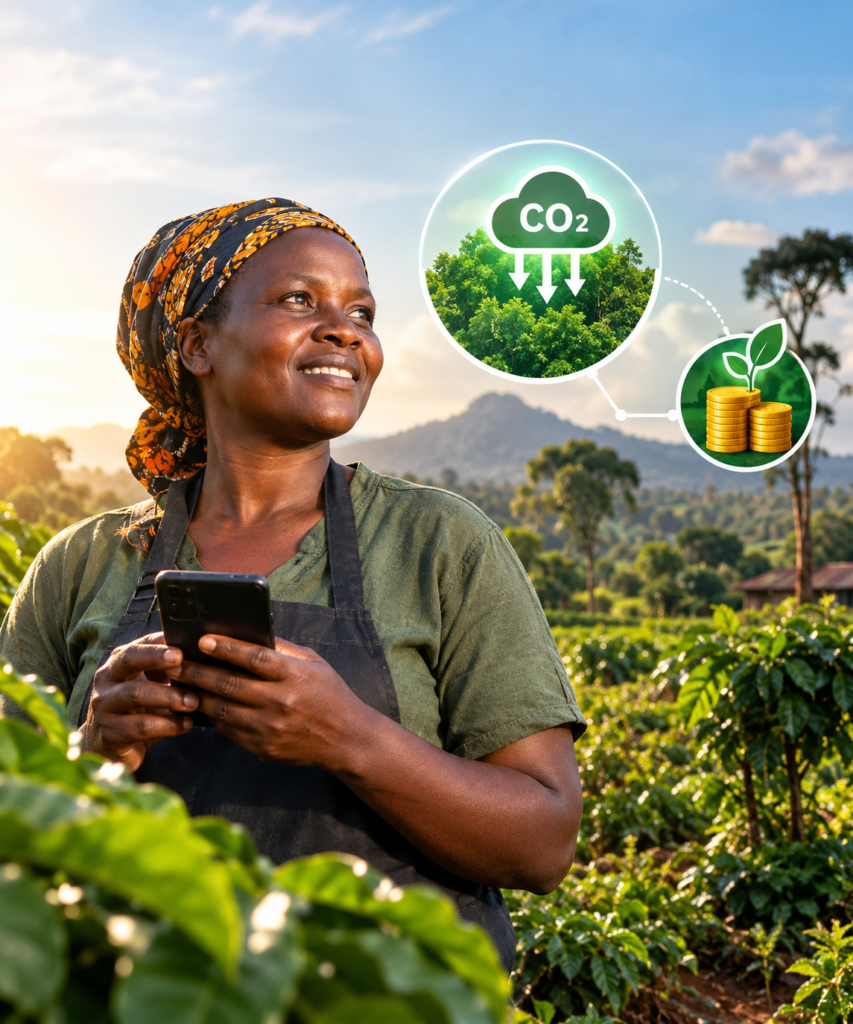
That distinction should increasingly matter for East Africa. Uganda, Kenya, Tanzania and Rwanda are all trying, in different ways, to attract capital into renewable energy, agriculture, mobility, carbon markets and other parts of the emerging climate economy. Carbon markets are particularly instructive. For farmers, forestry projects, clean cooking businesses and other developers, carbon finance can create revenue around emissions reductions that previously had little or no commercial value. But a carbon credit does not eliminate the capital problem. Someone still has to finance the project before credits are issued. Businesses need working capital, technology must be purchased, projects must be measured and verified, and developers have to survive the period between investment and revenue.
The success of Africa’s climate economy will therefore depend as much on banks, investors, development finance institutions and capital markets as it does on climate policy. This becomes particularly important because international sources account for 87 percent of Africa’s tracked climate finance. Private finance almost doubled to about $8 billion in 2021 and 2022 but still represented only 18 percent of total climate flows. Africa is attempting to finance a major economic transformation while remaining heavily dependent on capital originating outside the continent.
International climate finance will remain essential, particularly for adaptation and projects that cannot generate conventional commercial returns. Development finance institutions can also play an important role by absorbing some risk through guarantees, concessional capital and blended finance structures. But Africa also has to mobilise more of its own money. Its banks, pension funds, insurers, development banks and capital markets collectively control pools of capital that could play a larger role in financing the transition if appropriate investment instruments, viable project pipelines and effective risk structures are developed.
The objective should not be to pretend African markets carry no risk. They do. The objective should be to stop allowing those risks to make otherwise viable African projects prohibitively expensive.
The scale of the opportunity becomes clearer when financing costs are considered. The IEA estimates that narrowing the cost of capital gap between emerging and developing economies and advanced economies by just one percentage point could reduce clean energy financing costs across emerging and developing economies by about $150 billion a year.
The battle over Africa’s climate future is therefore not only about emissions, adaptation or how much wealthy countries should contribute. It is also about the price of money. If an African solar developer has to raise capital at substantially higher rates than a comparable developer elsewhere, the disadvantage begins before the first panel is installed. If an African climate technology entrepreneur cannot finance expansion, a promising idea remains a pilot. If African countries export the raw materials, environmental assets and carbon credits underpinning the global green transition while importing the technology and capital required to monetise them, the continent risks repeating a familiar economic pattern under a greener name.
That is why the next phase of Africa’s climate finance conversation should be more ambitious than asking how much money the world is willing to provide. Africa also needs to ask what kind of economy that money is helping to build and whether African companies, workers, investors and economies are capturing a meaningful share of the resulting value.
Africa needs roughly $190 billion a year to meet its current climate commitments and today receives less than a quarter of that. Closing the financing gap matters, but changing the economics behind the gap matters just as much.
Africa does not simply need more climate finance. It needs capital it can afford, businesses it can own and a green transition from which it can capture value.