Uganda’s farmers have a collateral problem. It is not necessarily that they lack productive assets. Many smallholders own land, grow crops, keep livestock or manage trees, but much of that productive wealth remains difficult for conventional lenders to recognise as security for a loan. The result is a familiar contradiction: a farmer can be economically productive and still struggle to become bankable.
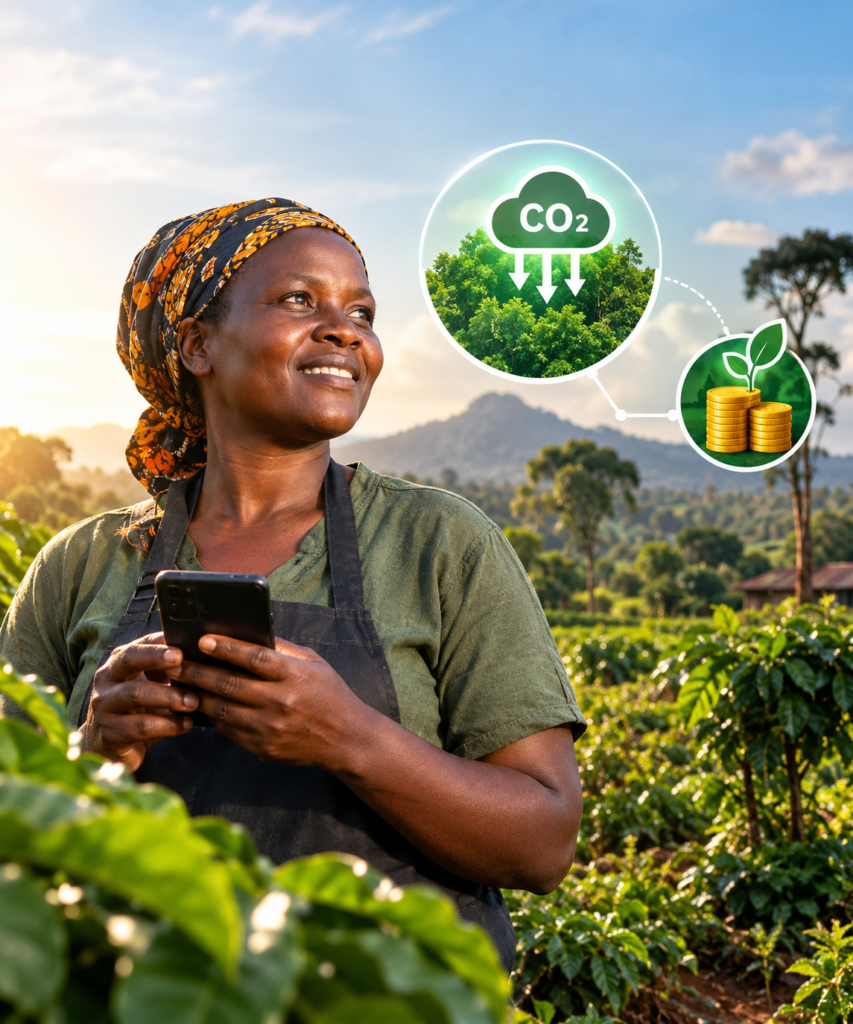
Uganda’s emerging carbon market is beginning to introduce a different possibility. If farmers can generate income from activities such as agroforestry, conservation and land restoration, could the contractual right to receive that future income help them access credit?
The proposition is more precise than simply asking whether carbon credits can become collateral. A carbon credit is not automatically equivalent to land, a building or cash. The more interesting question is whether a credible, long-term contract that gives a farmer a right to future carbon or payments for environmental services (PES) can become part of a lender’s assessment of the farmer’s ability to repay.
Uganda’s carbon market could create more than a new source of farmer income. Long-term environmental contracts are already being tested as a basis for accessing green finance, raising a bigger question. Can future carbon income become part of the collateral and credit assessment system for smallholder farmers?
There is already an early Ugandan example. ECOTRUST’s Uganda Carbon and Coffee Project is designed to establish a PES incentive scheme for up to 3,000 smallholder coffee farmers in the operational areas of the Ankole Coffee Producers Cooperative Union in southwestern Uganda. The project plans to mobilise farmers to plant more than 900,000 trees on more than 3,000 hectares, with payments linked to environmental performance. ECOTRUST says farmers will enter conservation agreements covering a 10- to 25-year period and that the 25-year PES/carbon agreements will serve as collateral for growers seeking green loans through their local cooperatives. ECOTRUST also says the conservation agreements can help establish a credit history that enables farmers to seek financing from other local financial institutions.
That is important, but it needs to be understood correctly. It does not mean Uganda’s commercial banks have generally begun accepting carbon contracts in place of land titles. What ECOTRUST describes is a specific financing model linked to its project, its participating farmers and local cooperatives. It is an early experiment in connecting long-term environmental contracts with access to finance, rather than evidence of a mature carbon-collateral market across Uganda.
That distinction is central to understanding where this idea could go. A lender is ultimately interested in repayment. If a farmer has a contract that is expected to generate future environmental payments, the lender can potentially examine who is making those payments, how much the farmer is expected to receive, when payments will be made and what conditions the farmer must meet.
In that sense, the potential value of a carbon contract may lie less in the carbon credit itself than in the future cash flow attached to a credible contractual arrangement.
That could matter for Uganda because agriculture remains one of the country’s largest economic activities even as access to finance remains a challenge. Preliminary government figures show that agriculture, forestry and fishing grew by 6.5% in FY2025/26 and accounted for 26.2% of GDP. The wider economy grew by 6.4% during the same financial year.
Yet economic importance does not automatically translate into financial bankability. Smallholder farmers often face seasonal incomes, production risks and limited financial records. Conventional lending can also favour borrowers who can provide readily enforceable collateral.
The World Bank has highlighted the scale of the broader problem, noting that less than 3% of bank credit goes to agriculture in some emerging-market contexts and that banks often rely on financial records, credit history and collateral when assessing agricultural borrowers.
Carbon-linked income will not eliminate those challenges. But it could give lenders another piece of information. A farmer who is participating in a credible agroforestry or coffee programme could potentially demonstrate not only expected agricultural income, but also a documented environmental income stream linked to a long-term agreement. That could become useful when combined with other forms of security and evidence of repayment capacity.
The difficult part is turning that potential into something a lender can actually rely on.
Uganda’s regulatory framework for carbon markets is developing. The National Environment Management Authority lists the National Climate Change (Climate Change Mechanisms) Regulations, 2025, which establish the regulatory framework for climate-change mechanisms and carbon-market activities. But a carbon-market regulatory framework is not the same thing as a fully developed collateral market.
The critical questions are therefore increasingly financial and legal. If a farmer has a contractual right to future carbon or PES payments, can that right be assigned or pledged to a lender? How would the lender establish priority over that income? How would the value of the future payments be determined? What happens if the project does not generate the expected carbon income? And what happens if the farmer defaults?
Those questions become particularly important because carbon income is performance-dependent. Trees have to survive. Environmental outcomes have to be demonstrated. Carbon has to be measured and verified according to the applicable standard. Farmers have to comply with their conservation obligations. And there ultimately has to be demand for the resulting environmental assets.
The ECOTRUST model itself recognises some of these risks. Its Uganda Carbon and Coffee Project includes a community carbon fund intended to help de-risk the farmers and assist growers in the event of losses or disasters.
That kind of risk-sharing could become critical if carbon-linked lending is to move beyond small pilots. A farmer who borrows today against expected environmental income should not be left carrying the entire downside if that income later falls below projections because of poor environmental performance, project disruption or market conditions.
This is why the most realistic future model may not be carbon contract versus land title. It could be a layered financing structure in which several parties share information and risk.
A cooperative could aggregate hundreds or thousands of farmers and provide lenders with a stronger institutional relationship. A carbon project developer could provide conservation contracts, environmental-performance data and payment histories. The lender could assess those future payments alongside agricultural cash flows, savings, guarantees and whatever conventional security the farmer can provide. A guarantee or blended-finance facility could then absorb part of the risk.
In such a model, carbon income would not replace conventional collateral. It would become one component of a broader assessment of the farmer’s creditworthiness and repayment capacity.
That is arguably a more realistic proposition for Uganda than treating carbon credits as a new form of land title.
It also changes the way financial institutions could think about agricultural assets. Instead of asking only what physical property a farmer owns, lenders could increasingly ask what predictable and verifiable future cash flows the farmer can demonstrate.
That shift could be significant. But it must be accompanied by strong protection for farmers. Long-term environmental agreements can impose obligations over many years. In the ECOTRUST project, the conservation arrangements can extend to 25 years.Farmers therefore need to understand how payments are calculated, what environmental obligations they are accepting, how land-use requirements affect their farms and what happens if expected carbon revenues do not materialise.
A contract should not become bankable at the expense of becoming incomprehensible to the farmer who signs it. Uganda should therefore resist the temptation to describe carbon contracts as a replacement for conventional collateral. The more defensible proposition is narrower and potentially more useful: long-term, credible contractual rights to environmental income could become another asset that lenders consider when assessing agricultural borrowers.
The distinction matters because Uganda is trying to expand agricultural productivity while deepening private-sector finance. If environmental income can be measured, verified and incorporated into a lending decision, carbon markets could help make some activities that were previously difficult to finance more visible to financial institutions.
The opportunity is therefore bigger than paying farmers to plant trees. It is about whether the future income generated by those trees can help finance the farms that grow them.
Uganda’s carbon market is still developing, and the evidence so far points to an emerging model rather than an established banking product. ECOTRUST’s Uganda Carbon and Coffee Project provides a concrete example of how long-term PES/carbon agreements can be connected to green lending through cooperatives. The next challenge is determining whether that approach can be independently evaluated, legally strengthened and scaled without transferring disproportionate risk to farmers.
If Uganda can build that architecture, carbon finance could become more than a mechanism for rewarding environmental conservation. It could become part of the financial infrastructure that helps farmers borrow, invest and grow. The real question, then, is not whether a carbon credit can replace a land title. It is whether a credible claim on future carbon income can help make a productive farmer more bankable.
Editor’s Note: This article is part of the I Am An Agripreneur thought leadership series by Publicist East Africa, exploring the ideas, policies, market innovations and investment opportunities shaping the future of agriculture, agribusiness and industrialisation across East Africa. We welcome diverse perspectives, evidence-based debate and contributions from farmers, entrepreneurs, policymakers, researchers, investors and development practitioners. To share your insights, submit an article or join the conversation, write to yourstory@publicisteastafrica.com.