By Publicist East Africa
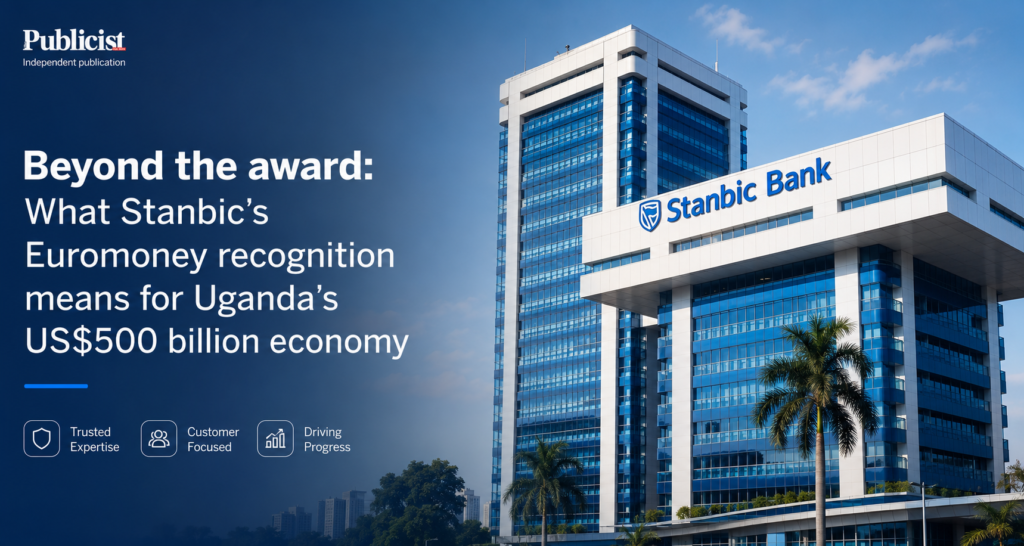
When Euromoney named Stanbic Bank Uganda the country’s Best Investment Bank for 2026, it recognised more than another year of strong institutional performance. It acknowledged the growing role of investment banking in financing Uganda’s economic transformation.
The award, announced as part of Euromoney’s annual Awards for Excellence programme, reflects Stanbic’s capabilities in corporate advisory, structured finance, capital raising and delivering complex financial solutions for businesses, institutions and government.
That capability is not simply theoretical. In 2025, Stanbic Bank Uganda delivered East Africa’s first blended finance solution, a structure combining development finance, philanthropic capital, commercial balance sheet funding and microfinance distribution networks to expand access to affordable financing for women-owned micro-enterprises.
The transaction demonstrated the evolving role of investment banking beyond traditional deal-making: bringing together different sources of capital to solve financing challenges that conventional banking alone cannot address. But beyond the accolade lies a more important question.
What does a stronger investment banking sector mean for Uganda’s economic future?
Financing growth beyond traditional banking
For many Ugandans, banking is associated with savings accounts, personal loans and business financing. Investment banking, however, operates on an entirely different scale.
It is the part of the financial sector that structures major infrastructure financing, advises on mergers and acquisitions, raises capital for expanding businesses, supports governments in delivering strategic projects and connects investors with long-term opportunities.
As Uganda pursues industrialisation, infrastructure development, energy expansion, manufacturing growth and regional trade integration, these capabilities become increasingly important.
Economic transformation is not driven by finance alone, but neither can it happen without institutions capable of mobilising and deploying capital at scale.
Beyond blended finance, Stanbic’s 2025 investment banking activity covered sectors including infrastructure, manufacturing, fast-moving consumer goods and public sector financing, areas where successful transactions require deeper understanding of business models, sector risks and long-term cash flows rather than conventional lending approaches.
The growth of these capabilities signals a broader shift in Uganda’s financial sector, where banks are increasingly becoming strategic partners in economic development.
Building confidence in Uganda’s investment story
International recognition from Euromoney carries significance because the awards are regarded among the financial industry’s respected benchmarks for excellence.
Recognition from such a platform sends a positive signal not only about an institution but also about the broader market in which it operates.
For international investors evaluating emerging markets, the strength of local financial institutions matters. Sophisticated investment banks reduce transaction complexity, improve investor confidence and provide the expertise required to structure complex investments according to international standards while understanding domestic market realities.
Stanbic’s position gives the recognition additional weight. The bank remains Uganda’s largest commercial bank by assets. That scale represents a significant institutional foundation by regional standards. However, it also highlights the size of the challenge ahead. A US$500 billion economy will require a financial system capable of intermediating capital far beyond the capacity of any single institution.
The evolution of corporate and investment banking
Uganda’s financial sector has evolved considerably over the past two decades.
Banks today do far more than provide traditional lending. They increasingly serve as strategic advisers to businesses pursuing expansion, governments financing development priorities and investors seeking opportunities across multiple sectors.
Corporate and Investment Banking now supports businesses through advisory services, capital raising, treasury solutions, structured finance, risk management and access to regional and international capital markets.
As Uganda deepens regional integration through the East African Community and the African Continental Free Trade Area (AfCFTA), demand for these capabilities is expected to continue growing.
Businesses expanding across borders, infrastructure projects requiring long-term financing and industries seeking global investment partners will increasingly depend on institutions capable of structuring complex transactions.
The other side of the balance sheet
A stronger investment banking sector is important, but Uganda’s financing challenge requires a broader conversation.
Across the banking sector, including at institutions such as Stanbic, banks have increasingly balanced private-sector lending with investments in government securities. Treasury instruments have historically offered banks attractive returns with lower risk, making them an important part of balance sheet management.
However, unlocking the scale of private investment required for a US$500 billion economy will require more than strong commercial banks.
It will require deeper capital markets, stronger corporate bond markets, increased equity financing, pension fund participation and more investment instruments that allow businesses to raise long-term capital.
The challenge is not simply creating more money. It is creating more channels through which capital can reach productive sectors of the economy.
More than one institution
While Euromoney’s award celebrates Stanbic Bank Uganda’s achievement, it also reflects the continued maturation of Uganda’s financial ecosystem.
Successful investment banking depends on credible regulation, stable macroeconomic management, active capital markets, professional advisory services, legal expertise and investor confidence.
The stronger these institutions become, the more competitive Uganda becomes as an investment destination.
Awards therefore recognise individual excellence while also highlighting the progress of the wider financial system that supports economic growth.
The road to a US$500 billion economy
Uganda’s ambition to build a US$500 billion economy will require unprecedented levels of long-term investment.
Financing that ambition will depend on investments across transport, energy, manufacturing, agriculture, digital infrastructure and industrial development. But mobilising capital at that scale will rely as much on deepening Uganda’s capital markets as on the strength of individual financial institutions.
Investment banks will play a central role by connecting investors with opportunities, structuring complex transactions and helping businesses access capital.
But the broader objective must be building a financial ecosystem where entrepreneurs, companies, governments and investors have multiple pathways to finance growth.
In that context, Euromoney’s recognition of Stanbic Bank Uganda extends beyond institutional prestige. It highlights the increasingly strategic role that sophisticated financial institutions will play in transforming economic ambition into investable opportunities.
Awards alone do not build economies. Capital does. Confidence does. Strong institutions do.
As Uganda advances towards its long-term development aspirations, the strength of its investment banking sector will influence not only how much investment the country attracts, but how effectively that capital is deployed to create jobs, expand industries and accelerate sustainable growth.
If Uganda is to realise its vision of becoming a US$500 billion economy, institutions capable of mobilising long-term capital will not simply support that journey. They will help shape it.
.