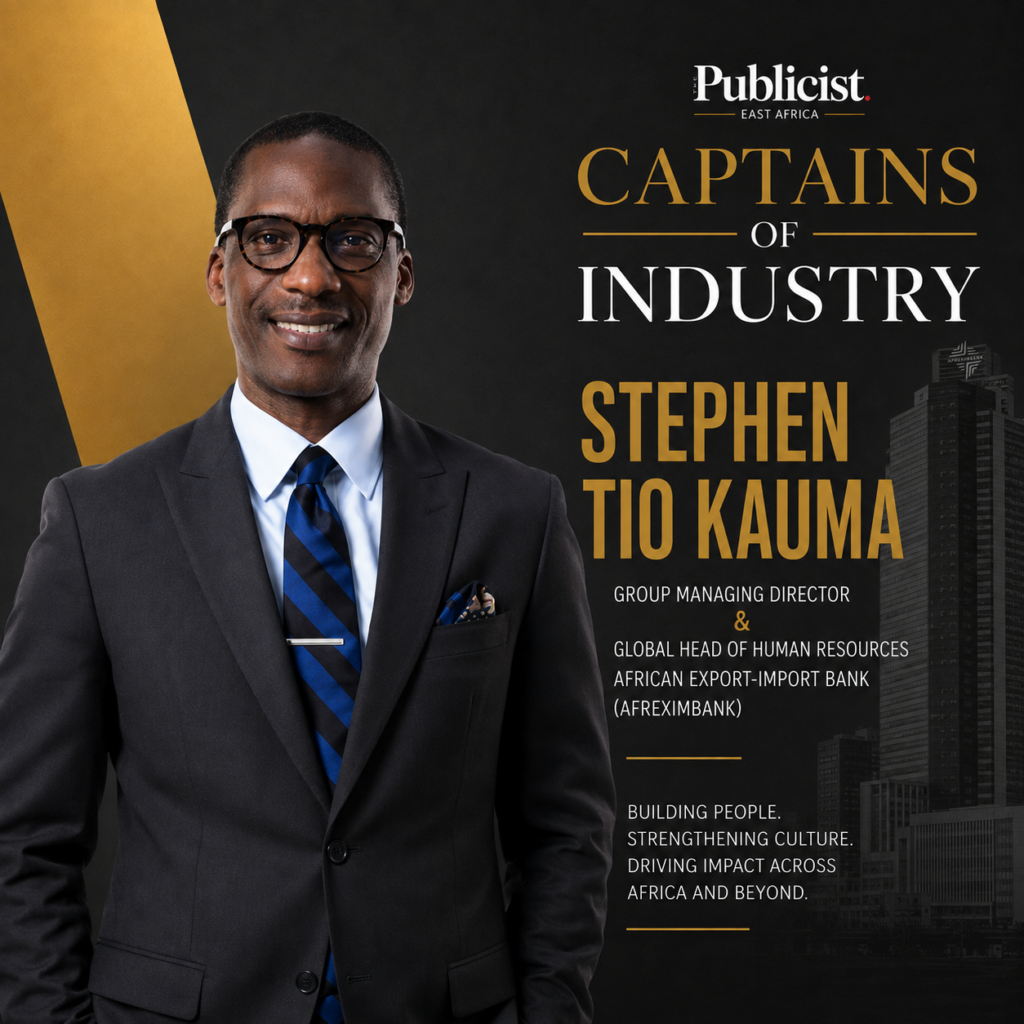
Stephen Tio Kauma‘s career is difficult to place neatly into one industry. And perhaps that is precisely the point.
From professional services and manufacturing to continental finance, education and contemporary African art, the Ugandan executive has spent more than two decades working around one of Africa’s most consequential challenges: building the people and institutions capable of turning ambition into results.
It is an increasingly important question for a continent that does not lack ambition. Africa has sophisticated financial institutions, ambitious trade agreements, expanding digital infrastructure, a young population and an entrepreneurial class eager to participate in a rapidly changing global economy. The harder task is converting those advantages into institutions that work, businesses that scale and opportunities that reach ordinary Africans.
Kauma’s professional journey offers an interesting perspective on that challenge.
His early career took him through KPMG Uganda as a business adviser, PricewaterhouseCoopers in human-resource consulting and Lafarge/Hima Cement, where he led human resources and organisational management. He subsequently joined the African Export-Import Bank, Afreximbank, beginning a long chapter that would eventually see him rise to lead the Bank’s human-capital function.
That progression matters because it places Kauma’s career at the intersection of two subjects that are often discussed separately in Africa: capital and capacity.
Afreximbank has become one of the institutions at the centre of Africa’s efforts to expand intra-African trade, accelerate industrialisation and strengthen the continent’s position in global commerce. But financing alone cannot deliver that transformation. Behind every trade transaction, infrastructure project and expanding African enterprise are institutions and people capable of translating strategy into execution.
Viewed through that lens, human capital is not merely an administrative function. It is part of Africa’s economic infrastructure.
Kauma’s work around knowledge and professional development reinforces that idea. Through the Afreximbank Academy, AFRACAD, the Bank has sought to consolidate its capacity-building initiatives into a platform providing trade-related learning, knowledge and networking opportunities to professionals and businesses across Africa. Kauma has been closely associated with that agenda, arguing for the development of the practical skills African businesses need to take advantage of opportunities created by initiatives such as the African Continental Free Trade Area.
The underlying proposition is straightforward: a continental market can be created through agreements, but Africans still require the knowledge and institutional capability to trade within it.
Knowledge, in that sense, becomes infrastructure too.
There is another side of Kauma’s journey that might initially appear removed from finance and organisational transformation: contemporary African art. Yet it raises a remarkably similar question about African value.
Kauma is a founding member of the Contemporary Art Society of Uganda and has built a collection encompassing contemporary artists from numerous African countries. His engagement with the sector has also extended into Afreximbank’s art programme and wider efforts to promote Africa’s visual arts ecosystem.
The significance goes beyond collecting.
For generations, African creativity has travelled around the world while substantial portions of its cultural and commercial value have often been recognised and captured elsewhere. The rise of contemporary African art, music, film, fashion and other creative industries is beginning to alter that equation, creating opportunities for African artists, collectors, galleries, investors and institutions to participate more meaningfully in the value generated by the continent’s creativity.
Viewed together, Kauma’s interests in human capital, knowledge, trade and culture reveal a wider concern with African capacity: the ability of Africans not simply to participate in economic opportunity, but to create, manage and retain more of its value.
It is a theme that resonates well beyond his own career.
Africa’s next phase of transformation will require more than capital. It will require institutions capable of deploying that capital effectively, businesses capable of scaling across borders, professionals equipped to manage increasingly sophisticated organisations and creative industries capable of retaining more of the value generated by African talent.
The African Continental Free Trade Area illustrates the challenge particularly well. A trade agreement can create a market on paper, but businesses still require financing, logistics, market intelligence, technology and capable people to take advantage of it. Digital infrastructure can connect millions of Africans, but its economic value depends on the businesses and services built upon it. Capital can unlock growth, but only when institutions possess the capacity to deploy it productively.
The difference between ambition and transformation is often execution.
That is what makes Stephen Tio Kauma’s journey worthy of closer attention. His career is difficult to reduce to a single sector because much of his work has been concerned with what connects sectors: people, institutions, knowledge, capital and creativity.
It is also why Publicist East Africa recognises Stephen Tio Kauma as a Captain of Industry.
Not simply for the senior positions he has occupied, but for the breadth of a career that has consistently engaged with one of Africa’s defining development questions: how do we build the people, institutions and systems capable of turning the continent’s ambition into results?
His journey offers a useful reminder that Africa’s transformation will not come from isolated interventions. Capital must connect with talent. Knowledge must connect people to opportunity. Creativity must translate into economic value. And institutions must be strong enough to turn all of those ingredients into sustainable outcomes.
Africa has no shortage of potential, ambition or ideas. The leaders who define its next chapter will increasingly be judged by how effectively they convert those assets into institutions that perform and opportunities that endure.
Stephen Tio Kauma’s journey suggests that building that capacity may be among the most important work of all.
This feature forms part of Publicist East Africa’s weekly Captains and Lionesses of Industry series, profiling African leaders whose work is strengthening institutions, transforming industries, creating opportunity and shaping the continent’s future.