As Africa’s economies navigate intensifying global uncertainty, accelerating digital disruption, climate-linked financial pressures, and shifting geopolitical trade dynamics, central banks across East Africa are quietly moving toward deeper coordination. While still informal and evolving, this trajectory signals the early formation of a regional financial governance architecture that could reshape how the continent manages monetary stability and financial innovation.
This emerging shift was reinforced by a recent regional engagement tour by the Governor of the Bank of Namibia, Ebson Uanguta, whose high-level meetings focused on strengthening central banking cooperation, advancing technical collaboration, and building resilience within Africa’s increasingly interconnected financial systems.
Across the continent, central banks are increasingly recognising a structural reality, monetary authorities can no longer operate in isolation. The rapid expansion of cross-border digital payments, fintech ecosystems, mobile money platforms, and integrated trade systems is steadily eroding traditional regulatory boundaries.
During the engagements, discussions with the National Bank of Rwanda in Kigali and the Bank of Uganda in Kampala centred on financial innovation, macroeconomic stability, digital transformation, and the evolving regulatory demands of a rapidly digitising financial landscape.
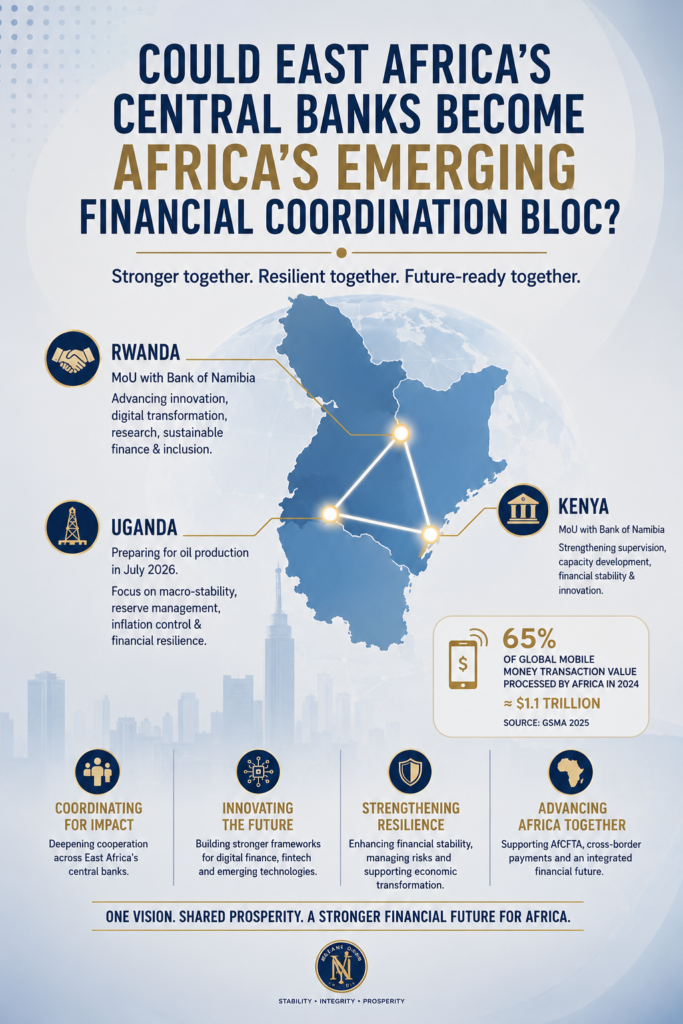
A key milestone emerged in Kigali with the signing of a Memorandum of Understanding between the Bank of Namibia and the National Bank of Rwanda, aimed at deepening cooperation in financial innovation, economic research, digital transformation, sustainable finance, and financial inclusion. Beyond its formal structure, the agreement reflects a broader shift toward institutional alignment in financial governance across African economies.
Africa’s financial transformation is increasingly being driven by scale and speed. According to the GSMA 2025 State of the Industry Report, the continent accounted for approximately 65% of global mobile money transaction value in 2024, processing nearly $1.1 trillion.
This positions Africa at the centre of global mobile money innovation, but it also exposes structural weaknesses in regulatory coordination.
Central banks now face a dual mandate, enabling innovation while managing systemic risks. These include rising cyber fraud threats, fragmented regulatory environments, digital exclusion gaps, and cross-border financial vulnerabilities intensified by borderless digital transactions. The expansion of fintech platforms and emerging digital currency experiments further complicates traditional supervisory models.
Taken together, these pressures are accelerating a quiet but important convergence in regulatory thinking across East Africa.
In Kampala, discussions with Governor Michael Atingi-Ego and Deputy Governor Augustus Nuwagaba focused on Uganda’s preparations for commercial oil production expected in July 2026.
Rather than a sector-specific issue, the discussions reflected broader concerns about macroeconomic stability during resource transitions, particularly reserve management, inflation control, exchange rate volatility, and fiscal-monetary coordination.
Uganda’s projected oil revenues of approximately UGX 2.2 trillion in the 2026/27 financial year introduce both opportunity and structural risk. Historical experience from resource-dependent economies highlights persistent challenges, including commodity-driven volatility, fiscal discipline pressures, rising debt exposure, and weakened economic diversification pathways.
This makes Uganda’s transition a live case study for African central banks increasingly focused on cross-country learning in managing resource-led economic shifts.
In Nairobi, engagements with Governor Kamau Thugge and the Central Bank of Kenya built upon earlier institutional collaborations, including discussions initiated during the 2025 Alliance for Financial Inclusion Global Policy Forum hosted by the Bank of Namibia.
The Nairobi meetings concluded with another Memorandum of Understanding aimed at strengthening cooperation in banking supervision, institutional capacity development, financial stability frameworks, and financial innovation.
More importantly, these engagements reflect a growing recognition that East Africa’s financial systems are becoming structurally interdependent, requiring more coordinated regulatory responses to technological and economic shocks.
As implementation of the African Continental Free Trade Area deepens, financial integration is becoming a functional necessity rather than a policy aspiration. Cross-border payments, trade settlement systems, and regional capital flows increasingly depend on regulatory harmonisation and institutional trust between central banks.
Collectively, these developments suggest that East Africa is not yet forming a formal “central bank bloc,” but is instead building something more fluid and strategic: an emerging coordination network for monetary governance.
Within this evolving architecture, central banks are expanding their roles beyond traditional monetary policy. They are increasingly shaping digital financial infrastructure, guiding innovation ecosystems, and acting as stabilising anchors in an era of rapid technological and economic transition.
If this trajectory continues, East Africa’s central banks may become one of the continent’s most influential centres of financial coordination, not through formal integration, but through steadily deepening institutional alignment that strengthens Africa’s monetary resilience and global economic positioning.