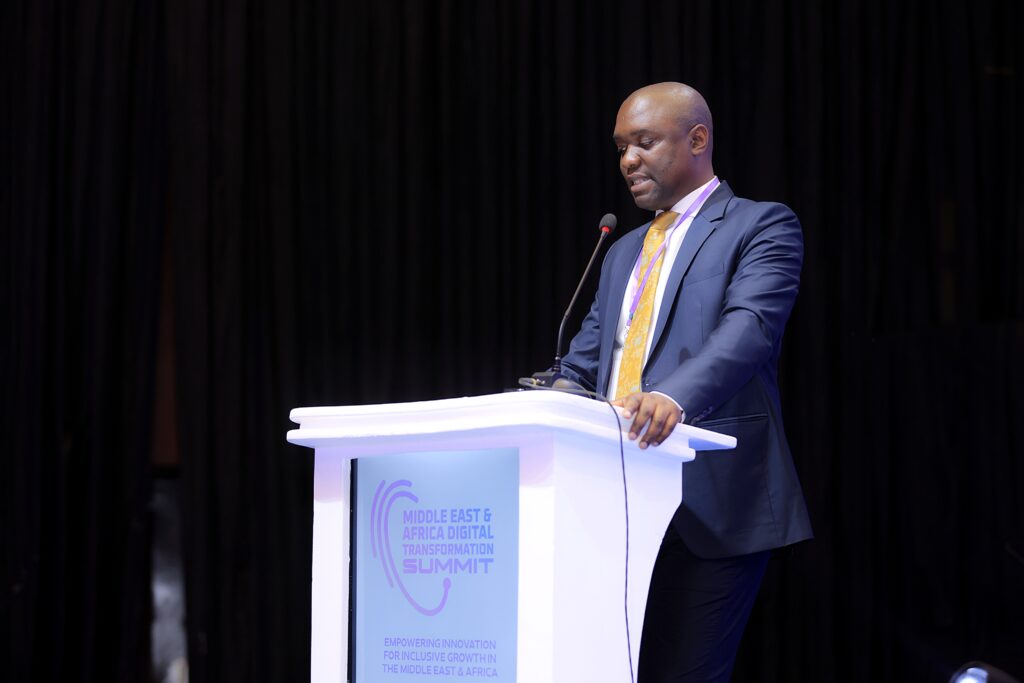
Uganda’s digital future isn’t just a vision; it’s actively being built, and MTN Uganda stands at the forefront of this transformation. At the recent Middle East and Africa Digital Transformation Summit held at the Kampala Serena Hotel, Ibrahim Senyonga, MTN Uganda’s General Manager for Enterprise Business, articulated a profound shift in focus.
“Connectivity is no longer a finish line; it is merely the runway,” he declared, adding, “Our task is to build secure, scalable, and intelligent solutions that let Uganda’s enterprises, public institutions and citizens take off in the digital economy.”
This statement underscores MTN’s strategic evolution from a traditional telecommunications provider (Telco) to a comprehensive technology company (TechCo), committed to driving Uganda’s digital leap.
Partnerships Driving National Digital Ambition
MTN’s participation in the summit was a continuation of its deepening collaboration with the Ugandan government.
Just weeks prior, in May, MTN co-hosted a high-level Government ICT Round Table with the Ministry of ICT and National Guidance.
This crucial gathering united key players from government and the private sector, resulting in a clear, shared roadmap.
This plan aligns MTN’s efforts directly with Uganda’s Vision 2040 and the national Digital Transformation Roadmap, focusing on modernising service delivery, expanding broadband access, and developing essential digital public infrastructure to empower both government and citizens.
Ambition 2025: A Deliberate TechCo Transition
MTN’s Ambition 2025 strategy is far more than a simple rebrand; it’s a deliberate, well-resourced transition.
The company has reorganized itself around five core solution pillars which include: Cloud and Colocation, IoT and Big Data, Cybersecurity, Unified Communications, and Platform Services.
These, Senyonga said, aren’t abstract concepts; they’re direct responses to the real-world demands of the Ugandan market.
He noted that Ugandan SMEs need fast, affordable, and secure virtual servers. Government MDAs require real-time platforms for citizen engagement and service delivery, while entrepreneurs demand smart, scalable solutions built for a mobile-first world.
As Senyonga emphasised, “Everything we build must lift productivity and lower barriers. That is how technology creates shared prosperity. When a farmer in Masindi can query real-time crop prices on a low-cost handset, or when a start-up in Jinja deploys machine-learning models without importing servers.” This highlights the practical aspect of transformation, where digital inclusion is a fundamental strategy for economic growth.
Next-Generation Connectivity: 5.5G Readiness
MTN Uganda’s commitment to innovation was vividly demonstrated on June 11, 2025, when it conducted East Africa’s first 5.5G (5G-Advanced) showcase at its Kampala headquarters.
This trial, delivering unprecedented speeds and ultra-low latency, positioned Uganda at the forefront of next-generation connectivity. The demonstration wasn’t just about speed; it was a clear display of MTN’s engineering readiness.
The company’s core network has been modernised, its fiber backbone upgraded to handle 400 Gbps, and its architecture redesigned to be cloud-native. When commercial licenses for 5.5G are granted, MTN will be ready for market almost immediately.
As part of its infrastructure upgrade, MTN Uganda also launched its shortest and fastest fiber route in May. This new link boosts network speed and introduces vital redundancy, ensuring seamless connectivity for businesses, government, and future-ready technologies like 5.5G.
Ensuring Inclusive Digital Access
Crucially, MTN’s extensive infrastructure development centers on people. Through a combination of device financing models, strategic rural connectivity investments, youth innovation hubs, and targeted digital literacy programs via the MTN Foundation, the company is ensuring more Ugandans come online and can benefit from the digital economy.
This people-first approach was evident throughout the summit, especially during the Africa Youth Innovation Challenge.
Students from across the continent showcased groundbreaking health-tech, agri-tech, and fintech innovations, many powered by platforms and connectivity provided by MTN.
“Our network is becoming a canvas for local ingenuity,” Senyonga noted. “We are not just enabling services; we are co-creating solutions,” he added.
Uganda’s Digital Transformation Roadmap envisions a future where digital tools drive economic productivity, enhance efficiency in government, and foster inclusion across all sectors.
With over US$300 million committed to network expansion and technology upgrades between 2020 and 2025, MTN is clearly aligning its substantial investments to meet these national development goals.
Strategic Collaboration for the Win
As Senyonga concluded, “Building the digital state requires spectrum policy, data protection laws, last-mile power, and affordable devices, none of which any single actor controls. Uganda’s digital decade is already under construction, and MTN is on-site for the long haul.”