
Part 1: The Institutions Shaping Uganda’s Industrial Future
Uganda’s industrial ambition is no longer rhetorical. As the nation transitions into the National Development Plan IV (NDPIV) cycle, the vision of a transformed society is crystallising.
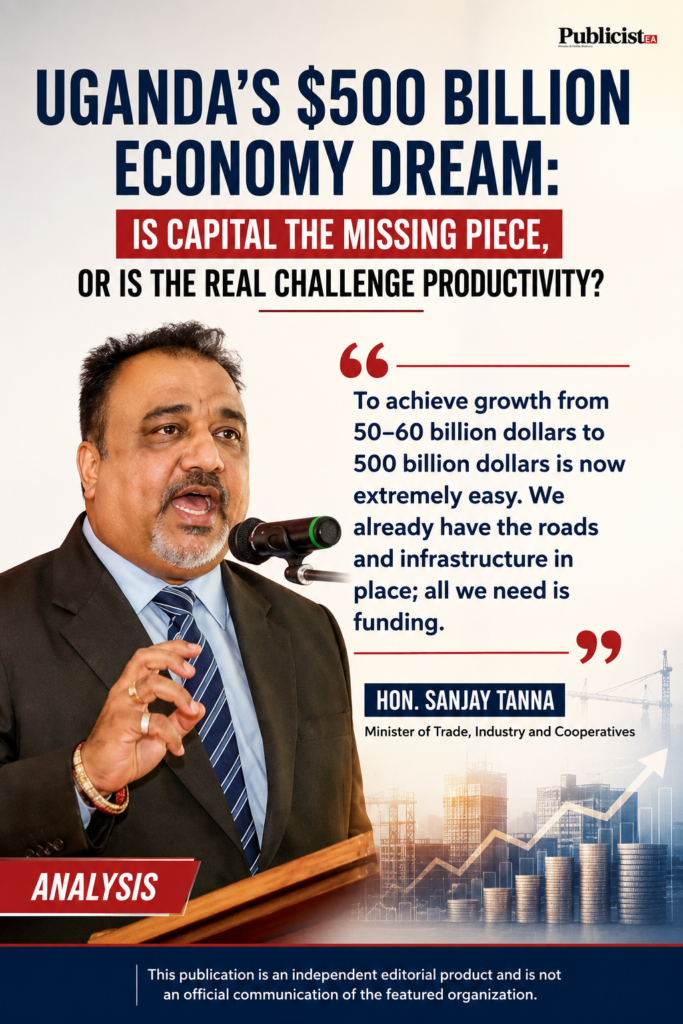
Agro-processing zones are expanding, oil-linked infrastructure is accelerating, and the conversation has shifted toward the Tenfold Growth Strategy, a bold roadmap by President Yoweri Kaguta Museveni aimed at expanding Uganda’s GDP from USD50 billion to USD500 billion by 2040.
The language of value addition has moved from conference halls into the core of Vision 2040. But industrial transformation does not run on ambition alone. It runs on structured capital. And structured capital is not accidental; it is institutional.
The real question now is no longer whether Uganda wants to industrialise, but which institutions are shaping the financial architecture to make it happen.
It is imperative to note that development finance in Uganda is not confined to one institution. It is influenced by a network of actors, including the Uganda Development Bank (UDB), led by Dr. Patricia Ojangole the Trade and Development Bank Group (TDB), led by Group President H.E Admassu Tadesse, the African Development Bank (AfDB), led by Dr. Sidi Ould Tah, and the International Finance Corporation (IFC), led by Makhtar Diop as Managing Director.
Alongside these are bilateral partners like the China Exim Bank and climate finance vehicles. Together, they define whether Uganda’s industrial dream becomes a structured reality or remains policy rhetoric.
President Museveni has consistently framed industrialisation and value addition as central pillars of Uganda’s economic transformation. His Tenfold Growth Strategy identifies four key anchors: Agro-industrialisation, Tourism, Mineral Development (including Oil and Gas), and Science, Technology, and Innovation (STI). The President has often emphasised that exporting raw materials is equivalent to exporting jobs and that wealth is created through production rather than trade alone.
Industrialisation is, therefore, not simply a private sector aspiration; it is a state doctrine. When political leadership signals industrial transformation as a national priority, as seen in the NDPIV focus on sustainable industrialisation, the responsibility shifts to financial institutions to design capital that matches the ambition.
Modern DFIs Should Go Beyond Traditional Lending
Globally, and within the context of Vision 2040, development finance institutions (DFIs) have evolved. They are no longer merely providers of capital; they are sector builders, risk absorbers, and policy translators. Hence, modern DFIs must design ecosystems that:
Crowd in private capital to meet the massive investment requirements of the Tenfold Growth Strategy.
De-risk emerging industries, particularly in the mineral-led and high-tech sectors.
Align financing instruments to the national strategy to ensure that “patient capital” is available for long-term projects.
This is because Industrialisation requires financing horizons that stretch beyond short-term commercial cycles. It demands grace periods aligned to production realities and risk-sharing frameworks. This is development finance territory, which is the bridge between the “now” and the Uganda of 2040.
The Convergence Moment: NDPIV and Regional Competitiveness
Uganda is approaching a convergence moment. Oil revenues are nearing operational reality. Agro-industrialisation is positioned as a national priority to drive rural prosperity. Export diversification under the African Continental Free Trade Area (AfCFTA) has become urgent. SME scaling is politically central to job creation and social stability.
In such moments, DFIs become strategic partners in national execution. However, NDPIV emphasises that strategy requires coordination. Across Africa, countries that have advanced their industrial bases share recognisable patterns:
Strong National Development Banks anchored in clear sector priorities.
Multilateral Alignment, where global support mirrors domestic industrial policy.
Blended Finance is used to de-risk new, high-potential sectors.
Structural Questions for a Decisive Decade
Uganda has elements of this architecture in place, yet as we strive for the tenfold growth target, the cohesion of the system remains a subject of inquiry. Are institutions reinforcing one another’s mandates, or duplicating effort? Are capital instruments aligned to long-term industrial cycles, or constrained by short-term prudential pressures? These are structural questions, not institutional criticisms, and they merit serious national dialogue.
Thus, development finance may appear technical, but its consequences are deeply practical. It determines which sectors scale, which SMEs survive, and which jobs are created for the millions of youths envisioned in Vision 2040. As Uganda positions itself for industrial takeoff, the strength and coordination of its development finance architecture will matter as much as the policy ambition itself.
In Part 2 of this series, we examine how different development finance institutions operating in and around Uganda are structuring capital, what emerging models reveal about the future of industrial financing, and whether Uganda’s ecosystem is evolving fast enough to match the Tenfold Growth Strategy.