
As Artificial Intelligence (AI) matures from a digital novelty into a foundational pillar of the global economy, the National Social Security Fund (NSSF) has launched a high-level dialogue on the future of work.
The 16th edition of the NSSF Career Expo, themed ‘Man or Machine: Exploring AI’s Impact on Careers’, officially opened at Makerere University this week, signalling a strategic shift in how Uganda prepares its youth for an automated world. The event attracted academicians, government officials, officials from the Uganda Communication Commission (UCC), Bankers, Federation of Uganda Employers, Mastercard, Absa Bank, AI experts, students, and other stakeholders.
The three-day event, presided over by Hon. Dr. Monica Musenero Masanza, the Minister for Science, Technology, and Innovation, highlighted a critical transition: the shift of value creation from traditional sectors into the Ugandan Digital Economy.
The Pivot to Uganda’s Digital Economy
The central theme of the Expo was the realisation that Uganda’s economic future is no longer tied solely to physical labour or brick-and-mortar trade. Digital transformation is now a primary driver of the National Development Plan IV (NDPIV), with AI acting as the engine.
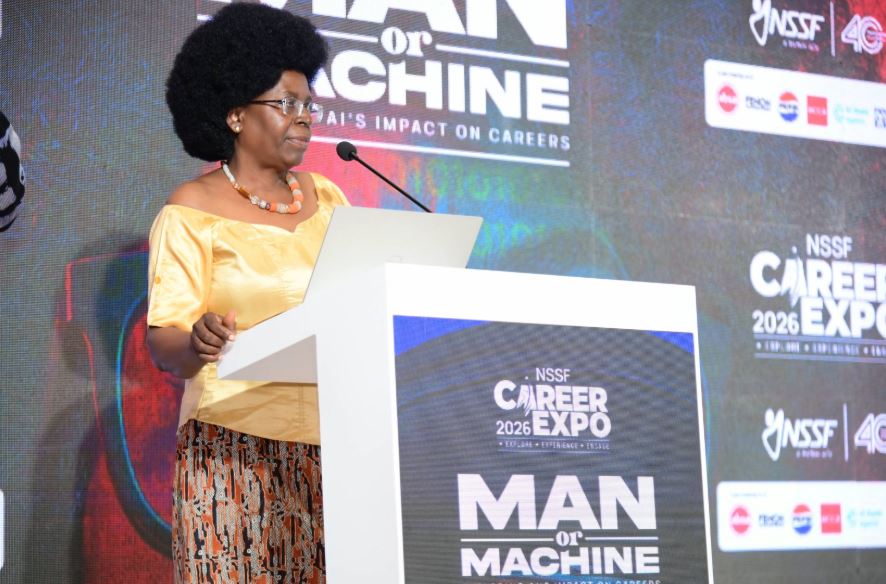
In her keynote address, Dr. Musenero emphasised that the digital economy is not just about getting information faster, but about the structural movement of wealth.
“Too often we look at technology in isolation. For example, I may admire a nice car simply because it is comfortable and attractive. But if the economy around me is not functioning well, very soon it becomes clear that I cannot continue driving that nice fuel-powered car, because there is too much money lost at the end of the month,” Dr. Musenero said.
“So the real goal of technological change is to accelerate productivity, expand market access, foster innovation, and improve service delivery. Industrial revolutions are not simply about gadgets. They are about increasing the speed and scale at which value is created. And that brings me to a very important point: digital transformation. AI shifts value creation from traditional parts of the economy into the digital economy. That is the key shift!”

The Minister noted that AI is not only about getting information faster or submitting a report more quickly, but also about creating more value.
She highlighted that it is the responsibility of leaders in science, technology, and innovation to guide the nation, especially the young people, on how to constructively use AI, because it is part of the digital transformation.
“This process started long ago, and with each stage, new technologies are added, improved, and embedded into everyday life. Every industrial revolution starts small, grows, takes over, and eventually becomes unavoidable,” the Minister observed.
Dr. Musenero noted that in Uganda, this is manifesting through:
Platform Economy Growth: The rise of home-grown apps in logistics, fintech, and e-commerce that rely on AI for predictive analytics.
The Gig Economy Transition: Thousands of Ugandan youth are now exporting digital services from coding to AI data labelling, to global markets from hubs in Namanve, Kampala and Entebbe.
Infrastructure as an Asset: With the government’s investment in the National Backbone Infrastructure (NBI), AI tools are becoming accessible to rural entrepreneurs, bridging the urban-rural productivity gap.
“Digital transformation, including AI, shifts value creation from traditional parts of the economy into the digital economy. That is the key shift!” Dr. Musenero noted, adding, “Industrial revolutions are about increasing the speed and scale at which value is created.”
Value Creation vs. Digital Idleness
Dr. Musenero also challenged students to use the time saved by AI for high-impact innovation rather than passive consumption. She argued that in a digital economy, time is the primary currency.
“If AI helps you finish your assignment quickly, what do you do with the rest of your time? Social media? TikTok?” she asked. “The purpose of saving time is not idleness. It is to create more value.”
NSSF Investing in the Digital Workforce
For the National Social Security Fund (NSSF), the Career Expo is a long-term investment in the financial health of Uganda’s digital natives. Gerald Paul Kasaato, Deputy Managing Director of NSSF, who revealed that the Fund is to hold such expos in 16 universities and tertiary institutions across the country, highlighted the tangible impact the Expo has had on student savings.

“We believe we have an obligation to prepare young Ugandans for the realities of the workplace. Every year, over 25,000 students graduate from universities and tertiary institutions across the country, yet the world of work is evolving every single day. We believe the Expo allows students to better understand these realities and prepare themselves for meaningful careers.”
He revealed that ever since NSSF kicked off the annual career Expo, the Fund has so far registered over 120,000 students, who have since saved Shs235Bn with the Fund.
“We see these students not only as young people preparing for work, but also as our future members,” Kasaato noted.
Kasaato, who also awarded internship opportunities to some of the students who participated in the expo, observed that as the digital economy grows, these early savings will form the capital base for Uganda’s future tech entrepreneurs.
Critical Thinking in the Age of AI
Representing Vice Chancellor Prof. Barnabas Nawangwe, Prof. Moses Musinguzi, Principal of CEDAT, addressed the integration of AI in Ugandan classrooms. He stressed that while AI can generate answers in seconds, the university must protect the ‘human advantage’, which is critical thinking and problem-solving.
“The consensus worldwide is that AI cannot simply be rejected. Instead, the question we must ask is how we can use AI in ways that are responsible, effective, and productive. As lecturers and teachers, we often give assignments to students. Today, a student can generate an answer using AI in less than a minute. But that is not ultimately what we want. Our goal is to impart knowledge, critical thinking, and practical skills to our students,” Prof. Musinguzi stated.
“Therefore, we are now exploring better ways of integrating AI into education while still maintaining our core objective: producing graduates who possess strong knowledge, meaningful skills, and the capacity to contribute to society,” he added.
He observed that the 2026 Career Expo converged on three pillars for navigating the digital economy:
Productive Output: Using AI to multiply results, not to replace effort.
Digital Export: Leveraging remote work tools to participate in global digital value chains.
Financial Resilience: Starting the journey of social security and saving early to hedge against the rapid shifts in the labour market.
As the Expo continues, the message remains clear: the machine is a tool, but the Digital Economy is the arena where Uganda’s youth must lead.