
The Ministry of Finance, Planning and Economic Development (MoFPED) is embarking on a new phase of its ambitious plan to transform the national economy. This was revealed today by Mr Kaggwa Moses, the Director of Economic Affairs, during a presser at the Uganda Media Centre, where he unveiled the tax policy-making process for the Financial Year 2026/27, emphasising a commitment to transparency, stakeholder engagement, and a sustainable tax system that will finance the nation’s 10-fold growth strategy.
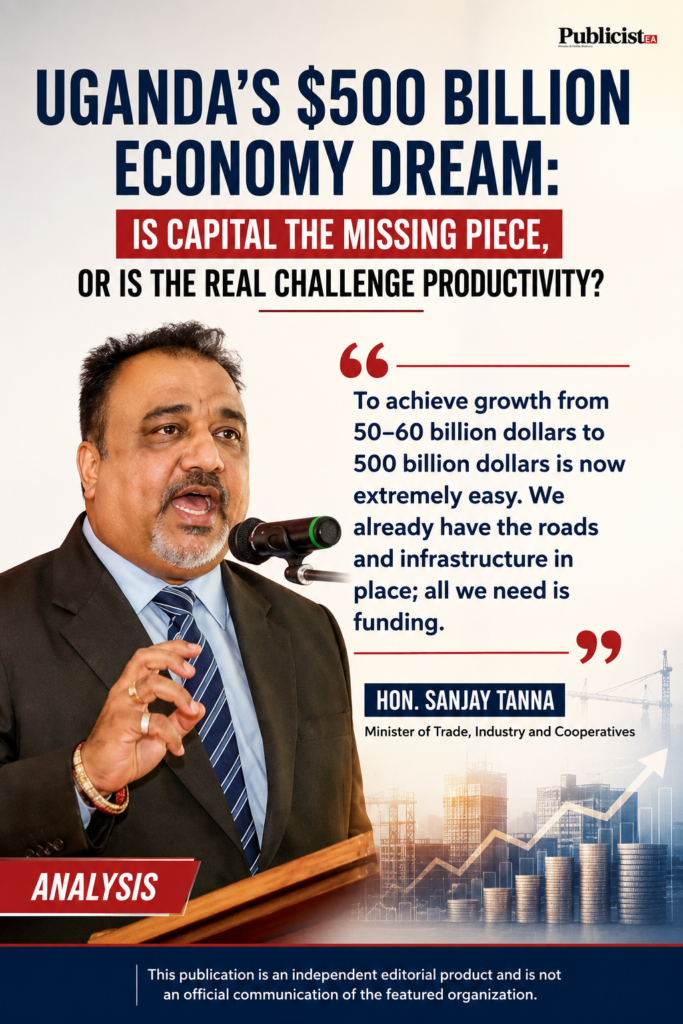
The strategy, a bold blueprint for rapidly expanding Uganda’s economy from its current US$50 billion to US$500 billion by 2040, is the driving force behind the government’s tax reforms.
To achieve this, Mr Kaggwa said, “The Ministry aims to increase the country’s revenue collection from the current 14% of GDP to 30% by 2040,” adding that, “This is a formidable challenge that requires a predictable, equitable, and sustainable approach to revenue mobilisation.”
Modern, Inclusive Tax Framework
Mr Kaggwa highlighted a streamlined tax policy process designed to be more inclusive and effective. He revealed that the Ministry is actively seeking proposals and feedback from all stakeholders, including government agencies, the private sector, civil society, and the general public, to ensure that tax policies are fair and supportive of economic growth.
This consultative approach, he noted, is a deliberate effort to avoid the “fragmented approaches” of the past that led to unintended consequences and discouraged compliance.
The Ministry outlined six key principles that guide tax policy formulation:
Neutrality, equity, and fairness: Ensuring taxpayers contribute based on their ability, without discrimination.
Simplicity, certainty, and clarity: Making tax laws easy to understand and comply with.
Low compliance cost: Minimising the direct and indirect costs for businesses and individuals to pay their taxes.
Low cost of tax administration: Ensuring an efficient and cost-effective tax collection process.
Flexibility: Allowing the tax system to adapt to a changing economic landscape.
Sustainability: Ensuring tax policies support long-term economic growth and development.
Tangible Results and a Way Forward
Uganda’s commitment to these reforms is already yielding positive results. According to Kaggwa, in the 2024/25 financial year, the country’s revenue effort increased to 14.27% of GDP, and overall revenue collections registered a surplus of Shs 21 billion. Well-targeted tax policies and administrative measures alone contributed over Shs1.4 trillion in revenue.
This progress, he observed, is essential for financing the government’s key priority areas, which include the Agro-Industrialisation, Tourism, Mineral-Based Industrial Development, and Science, Technology, and Innovation (ATMS) sectors, as well as critical enablers such as infrastructure development and human capital development.
Kaggwa emphasised that tax policy is being deliberately designed to promote these areas, support SMEs, and encourage value addition, thereby ensuring that the private sector continues to thrive as the engine of Uganda’s socioeconomic transformation.