On a mining site in Buhweju, western Uganda, a small-scale miner sifts through soil with basic tools, hoping that the next pan will yield enough gold to cover rising food prices, school fees, and transport costs. The work is steady but uncertain. Some days are rewarding. Many are not.
Yet far above this daily struggle, Uganda’s gold economy is breaking records. Uganda’s external sector is undergoing a transformation that is difficult to ignore, driven by one commodity that has rapidly moved from the margins to the centre of the country’s export economy, gold.
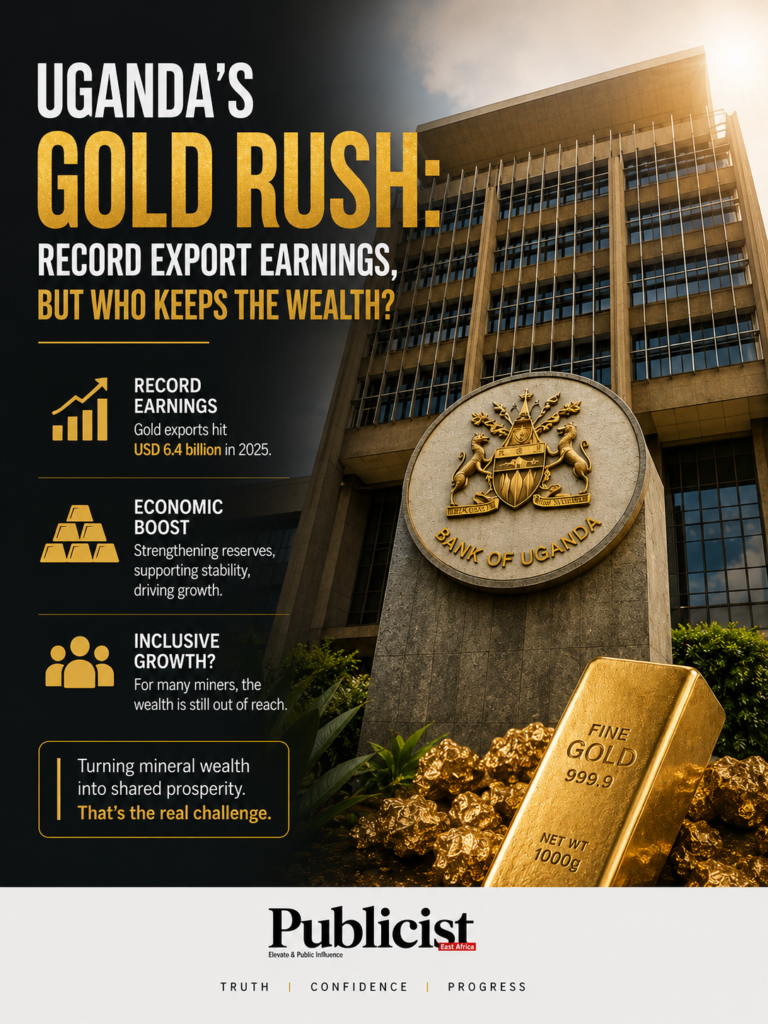
The scale of this shift is reflected in the numbers. Uganda’s merchandise export earnings reached a ten-year high of approximately USD 13.4 billion in 2025, up sharply from about USD 2.67 billion a decade earlier. Gold accounted for the largest share of this growth, generating an estimated USD 6.4 billion, ahead of coffee, which brought in about USD 2.46 billion.
This performance helped narrow Uganda’s merchandise trade deficit by roughly 24%, strengthening the country’s external position and easing pressure on foreign exchange markets. But beyond the headline figures lies a deeper structural shift, one that is reshaping how Uganda earns foreign exchange, how it integrates into global markets, and how the benefits of that growth are distributed.
The rise has not been sudden. A decade ago, gold played a marginal role in Uganda’s export profile. By 2014, it contributed less than 1% of export earnings. By 2024, however, it had become one of the country’s dominant export categories, at times accounting for nearly half of non-coffee export receipts. This rapid expansion reflects both policy decisions and changing global market dynamics.
A key turning point came in 2017, when government policy encouraged value addition in minerals by supporting refining activity and removing barriers that had previously limited the import and processing of unrefined gold. This helped attract private investment into refining and trading infrastructure, positioning Uganda as a regional hub in the gold value chain. Today, the country hosts several gold refineries and has become a key export point for refined bullion destined mainly for markets such as the United Arab Emirates.
This expansion has also been reinforced by policy coordination across government. In recent public statements, the Ministry of Finance and Economic Development noted that the sharp rise in gold export earnings has strengthened Uganda’s foreign exchange position, improved reserve accumulation, and supported macroeconomic stability at a time of global uncertainty. The Ministry also highlighted gold as a major driver of improvements in external sector performance, alongside continued growth in traditional exports such as coffee.
Uganda’s gold boom is also unfolding in a global environment marked by heightened geopolitical tensions, inflation concerns, and sustained demand from central banks. These conditions have supported higher gold prices and increased global appetite for the asset as a store of value.
For the Bank of Uganda, this has had a stabilising effect. Strong gold export inflows have improved foreign exchange liquidity, supported international reserves, and eased pressure on the Ugandan shilling during periods of global volatility. In some months, gold exports have accounted for a significant share of total export earnings, highlighting how central the sector has become to external stability.
But behind these macroeconomic gains, the reality on the ground is far more uneven.
A large share of Uganda’s gold is produced by artisanal and small-scale miners, many of whom operate informally and at the lowest end of the value chain. For them, the gold boom does not always translate into rising incomes. Instead, they face fluctuating prices, limited access to capital, and dependence on middlemen who often capture a significant share of the value.
As one miners’ cooperative leader in western Uganda put it, the challenge is not only production, but survival within the system. Without access to financing or modern equipment, many miners remain stuck in low-output operations despite working in an industry that is generating billions in export earnings.
At the centre of Uganda’s gold boom is a policy environment that has encouraged relatively open capital flows into the sector. This openness has helped attract traders, refiners, and investors into the country, integrating Uganda more deeply into global commodity and financial networks. It has supported rapid scaling of exports and improved access to foreign exchange.
But capital openness also carries risk. In commodity-driven sectors like gold, capital flows are highly sensitive to global price cycles and investor sentiment. When global uncertainty rises, gold prices tend to increase and inflows strengthen. When conditions stabilize, those flows can soften or shift quickly. This makes export earnings closely tied to external financial conditions that Uganda does not control.
The most important question, however, is not only about growth, but about value retention.
Despite billions in export earnings, domestic fiscal capture from the gold sector remains relatively limited. Official estimates suggest that tax revenues from gold exports are modest compared to the scale of trade, reflecting both structural and enforcement challenges. Uganda applies royalties on domestically mined gold and export-related charges on refined gold, but compliance gaps, informal trade networks, and valuation challenges continue to affect revenue collection.
Smuggling remains a significant concern. Independent estimates across the region suggest that large volumes of artisanal and small-scale gold production in Africa move through informal or undeclared channels each year. Uganda’s proximity to gold-producing regions in eastern Democratic Republic of Congo further complicates traceability and enforcement.
At the same time, Uganda’s investment framework allows foreign investors significant flexibility in profit repatriation, which supports capital inflows but limits the extent to which earnings are retained domestically. This trade-off sits at the heart of Uganda’s current growth model: attracting investment and liquidity while trying to build long-term domestic value.
The Bank of Uganda has increasingly engaged with the sector as a stabilising force in the foreign exchange market. By strengthening oversight and participating in the gold value chain through official channels, the central bank aims to improve reserve accumulation, formalise parts of the sector, and reduce exposure to illicit trade flows. These efforts reflect a broader recognition of gold’s importance to macroeconomic stability.
Yet the structural risk remains unchanged: Uganda’s export boom is heavily concentrated in a single commodity whose price is set entirely outside the country.
Gold occupies a unique position in global markets. It is both a financial asset and a commodity, meaning its price responds not only to supply and demand but also to investor fear, interest rates, and geopolitical uncertainty. This makes Uganda’s export earnings partly dependent on global cycles that are inherently unpredictable.
When uncertainty rises, gold prices tend to rise, benefiting exporters. When global conditions stabilise and investors shift toward risk assets, prices can soften, reducing export earnings without warning. This creates a cycle of boom and moderation that is difficult to manage through domestic policy alone.
The result is a paradox: Uganda is earning more foreign exchange than ever from gold, but it is also becoming more exposed to external volatility.
For policymakers, the challenge is therefore not simply to support growth, but to convert it into durable national wealth. That requires stronger enforcement against illicit flows, improved formalisation of artisanal mining, more effective taxation systems, and greater domestic value capture through refining and related industries.
The gap between rising export earnings and limited domestic revenue capture is where Uganda’s central economic challenge now sits.
Uganda’s gold boom is real, significant, and strategically important. But its long-term success will not be judged by export figures alone. It will be judged by how much of that value remains within the country, how widely its benefits are distributed, and how effectively it is shielded from global volatility.
Uganda is becoming more deeply integrated into global markets. In that integration lies opportunity, but also unfinished business.