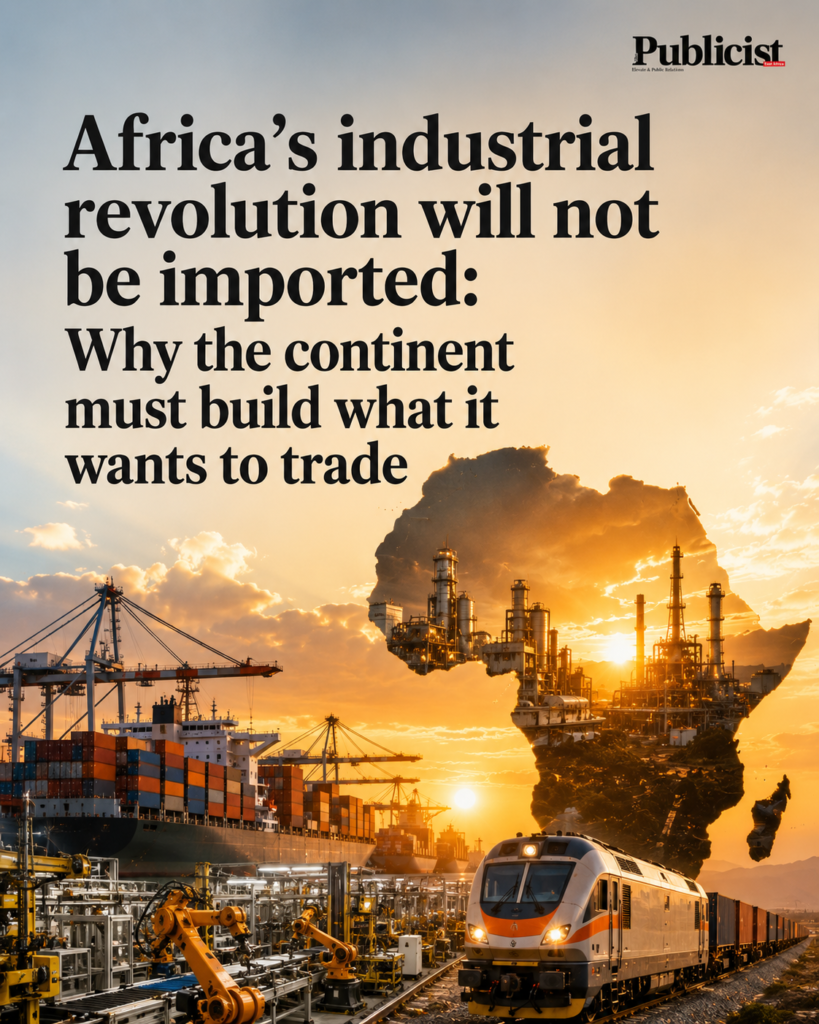
East Africa is industrialising. Governments across Uganda, Kenya, Tanzania and Rwanda are accelerating agro-processing, expanding manufacturing zones, investing in power generation and pushing value addition.
But beneath the policy speeches and factory announcements lies a deeper question:
What materials will define the quality, durability and competitiveness of this industrial shift?
Because industrialisation is not just about building more factories.
It is about what those factories are made of, and what they produce.
The real transformation begins with materials science.
The Missing Layer in East Africa’s Industrial Story
For decades, the region’s development narrative has focused on:
Raw material exports
SME financing
Infrastructure expansion
Trade corridors
What receives far less attention, however, is the materials layer; the advanced polymers, construction compounds, coatings, packaging systems, adhesives, insulation solutions and water technologies that determine industrial standards.
Without advanced materials:
Agro-processing loses shelf life.
Construction deteriorates faster in harsh climates.
Manufacturing struggles to meet export-grade quality.
Waste systems fail to close the loop.
But what is important is that materials science is not a supporting detail. It is the foundation.
Where Dow Enters the Conversation
This is where Dow becomes strategically relevant to East Africa’s next phase.
Globally recognised for applying materials science to real-world challenges, Dow operates at the intersection of:
Sustainable infrastructure
Advanced manufacturing
Circular packaging
Climate-resilient materials
Industrial efficiency
Its investment in Mr. Green Africa, which transforms plastic waste into high-quality, traceable raw materials, signals something important:
Circularity is not an environmental afterthought.
It is an industrial opportunity.
For East Africa, where plastic waste and import dependency remain structural challenges, such models represent scalable value chain innovation.
The Multiplier Effect of Advanced Manufacturing
Industrial strategy is increasingly measured not just by output, but by ecosystem impact.
Advanced manufacturing frameworks demonstrate that a single high-technology job can stimulate multiple additional jobs across supply chains, logistics, engineering and services.
In regions pursuing structural transformation, that multiplier effect matters.
If East Africa wants to transition from being a commodity exporter to a competitive manufacturing hub, materials innovation must be embedded early, not retrofitted later.
Leadership and Regional Engagement
Under the leadership of Mumbi Keega, Dow’s engagement in Eastern Africa has increasingly intersected with sustainability, public affairs and workforce transformation. That intersection is critical because;
Industrialisation without skills development creates dependency.
Industrialisation without sustainability creates fragility.
Industrialisation without science creates mediocrity.
It’s imperative to appreciate that the future requires all three.
Through initiatives that support youth engagement, STEM exposure and sustainable business dialogue, Dow’s regional footprint signals a willingness to think beyond product supply and toward ecosystem participation. But the opportunity ahead is larger.
Aligning Materials Science with East Africa’s Industrial Agenda
East Africa’s policy frameworks are increasingly prioritising the following:
Agro-industrialisation
Climate resilience
Green growth
Circular economy models
Youth employment
Hence, the science community and global materials leaders must now align with these priorities in a more structured way, which is the mandate Dow is executing.
That means:
Engaging policymakers early
Supporting standards development
Contributing to industrial roadmaps
Building local technical capacity
Partnering with industry and academia
The companies that help shape this phase will not just supply products but also shape industrial standards for decades.
A Strategic Moment
East Africa is entering a decisive industrial decade in which energy capacity is expanding, manufacturing ambitions are rising, and regional trade integration is deepening.
The question, thus, is no longer whether the region will industrialise, but rather;
Who will shape the science that underpins it?
An Invitation to Engage
At Publicist East Africa, we believe materials science must move from the margins of policy conversations to the centre of industrial strategy.
We invite Dow’s Eastern Africa leadership to engage in a deeper dialogue on:
Embedding materials innovation into agro-processing value chains
Scaling circular manufacturing models
Strengthening climate-resilient construction standards
Aligning science capability with regional policy frameworks
The industrial leap has begun.
The science must lead.
About Publicist East Africa
Publicist East Africa is a regional business and brand leadership platform exploring the intersection of industry, policy, innovation and socio-economic transformation across East Africa.
Reach Us: info@publicsafrica.com to share your thoughts.