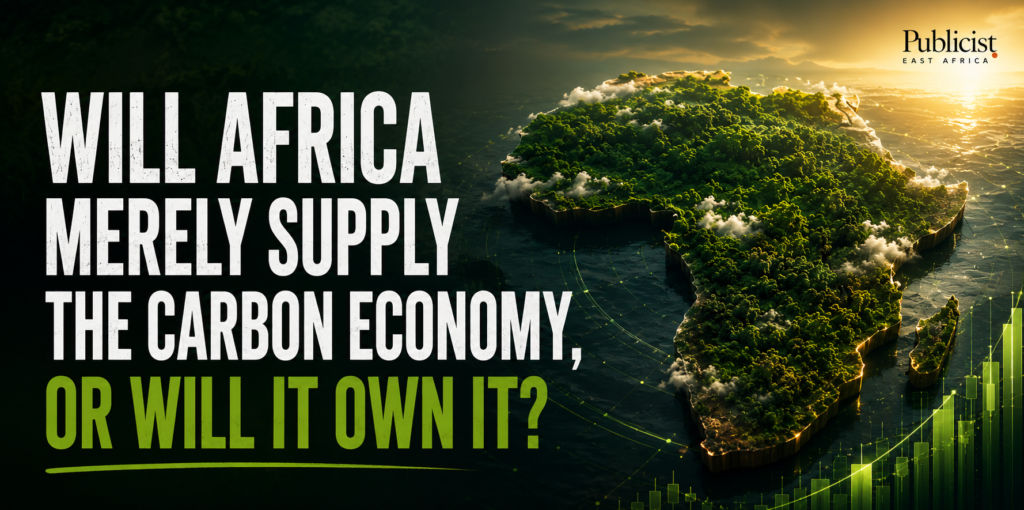
Africa sits on one of the world’s largest stores of natural wealth. Its forests absorb billions of tonnes of carbon, its wetlands regulate ecosystems, its mangroves protect coastlines and its vast landscapes hold enormous potential for nature-based climate solutions. Yet as carbon becomes one of the world’s fastest-growing financial assets, Africa remains largely a supplier of environmental value rather than an owner of the markets that determine its price.
That paradox lies at the heart of the continent’s emerging climate economy. Africa contributes less than four percent of global greenhouse gas emissions, yet it possesses some of the planet’s most valuable carbon sinks. The Congo Basin rainforest alone stores tens of billions of tonnes of carbon and is often described as the world’s second-largest tropical rainforest after the Amazon. Across the continent, forests, grasslands, peatlands, wetlands and agricultural landscapes provide enormous opportunities to generate carbon credits while supporting conservation and sustainable development.
Yet natural abundance alone does not translate into economic power. History offers Africa a familiar warning. The continent has repeatedly exported raw resources while others captured the highest-value stages of the value chain. Coffee is grown in Africa but global brands capture much of its value. Critical minerals essential for electric vehicles leave African mines only to return as expensive manufactured products. Cocoa producers earn a fraction of the profits generated by the global chocolate industry.
Carbon risks becoming the next chapter in that story. The voluntary and compliance carbon markets are expanding rapidly as governments strengthen climate policies and corporations pursue increasingly ambitious net-zero commitments. According to the World Bank, carbon pricing instruments now cover more than 28 percent of global greenhouse gas emissions, representing a market exceeding US$100 billion annually. Analysts expect that figure to grow significantly over the coming decades as climate regulation tightens across major economies.
For Africa, the opportunity is extraordinary. The African Carbon Markets Initiative estimates the continent could generate as many as 2.4 billion carbon credits annually by 2030, unlocking billions of dollars in climate finance while supporting more than 30 million jobs.
The resource is not the problem. Ownership is. Much of today’s carbon economy is controlled far from the forests and communities where carbon is actually stored. International project developers design many of the projects. Foreign verification firms certify them. Overseas registries issue the credits. International brokers facilitate transactions. Global exchanges determine pricing. Investment funds finance development, while multinational corporations become the largest buyers.
African communities often provide the asset. Others own the marketplace. That distinction matters because carbon is no longer simply an environmental concept. It has become financial infrastructure.
The real value in the carbon economy increasingly lies not only in generating credits but in controlling the institutions that transform natural capital into financial assets.
A standing forest has environmental value, but it becomes an economic asset only after measurement, reporting and verification (MRV), satellite monitoring, digital mapping, legal certification, registry issuance, insurance, financing and market trading. Every one of these stages creates additional economic value.
Who owns these systems ultimately captures the greatest share of the returns. This is where Africa’s strategic challenge lies.
Building a competitive carbon economy requires far more than protecting forests. It demands investment in digital environmental infrastructure, satellite observation systems, geospatial mapping, artificial intelligence for land monitoring, national carbon registries, verification agencies, carbon exchanges, climate finance institutions and regulatory frameworks that command international confidence.
Measurement, Reporting and Verification (MRV) systems, in particular, are becoming the backbone of modern carbon markets. Countries that own trusted MRV capabilities reduce dependence on expensive foreign certification while improving transparency and attracting greater investor confidence. Likewise, robust national carbon registries ensure that credits are transparently issued, tracked and retired, reducing risks such as double counting and increasing market credibility.
Several African countries are beginning to recognise this shift. Kenya has positioned itself as one of Africa’s leading carbon market hubs, supported by an active private sector, policy reforms and growing climate finance activity. Rwanda has invested heavily in positioning Kigali as a centre for sustainable finance and green investment. South Africa continues to develop carbon pricing mechanisms and institutional capacity that could support regional carbon trading. Through the African Carbon Markets Initiative (ACMI), governments, development finance institutions and private investors are also working to scale high-integrity carbon markets across the continent.
These are important beginnings. But the next phase requires something even more ambitious. Africa must stop viewing carbon simply as an environmental resource and start treating it as strategic economic infrastructure.
That means African universities training carbon scientists, environmental economists and climate financiers. It means African technology companies building digital MRV platforms and satellite analytics. It means African stock exchanges exploring carbon trading platforms. It means African banks developing climate finance products that help communities bring projects to market without relying entirely on foreign intermediaries. It also means harmonising regulations through regional institutions such as the African Union and the African Continental Free Trade Area (AfCFTA) so that carbon markets can operate across borders with consistent standards and greater scale.
The objective should not be to participate in the global carbon economy. The objective should be to shape it. Carbon has become one of the defining assets of the twenty-first century. Like data, artificial intelligence and critical minerals, it is creating entirely new markets whose value will depend as much on technology, finance and governance as on natural resources themselves.
Africa has already won the geography. It now needs to win the economics.
The future of the carbon economy will belong not simply to those who own the forests, but to those who own the registries, the verification systems, the exchanges, the investment platforms, the digital infrastructure and the financial institutions that determine how carbon is measured, priced and traded.
The continent’s greatest climate opportunity is therefore not producing more carbon credits. It is building the institutions that ensure Africa owns a far greater share of the carbon economy itself.