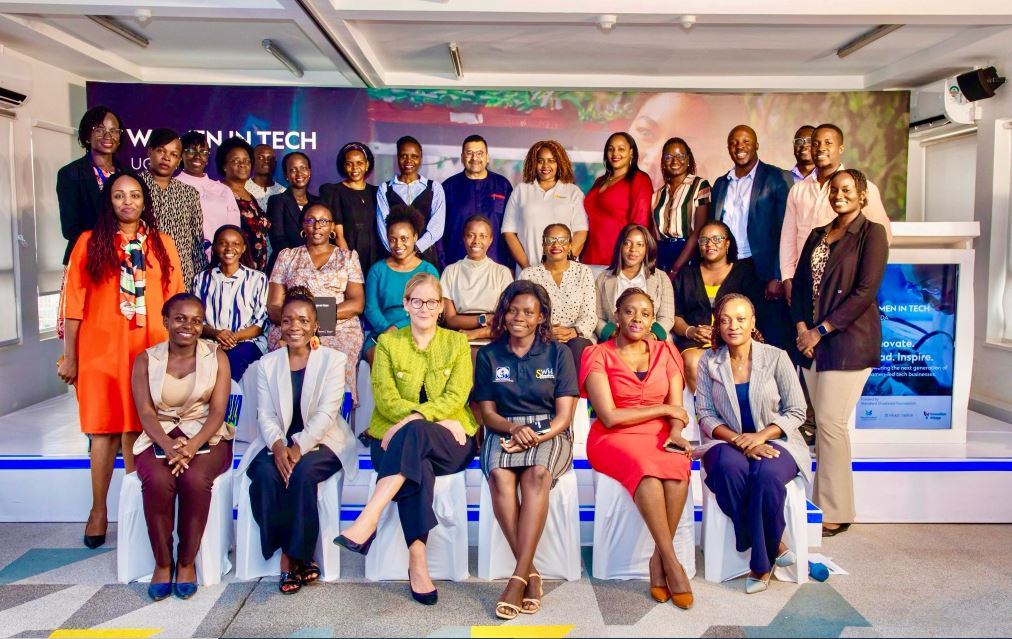
Standard Chartered Bank this week launched its first-ever Women in Tech (WiT) program in Uganda, a significant initiative that aims to empower women, boost digital inclusion, and drive socio-economic transformation.
According to Sanjay Rughani, the Stanchart CEO, this program, a part of the bank’s global Futuremakers initiative, intends to tackle inequality and promote economic inclusion by providing capital, mentorship, and support to women-led tech enterprises.
The initiative aligns directly with Uganda’s ambitious ten-fold growth strategy, which seeks to grow the nation’s economy from a GDP of about USD50 billion in 2023 to USD500 billion by 2040.
Fueling Uganda’s Growth Ambition
The WiT program is a powerful statement of commitment to Uganda’s future, particularly the Science, Technology, and Innovation pillars of the country’s ATMS (Agro-industrialisation, Tourism, Mineral Development, Science, Technology and Innovation) growth framework.
Rughani revealed that in partnership with Future Lab, an arm of The Innovation Village, Standard Chartered is investing USD540,000 (about Shs1.9 billion) over three years to support women’s entrepreneurship.
This investment, he noted, will provide 10 women-led tech enterprises with mentorship, and give five top finalists an equity-free grant of USD10,000 (about Shs35.6 million) each year.
This capital infusion, combined with targeted coaching in market validation, digital integration, and investment readiness, will equip these entrepreneurs to create jobs, develop breakthrough solutions, and inspire future generations of women leaders.
“This initiative is about building a movement. Together, we are not just creating opportunities, we are building a movement,” he said, adding, “A movement that is women-led, tech-driven, and destined to transform Uganda’s socio-economic landscape for generations to come.”
This vision, he said, positions the program not merely as a corporate social responsibility effort, but as a strategic investment in the country’s long-term prosperity.
Empowering Women, Transforming the Economy
By focusing on women in tech, the program directly addresses existing gender disparities in the business and technology sectors.
Kirsten Wilkinson, Chief Risk Officer and Regional Chief Credit Officer, AME, emphasised this, stating that the program “levels the scales, putting women at the forefront” and that “by empowering young women in Uganda, we put them at the heart of Africa’s emergence.”
This, according to Wilkinson, is crucial for Uganda’s economic development, as a significant portion of its population is women.
By providing women with the tools and resources to succeed in the digital economy, the program is fostering a more inclusive and dynamic entrepreneurial ecosystem.
The initiative also directly contributes to digital inclusion, a cornerstone of Uganda’s national development plans.
He explained that by supporting tech enterprises, the program promotes innovation and the creation of digital solutions that can be applied across various sectors of the economy.
The lessons shared by Mili Rughani, CEO of Craft Silicon Tanzania, further highlight the skills needed for success in the tech world. These include: hacking visibility, hunting for progress, and thinking like open source.
These principles, she noted, encourage a mindset of strategic networking, continuous improvement, and collaboration, which are essential for driving innovation and scaling businesses in the digital age.
This holistic approach ensures that the empowered women are not only equipped with capital but also with the crucial mindset and skill sets to navigate the challenges of entrepreneurship.