Every export-bound coffee bean grown in Uganda is set to carry a digital identity, traceable from the farm where it was harvested to the port where it is loaded onto a vessel. That is the ambition at the heart of a national coffee traceability system now being developed under Uganda’s 2025/26 economic reform agenda, and the implications stretch far beyond a simple technology upgrade.
The initiative, announced within the framework of Uganda’s broader export-led growth strategy, represents one of the most significant structural changes to the country’s agricultural export system in decades. It comes at a time when coffee remains Uganda’s largest agricultural export, generating an estimated USD 1.1–1.3 billion annually, with the country exporting between six and seven million 60-kilogram bags each year, placing it among Africa’s largest coffee exporters by volume. Behind those figures lies a sector that supports over 1.7 million smallholder farming households, anchoring rural livelihoods while driving foreign exchange earnings.
Speaking within the context of the government’s broader economic agenda, Permanent Secretary and Secretary to the Treasury Ramathan Ggoobi framed the reforms as part of a structural shift toward what he called full monetisation of production. “We must be producing for export. The eating here is a bonus, but we want dollars to come from coffee, from fruits and vegetables,” he said, signalling the government’s intention to reposition agriculture as a deliberate foreign exchange engine rather than a subsistence-driven system.
He further emphasised that digital infrastructure will be central to this transformation. “We are developing an online export system under the Ministry of Agriculture, Animal Industry and Fisheries so that all our coffee is traceable,” Ggoobi said, a statement that, in the context of shifting global trade requirements, carries considerable weight.
Uganda’s coffee industry has historically operated as a largely commodity-based system, raw bean exports, limited origin differentiation, and weak integration into premium value chains. That model is under pressure, and the pressure is coming from both directions.
Globally, the regulatory environment governing agricultural imports is tightening, nowhere more consequentially than in the European Union, Uganda’s most significant premium export destination. Sustainability requirements, deforestation compliance frameworks, and supply chain transparency mandates are increasingly shifting compliance responsibility upstream, onto producing countries. Exporters who cannot demonstrate verifiable traceability risk reduced market access, pricing penalties in premium segments, or outright exclusion from compliance-sensitive supply chains.
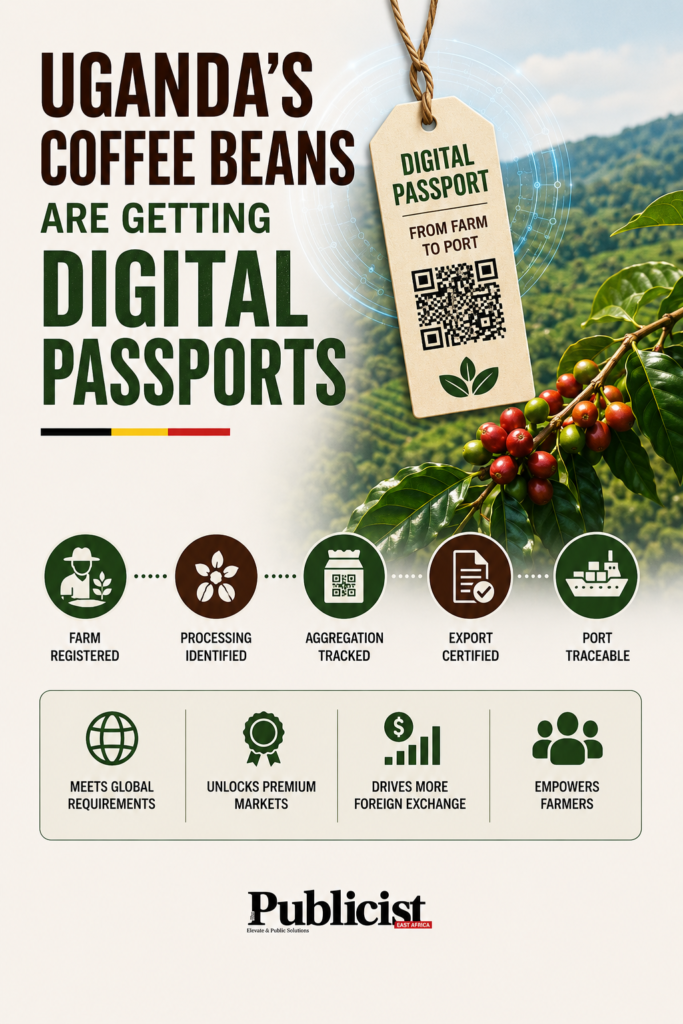
In this context, traceability is no longer an administrative nicety. It is becoming a condition of market participation. Uganda’s proposed system is designed to respond to precisely these demands, assigning digital identities to coffee batches, effectively transforming a previously anonymous commodity into a verifiable product with a documented origin, journey, and chain of custody.
In practical terms, the system is expected to link farm-level production data to processing, aggregation, and export certification through a centralized digital platform managed under the Ministry of Agriculture, Animal Industry and Fisheries. While the technical architecture is still being refined, it is likely to include farm registration systems, batch-level identifiers such as QR codes, and integrated export documentation enabling authorities and buyers to track coffee movement across the entire value chain.
The reform will not distribute its benefits evenly, and that distinction matters.
Those positioned to benefit include exporters with existing compliance infrastructure, who stand to gain improved access to premium and sustainability-certified markets. Certified processors and formal cooperatives are likely to become more deeply embedded in structured value chains that reward data integrity. Government institutions gain stronger oversight over production flows, export volumes, and quality assurance, improving both revenue monitoring and sector governance.
Those facing adjustment pressure are largely at the lower end of the supply chain. Smallholder farmers, who form the backbone of Uganda’s coffee industry, may face new requirements around registration, data capture, and compliance with digital systems, adding cost and complexity to operations that are already resource-constrained. Traders and intermediaries operating in informal aggregation networks face a more fundamental challenge: as supply chains formalise and data requirements tighten, participation in formal export channels may require structural changes to how they operate.
The reform, in other words, represents not only a technological upgrade but a reorganisation of how value and access are distributed across the sector.
Despite the ambition of the reform, the cost of implementation remains a critical and unresolved consideration. National agricultural traceability platforms typically require substantial investment in digital infrastructure, farmer onboarding, field verification systems, extension services, and ongoing data management. Comparable systems in other agricultural economies suggest implementation and operational costs can reach tens of millions of dollars over time, depending on scale and coverage.
Uganda has not publicly disclosed the full cost of the rollout. Nor has it clarified whether those costs will be borne entirely by the state, shared with exporters, or partially absorbed through value chain deductions. These questions are not peripheral, they will determine whether the system can achieve meaningful coverage across a production landscape dominated by small, geographically dispersed farms.
Although often described in simplified terms as a digital passport for coffee, the system is more accurately understood as a multi-layered data infrastructure, a centralized database linking farm registration, production records, batch identification, and export certification. It is intended not only to improve traceability, but to strengthen enforcement, ensuring that only verified and compliant coffee enters formal export channels.
This sits within Uganda’s broader 2025/26 economic framework, under which agriculture is being repositioned within an export-led growth model anchored in agro-industrialisation, digital transformation, and value addition. The underlying objective is to move beyond commodity exports toward higher-value, compliance-driven trade that generates greater foreign exchange earnings per unit of production.
The success of this transition will depend not only on technology and policy design, but on whether the system can function effectively across a fragmented production landscape dominated by smallholder farmers and informal trade networks, a challenge that no amount of digital architecture can fully resolve without sustained investment in farmer engagement, extension services, and ground-level implementation capacity.
What is emerging from Uganda’s coffee sector reform is a new logic of agricultural competitiveness, one in which data is as important as yield, and in which access to markets depends as much on documentation as it does on production capacity.
Uganda is no longer competing solely on how much coffee it produces. It is competing on how well it can document, verify, and certify that production for global buyers who increasingly treat traceability as a baseline requirement rather than a premium feature. In this emerging order, the ability to prove where a coffee bean came from, and how it was grown, processed, and exported, is not a differentiator. It is the entry ticket. Every coffee bean, it seems, must now earn its passport.