For generations, Uganda’s economy has been defined by what leaves its borders.
Coffee is shipped to Europe and Asia. Gold enters international commodity markets. Tea, fish, flowers and agricultural products move through regional and global supply chains. Export growth has traditionally been measured in tonnes, containers and cargo volumes. But another export has quietly become one of Uganda’s most valuable economic assets.
Unlike coffee or gold, however, diaspora income does not depend on rainfall, harvests, mineral production or commodity prices. Its foundation is the global demand for Ugandan skills.
It does not pass through customs. It is not loaded onto trucks or aircraft. It cannot be harvested from farms or extracted from mines. It is human capital.
This is not a literal export in the conventional trade sense. Rather, it is a different way of understanding Uganda’s growing participation in the global economy. Every year, thousands of Ugandans leave the country armed with education, professional skills and entrepreneurial ambition, joining labour markets across North America, Europe, the Middle East and beyond. Their expertise generates income abroad, but its economic value increasingly flows back home through remittances, investment, knowledge transfer, technology, business networks and innovation.
The result is something Uganda has never deliberately planned but is increasingly benefiting from: a global workforce whose contribution now rivals some of the country’s largest export industries.
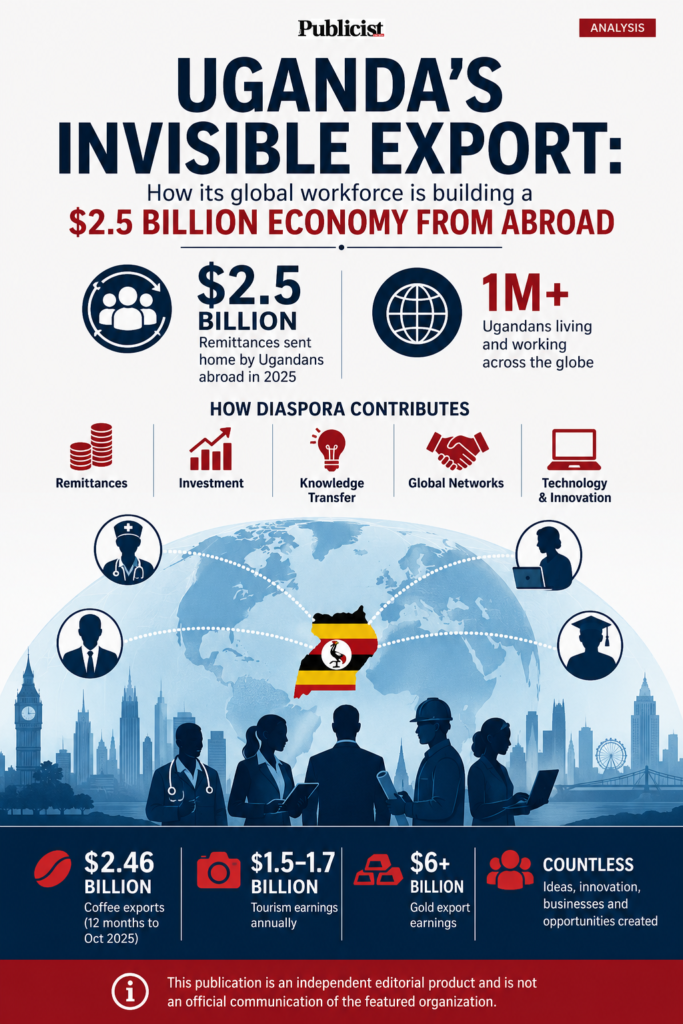
The most visible evidence of this transformation is remittances. According to estimates from the Bank of Uganda, the World Bank and international migration data, Ugandans living and working abroad sent home approximately US$2.5 billion in 2025. Those inflows have become one of the country’s largest sources of foreign exchange.
The comparison with traditional exports is striking. Coffee, Uganda’s flagship agricultural export, generated approximately US$2.46 billion during the twelve months to October 2025. Tourism has recovered strongly, earning an estimated US$1.5–1.7 billion annually, while gold remains Uganda’s largest merchandise export, generating more than US$6 billion in export earnings.
Unlike coffee or gold, however, diaspora income does not depend on rainfall, harvests, mineral production or commodity prices. Its foundation is the global demand for Ugandan skills.
A nurse working in London’s National Health Service, a software engineer in California, a financial analyst in Toronto, a lecturer in Australia or an entrepreneur in Dubai all represent Uganda’s participation in the international economy through knowledge rather than commodities. Remittances are therefore more than household transfers. They are evidence that Ugandan human capital has become a major generator of foreign exchange. Yet focusing only on the money tells only part of the story.
The true value of Uganda’s diaspora cannot be measured solely in dollars sent home. Every Ugandan who succeeds abroad accumulates assets that rarely appear in economic statistics: specialised knowledge, global professional networks, international business relationships, technological expertise and managerial experience. These assets often create far greater long-term value than remittances themselves. A software developer working for a global technology company can introduce Ugandan startups to international investors.
A medical consultant in Britain can support specialised training for doctors in Kampala. A Ugandan academic in Canada can establish collaborative research projects with local universities. An entrepreneur in Germany can open export markets for Ugandan businesses. Investors in the diaspora frequently finance enterprises, mentor founders, create employment and connect local companies to global value chains.
In today’s digital economy, expertise no longer needs to return on a plane to benefit the country. It can move instantly across borders through virtual collaboration, remote work, research partnerships, digital investment platforms and online mentorship. This means Uganda is exporting far more than labour. It is exporting capability.
For decades, African migration has largely been viewed through one lens: brain drain. The departure of doctors, engineers, scientists, teachers and other skilled professionals has understandably been seen as a loss for developing economies. That concern remains valid. Uganda continues to face shortages of healthcare workers and specialised professionals whose departure creates real challenges for national development. But the global economy is changing.
Increasingly, policymakers are replacing the language of brain drain with brain circulation. The concept recognises that talent no longer moves in only one direction. Skills, ideas, investment and innovation can circulate between countries even when people remain abroad.
India’s technology sector benefited enormously from professionals who built careers in Silicon Valley before investing back home. Israel has leveraged its global scientific community to strengthen research and innovation. Ireland transformed decades of emigration into a powerful international investment network. Rwanda has actively engaged its diaspora in national development through structured investment and skills initiatives.
These countries recognised that migration does not have to mean permanent loss. It can become a long-term national asset if governments deliberately create systems that connect citizens abroad with opportunities at home. Uganda has the same opportunity. Rather than asking how to stop people from leaving, policymakers should increasingly ask how to ensure that Ugandans abroad remain economically connected to the country’s future
This is where the conversation must change. Uganda has become increasingly effective at measuring remittance inflows, but far less effective at measuring the broader economic contribution of its global workforce. We know how much money returns. We know far less about how much investment, technology, research, innovation and market access the diaspora generates. That raises important policy questions.
Should Uganda have a comprehensive Diaspora economic strategy rather than focusing primarily on remittances? Should the Uganda Investment Authority actively recruit diaspora investors alongside foreign direct investment? Should universities create structured programmes that connect Ugandan academics abroad with research institutions at home? Should technology hubs systematically engage Ugandan engineers and entrepreneurs working in Silicon Valley, London or Berlin? Should government maintain a national database of diaspora expertise that businesses, researchers and public institutions can access?
These questions matter because the diaspora is no longer simply a community living abroad. It is an economic sector. Countries compete aggressively to attract capital, technology and talent. Uganda already possesses a global network of highly skilled citizens operating within some of the world’s most advanced economies. The challenge is not creating that network. It already exists. The challenge is building institutions capable of harnessing it.
For decades, Uganda has worked to increase exports by producing more coffee, attracting more tourists and extracting more minerals. Those sectors will remain essential to economic growth. But they are no longer the whole story. One of Uganda’s fastest-growing economic assets is dispersed across hospitals, laboratories, universities, technology companies, financial institutions and businesses around the world.
Its value lies not only in the billions of dollars it sends home each year, but in the ideas it generates, the technologies it develops, the businesses it builds and the international opportunities it creates. Perhaps the most important question facing Uganda is no longer how to reduce migration.
It is how to transform migration into national advantage. If human capital is becoming one of Uganda’s most important generators of foreign exchange, then the diaspora cannot continue to be viewed simply as relatives sending money home. It should be recognised as a strategic pillar of Uganda’s economic future. The countries that will thrive in the twenty-first century will not only export commodities.
They will learn how to mobilise the knowledge, capital, innovation and global networks of their people, wherever in the world those people happen to live. Uganda has already built that global workforce. The real question is whether it has a strategy to turn it into a lasting engine of national development.