At 45 years old, institutions are often expected to settle into maturity, to refine what they already are, not rethink what they could become. Yet Shelter Afrique Development Bank is doing the opposite. It is choosing reinvention.
In Rabat, Morocco, the institution marked its 45th Annual General Meeting with a symbolic and strategic unveiling, a new brand identity, including a new logo. But beneath the visual change lies something far more significant, a transition from a specialised housing financier into a fully fledged multilateral development bank.
This is not just a rebranding exercise. It is an attempt to reposition the institution within Africa’s rapidly evolving development finance landscape, where the scale of urbanisation and housing demand is forcing organisations to think beyond traditional mandates.
For decades, Shelter Afrique Development Bank operated within a relatively defined space. It supported governments and developers in financing housing projects, helping to address Africa’s growing demand for shelter. Its role, while important, was largely transactional, focused on projects, units, and financing gaps.
But Africa’s cities have outgrown that model. Urban populations are expanding at unprecedented speed. Informal settlements are spreading. Infrastructure systems are under pressure. And the housing deficit, now estimated at more than 53 million units, reflects not just a shortage of homes, but a deeper structural challenge in how cities are financed and built.
It is within this context that the institution’s transformation becomes meaningful. Becoming a multilateral development bank is not simply a change in status. It is a shift in philosophy, from financing housing as isolated projects to financing housing as part of broader urban systems.
This includes land markets, infrastructure networks, utilities, and the financial ecosystems that make cities functional. In other words, it is a move from building houses to enabling cities.
The scale of ambition is reflected in the numbers. Africa’s housing gap is estimated to require around US$1.3 trillion in financing. This is far beyond the capacity of conventional housing finance institutions. It demands access to larger pools of capital, innovative financing structures, and the ability to crowd in private investment at scale.
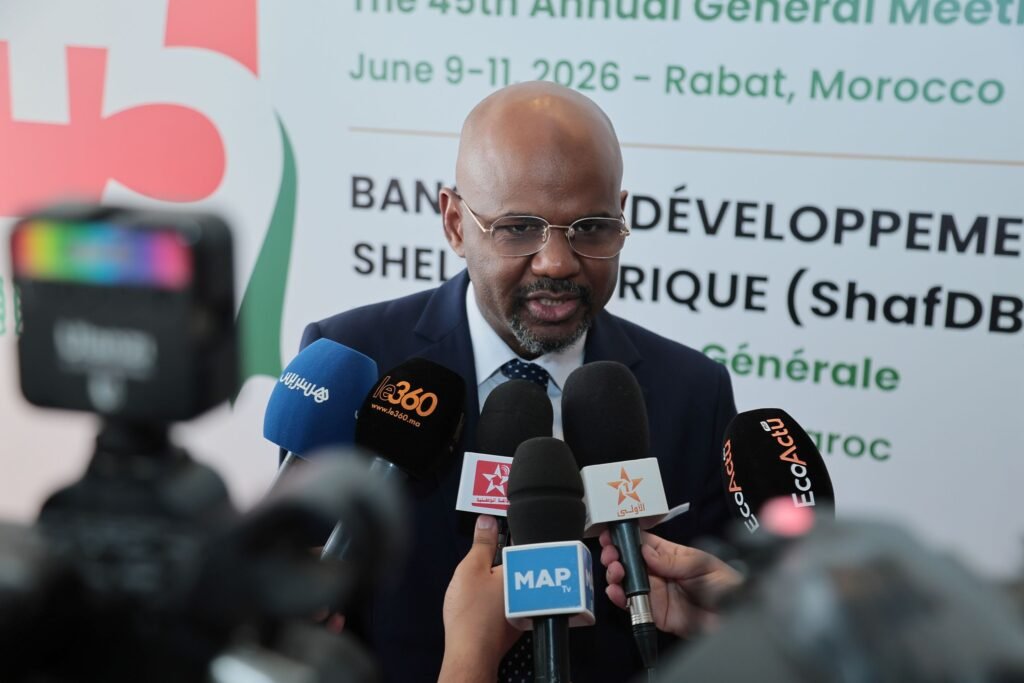
As Managing Director and CEO Thierno-Habib Hann said, the transformation is about more than appearance. It is about institutional capability.
“Rebranding means more than a name change,” he said. “It is about transforming the institution’s operational framework and expanding its role as a development bank.” he adds
That operational shift is central. Development banks operate differently from traditional lenders. They are designed not just to fund projects, but to shape markets. They de-risk investments, mobilise capital, and support long-term structural change in sectors that are often underfunded or considered too complex for private finance alone.
In this sense, Shelter Afrique Development Bank is attempting to join a small but influential group of African development finance institutions that are increasingly shaping the continent’s economic direction, alongside bodies such as the African Development Bank and the Africa Finance Corporation.
Yet the transition also raises important questions. Africa’s urban challenge is not only about financing. It is also about governance, land systems, construction capacity, regulatory frameworks, and inequality. Even with increased capital, the effectiveness of housing delivery depends on how these structural issues are addressed at national and city levels.
This is why the institution’s leadership has emphasised outcomes over process. Chairman H.E. Lionel Zinsou captured this shift clearly when he stated that success would not be measured by strategies or meetings, but by homes financed, cities improved, and lives transformed.
It is a reminder that institutional transformation must ultimately be judged in human terms.
The stakes are high because Africa’s urban future is already being written in real time. Cities like Kampala, Nairobi, Lagos, and Dar es Salaam are expanding rapidly, often faster than planning systems can accommodate. The result is a growing gap between urban demand and urban capacity, a gap that is increasingly economic as much as it is social.
Housing, in this context, becomes more than shelter. It becomes infrastructure. It becomes economic productivity. It becomes the foundation on which cities either function efficiently or struggle under their own growth.
This is the deeper logic behind Shelter Afrique Development Bank’s reinvention. It is an acknowledgement that housing cannot be treated in isolation from the broader systems that sustain cities.
At 45, the institution is therefore not just celebrating longevity. It is confronting relevance. The question it now faces is whether this reinvention can move from ambition to execution. Whether a new identity can translate into new capacity. And whether a redefined mandate can match the scale of Africa’s urban transformation.
Because in the end, the success of this transition will not be written in logos or speeches, it will be written in the cities Africa builds next.