“We have seen the commitment of our leaders, as they have signed the agreements… Now, the real work begins. We must also believe and champion a Pan-African vision.”
Across Africa, governments have invested billions of dollars in highways, ports, railways, One-Stop Border Posts and strategic logistics corridors. These investments have significantly improved regional connectivity, reducing transport times and laying the physical foundations for continental trade.
Yet despite this progress, businesses continue to face costly delays at border crossings, duplicated inspections, inconsistent customs procedures and administrative bottlenecks that erode competitiveness.
The emerging lesson is clear: Africa’s next trade revolution will not be driven by infrastructure alone. It will be driven by institutions.
Speaking during a public lecture on the implementation of the African Continental Free Trade Area (AfCFTA), TradeMark Africa Board Chair and former Ethiopian Prime Minister Hailemariam Desalegn Boshe argued that trade agreements, by themselves, cannot deliver Africa’s economic transformation.
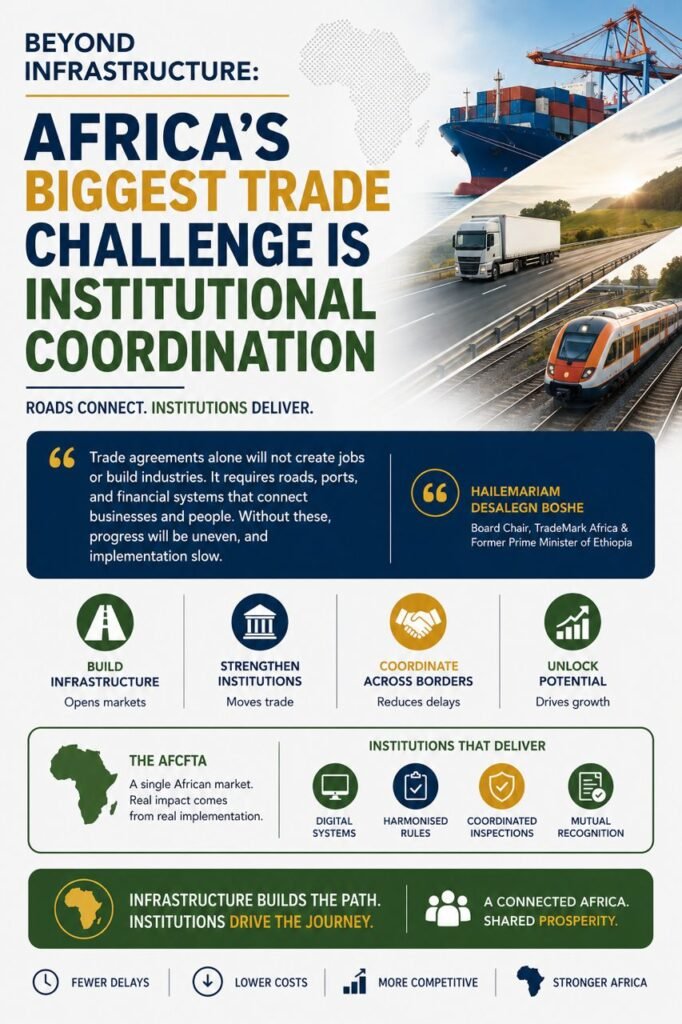
“Trade agreements alone will not create jobs or build industries. It requires roads, ports, and financial systems that connect businesses and people. Without these, progress will be uneven, and implementation slow.” he said.
His remarks highlight an important reality. While Africa has made considerable progress in building the infrastructure that enables trade, physical investments represent only part of the equation. The institutions responsible for facilitating cross-border commerce must evolve with equal urgency.
Infrastructure opens markets, but institutions determine whether businesses can actually access them.
Modern highways reduce travel time. Expanded ports increase cargo capacity. One-Stop Border Posts improve physical efficiency. Yet even the best infrastructure delivers limited value if customs authorities, standards agencies, immigration officials, transport regulators and border security agencies continue to operate in isolation.
A truck travelling from the Port of Mombasa to Kampala, for example, may spend days waiting at a border, not because the road is inadequate, but because multiple agencies require separate documentation, inspections and approvals. In many cases, the bottleneck is institutional rather than physical. This is where institutional coordination becomes a strategic economic advantage.
Digitised customs systems, harmonised regulations, coordinated inspections, shared data platforms and mutual recognition of standards can often reduce trade costs more effectively than additional infrastructure investments. When government agencies exchange information seamlessly and neighbouring countries align their procedures, goods move faster, businesses become more competitive and regional markets become more attractive to investors.
The African Continental Free Trade Area represents one of the world’s most ambitious economic integration initiatives, creating the framework for a single African market. However, lowering tariffs is only one dimension of integration. The real challenge lies in implementation.
As Hailemariam Desalegn observed during the same address:
“We have seen the commitment of our leaders, as they have signed the agreements… Now, the real work begins. We must also believe and champion a Pan-African vision.” he said.
That “real work” increasingly revolves around strengthening institutions. Efficient border management, regulatory cooperation, digital trade systems and coordinated implementation will determine whether African businesses can compete effectively across borders and fully benefit from the opportunities created by the AfCFTA.
For Uganda, this challenge carries particular significance.
As a land-linked economy, Uganda depends heavily on efficient transport corridors connecting it to regional markets and seaports. Every unnecessary hour spent at a border crossing increases transport costs, delays deliveries, raises prices and reduces the competitiveness of Ugandan exports.
This places renewed emphasis on customs modernisation, digital documentation, coordinated border management and stronger collaboration among East African institutions. While investments in roads and logistics remain essential, improving the efficiency of institutions that govern trade may yield even greater economic returns.
The countries that reform institutions as effectively as they build infrastructure are likely to emerge as Africa’s most competitive trading hubs.
Africa’s trade conversation is therefore entering a new phase. For years, progress was measured in kilometres of roads constructed, ports expanded and border facilities commissioned. Increasingly, success will be measured by different indicators: how quickly cargo is cleared, how many agencies inspect a single shipment, how easily businesses move goods across borders and how effectively neighbouring institutions work together.
These are the metrics that will shape Africa’s competitiveness over the coming decade.
Infrastructure remains indispensable, but infrastructure alone cannot unlock the continent’s trade potential. Institutions determine whether roads become trade corridors, whether ports become gateways for investment and whether regional agreements translate into tangible economic growth.
As Africa accelerates the implementation of the AfCFTA, the continent’s greatest competitive advantage may ultimately depend not on the infrastructure it builds, but on the institutions it aligns.
Editor’s Note: This article is part of Publicist East Africa’s Africa Trade & Investment Series, which examines the policies, ideas and leadership shaping regional integration, trade competitiveness and economic transformation across the continent. The series goes beyond reporting events to analyse what they mean for businesses, investors, policymakers and Africa’s long-term economic future.