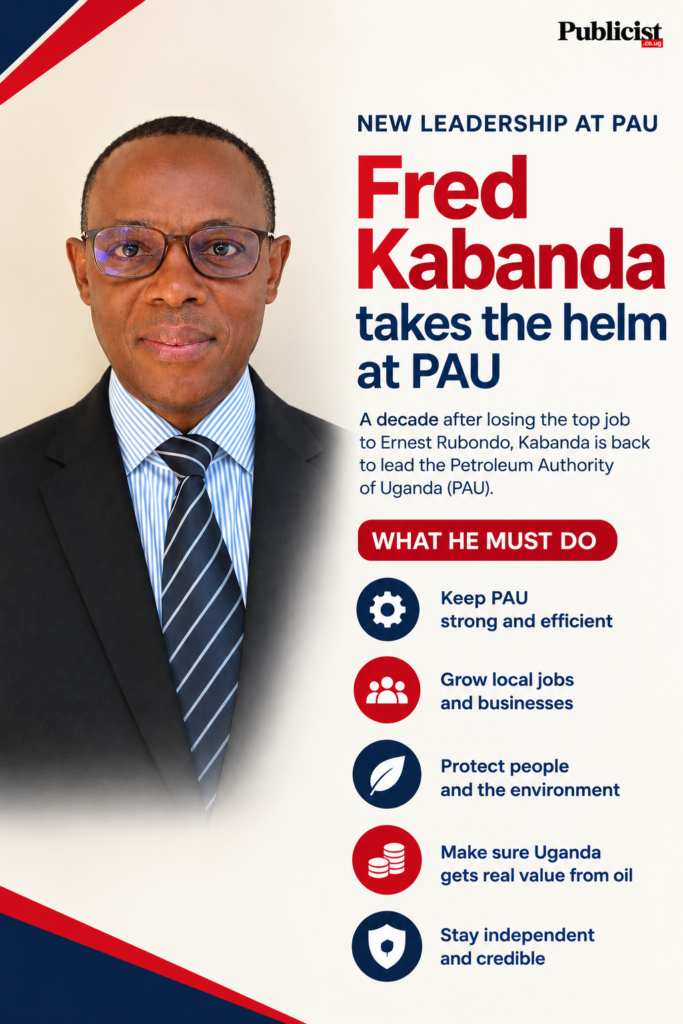
A decade after Ernest Rubondo beat Fred Kabanda to become the first Executive Director of the Petroleum Authority of Uganda (PAU), Kabanda is set to take over the institution Rubondo spent ten years building.
The PAU Board has appointed Kabanda as its new Executive Director, with the petroleum sector veteran expected to assume office on December 1, 2026. He succeeds Rubondo, whose second and final term ended on August 31. In the interim, PAU’s Director of Finance and Corporate Services, Otonga Michael Ochan, is serving as Acting Executive Director.
The appointment closes a leadership story that began when PAU itself was being established. In 2016, Kabanda and Rubondo were the final two candidates shortlisted for the regulator’s inaugural Executive Director position. Kabanda was then an Assistant Commissioner at the Ministry of Energy and Mineral Development, while Rubondo had risen through the petroleum establishment to head the Petroleum Exploration and Production Department.
Rubondo was selected for the job and became PAU’s founding Executive Director in September 2016. Kabanda left the ministry later that year and joined the African Development Bank, where he went on to build wider experience in extractives and natural-resource development across Africa.
Ten years later, the two careers have converged again, but at a very different point in Uganda’s petroleum story.
Rubondo spent his decade at PAU building the regulatory architecture for an industry that was still moving from exploration towards development. Under his leadership, the authority grew into the institution responsible for overseeing petroleum operations, from licensing and field development to national content, health and safety, environmental compliance and project regulation.
Kabanda inherits that architecture as Uganda moves closer to commercial production. That makes his task different from Rubondo’s. He will not be starting with an institution that needs to establish its place in the petroleum sector. He will be leading a regulator whose decisions will increasingly have direct consequences for production, investment, national participation and the economic value Uganda gets from its oil resources.
The immediate challenge will be ensuring that PAU remains technically strong as activity around projects such as Tilenga, Kingfisher and the East African Crude Oil Pipeline advances. But the more important test of Kabanda’s tenure will be what the regulator enables Uganda to achieve from the industry it oversees.
National content will be one of those tests. Uganda has spent years seeking to increase the participation of local companies in the oil and gas supply chain. PAU will have to ensure that national-content requirements translate into meaningful contracts, skills development, technology transfer and sustainable opportunities for Ugandan businesses rather than participation that exists largely on paper.
The same question applies to jobs. Petroleum investment can generate government revenue and attract foreign capital, but its wider economic impact depends on how much capability is built within Uganda. Kabanda will therefore face pressure to ensure that Ugandans are not only employed around individual projects but are increasingly positioned to provide the technical, professional and commercial services required by the industry.
His experience at the African Development Bank could be useful here. Kabanda has worked across Africa on extractive-resource issues and has been involved in areas including petroleum policy, regulation, licensing and natural-resource management. His previous work in Uganda also gives him knowledge of the institutions and sector he is returning to.
But his tenure will also be tested by the regulator’s ability to maintain confidence while exercising its mandate.
PAU sits between government, international oil companies, investors, local businesses and communities. As Uganda approaches production, decisions on technical standards, project approvals, environmental and social obligations, safety and compliance will carry greater economic and political weight.
That will require a regulator that can remain credible and technically independent while working effectively with the government and industry.
The environmental and social dimension will be equally important. As petroleum operations intensify, PAU will have to ensure that development continues to meet Uganda’s regulatory requirements while addressing the concerns of communities affected by projects.
Ultimately, however, Kabanda’s biggest challenge may be broader than regulation itself: whether Uganda’s petroleum resources produce measurable economic value beyond the oil fields.
That means looking at what happens across the wider value chain, the businesses that supply the industry, the skills that remain in the country, the jobs created, the revenues collected and the capacity built in Uganda’s economy.
It is a very different question from the one PAU faced in 2016.
Then, the priority was to build a credible regulator capable of overseeing an emerging petroleum industry. Now, the regulator must demonstrate that the system built over the past decade can work effectively as Uganda enters the production phase.
Kabanda arrives with the benefit of knowing the sector before PAU existed and with a decade of experience seeing extractives from a broader African perspective.
That gives his appointment a certain symmetry. In 2016, Rubondo won the race to build Uganda’s new petroleum regulator. In 2026, Kabanda takes over the institution after a decade of watching the sector evolve from outside its leadership.
His tenure will ultimately be judged by what happens next. Rubondo built much of the regulatory architecture for Uganda’s oil industry. Kabanda now has to prove what that architecture can deliver.