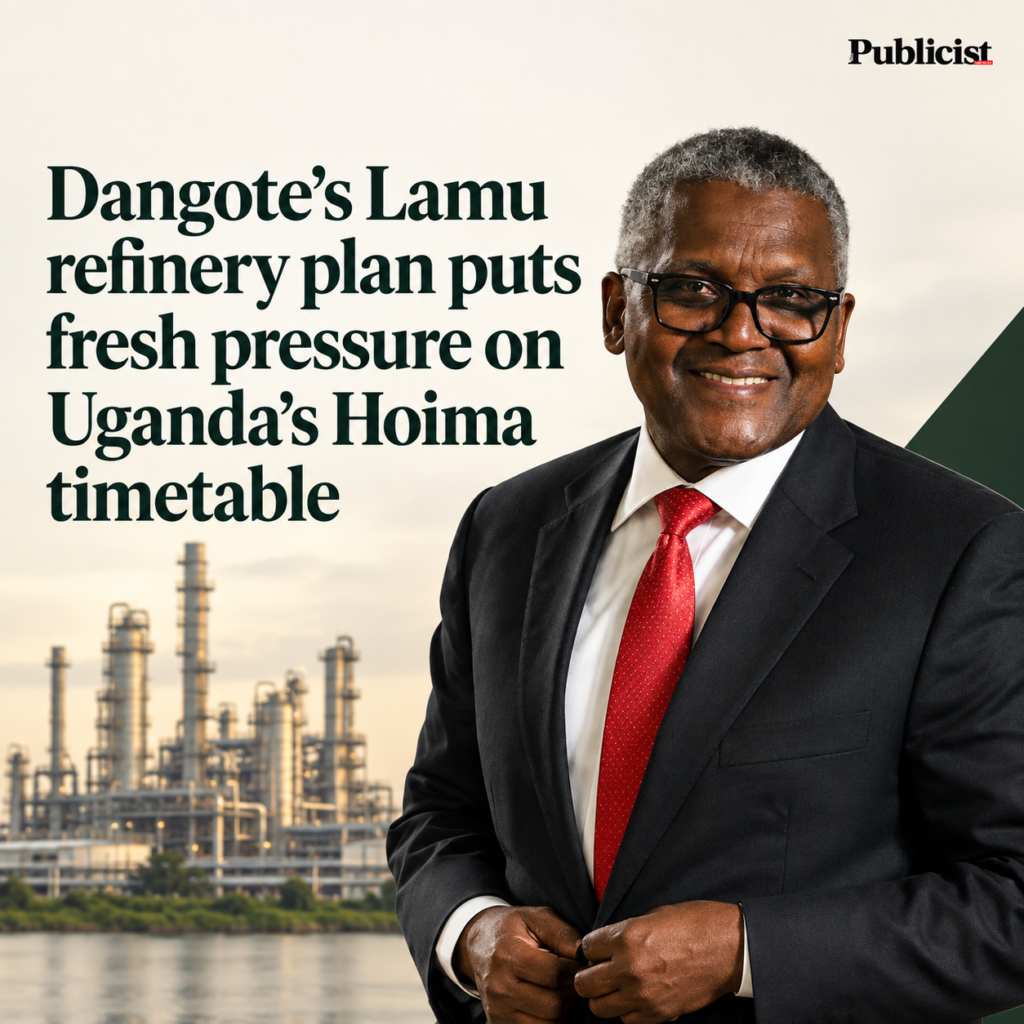
Aliko Dangote’s planned 700,000-barrel-per-day refinery in Kenya is putting fresh attention on Uganda’s delayed $4 billion refinery at Hoima. But the two projects are not yet in a straightforward construction race.
Dangote is scheduled to break ground on the Lamu refinery on September 30, 2026, while Uganda’s 60,000-barrel-per-day refinery remains ahead of a final investment decision expected in the first quarter of 2027.
The difference is significant. But so are the risks between a groundbreaking ceremony and a functioning refinery.
The Lamu project has already encountered a legal challenge. On September 28, the Malindi Environment and Land Court ordered parties to maintain the status quo on a disputed parcel of land, L.R. No. 13061, until October 14, when the case is scheduled for an inter-party hearing.
The application was filed by 133 residents of Chandavai who are challenging the development over alleged land and customary rights. The court did not expressly grant their request to stop the planned groundbreaking. Dangote has said the September 30 ceremony will proceed, although the ruling could affect activities on the disputed site.
That makes the timing of the two projects more complicated than simply comparing their groundbreaking dates.
The proposed Lamu refinery is expected to process 700,000 barrels of crude oil per day, more than 11 times the planned capacity of Uganda’s Hoima refinery.
Dangote has put the investment at roughly $15 billion to $17 billion, with construction expected to take about 30 months once the project moves fully into construction. Kenyan and company officials have targeted completion around 2030.
The project is strategically located at Lamu on Kenya’s coast, giving it access to a deep-water port and the Lamu Port-South Sudan-Ethiopia Transport Corridor. The location provides a potential logistics advantage for importing crude and distributing refined products across the region.
Construction momentum is also beginning to become visible. A vessel carrying about 2,930 tonnes of project cargo arrived at Lamu Port on September 26 ahead of the planned groundbreaking.
But the project still faces major execution questions. The most immediate is crude supply. Kenya does not yet have commercial-scale crude production capable of supplying a refinery of this size. Reuters reported earlier this month that Dangote could therefore face a significant feedstock challenge, with potential regional sources including Uganda and South Sudan also constrained by infrastructure and other commercial considerations.
Financing and supporting infrastructure are also part of the equation. Dangote has discussed a combination of debt and shareholder funding, while regional governments have been offered opportunities to participate in the project.
The land case adds another variable. So while September 30 would mark an important milestone, it would not by itself establish that the refinery is fully financed, legally unencumbered or guaranteed to enter production on schedule.
Uganda’s refinery is a different proposition. The planned Kabaale refinery in Hoima has a capacity of 60,000 barrels per day and is being developed by Uganda National Oil Company, through its refinery interests, together with UAE-based Alpha MBM Investments.
Under the agreement signed in March 2025, Alpha MBM holds 60 percent while UNOC holds 40 percent. The project is valued at about $4 billion. The agreement was an important step, but it is not the same as financial close or the start of full construction.
Uganda’s own project documentation shows that the parties have been working through Front-End Engineering Design and related commercial and technical requirements. The current target for the final investment decision has been pushed to the first quarter of 2027. UNOC has said the FID remains dependent on FEED completion, early works, technical milestones, commercial agreements and regulatory approvals.
That means Hoima remains a project moving toward construction rather than a refinery already under construction. The distinction matters because Uganda is approaching another major milestone at the same time: first oil.
Uganda’s upstream petroleum projects are moving towards commercial production, with the government and regional institutions targeting first oil around the end of 2026. The East African Crude Oil Pipeline is being developed to transport crude from the Tilenga and Kingfisher developments to the export terminal at Tanga in Tanzania.
This creates a strategic difference between the two refinery projects.
Uganda is developing a refinery alongside its own crude-production industry. UNOC has previously described the Hoima project as a tolling refinery in which it would be the sole supplier of crude, with negotiations involving the upstream partners.
Lamu, by contrast, will have to secure its feedstock through a combination of regional and international sources. Reuters has reported that the refinery may have to rely substantially on seaborne crude imports because Kenya currently lacks sufficient commercial production and regional supply routes remain uncertain.
This means the two projects could compete for refined-fuel customers without necessarily competing for the same crude supply.
In fact, Uganda’s emergence as an oil producer could eventually become relevant to the Lamu refinery’s feedstock calculations. But Uganda has not committed its crude to Lamu. Recent reporting indicates that Uganda is prioritising its own Hoima refinery and other regional arrangements rather than guaranteeing Lamu a supply of Ugandan crude.
The most immediate competitive overlap is therefore likely to be in refined petroleum products. Both facilities are designed to serve markets beyond their home countries.
Lamu is being positioned to supply Kenya and neighbouring markets across East and Central Africa, including Uganda, South Sudan, Tanzania, Rwanda, Burundi, Ethiopia and the Democratic Republic of Congo.
Uganda’s Hoima refinery is similarly intended to supply Uganda and regional markets, reducing the country’s dependence on imported refined products.
For Uganda, this creates a strategic question. If Lamu reaches production before Hoima, Uganda could find itself importing refined products from a large coastal refinery while simultaneously exporting crude through Tanzania.
That would mean Uganda’s crude is moving out of the country for export while some of the refined products consumed in the domestic market continue to come from outside.
Hoima is intended to change that equation by processing part of Uganda’s crude domestically and adding value before products are distributed into the Ugandan and regional markets.
But that benefit only materialises if the refinery moves from an investment agreement to financial close, construction and eventual operation.
The September 30 Lamu groundbreaking therefore matters to Uganda, but not simply because Kenya could build a refinery first.
The more important question is whether Uganda can maintain momentum on Hoima while its own crude production begins.
Lamu has a head start in terms of the publicly announced construction timetable. Dangote has set a groundbreaking date and says the facility can be built in roughly 30 months. Uganda, meanwhile, is targeting FID in the first quarter of 2027.
But Lamu’s timetable is not guaranteed. The project still faces the land dispute, financing and crude-supply questions, as well as the normal engineering and construction risks associated with a refinery of this scale.
Uganda faces a different set of risks like completing FEED and commercial agreements, securing the investment decision and financing, obtaining the necessary approvals and then actually constructing the plant.
The two projects are therefore not simply a race between Kenya and Uganda. They represent two different models of regional refining.
Lamu’s advantage is its coastal location, access to international shipping and potential to serve a large regional market from a major logistics corridor. Hoima’s strategic proposition is different: it sits alongside Uganda’s emerging crude industry and could allow the country to capture more value from its own petroleum resources.
For Uganda, the critical issue is not whether Dangote can stage a bigger groundbreaking ceremony or whether Lamu’s refinery is more than 11 times the size of Hoima’s.
It is whether Hoima can move quickly enough from agreements and engineering studies into financed construction while Uganda’s crude production is coming online.
The September 30 ceremony in Lamu will be a milestone. Uganda’s Q1 2027 FID target will be another. Neither, on its own, guarantees a functioning refinery. The decisive milestones will come later, financial close, construction progress, secure crude supply, commissioning and the ability to operate commercially at scale. That is where the real East African refinery race will be measured.