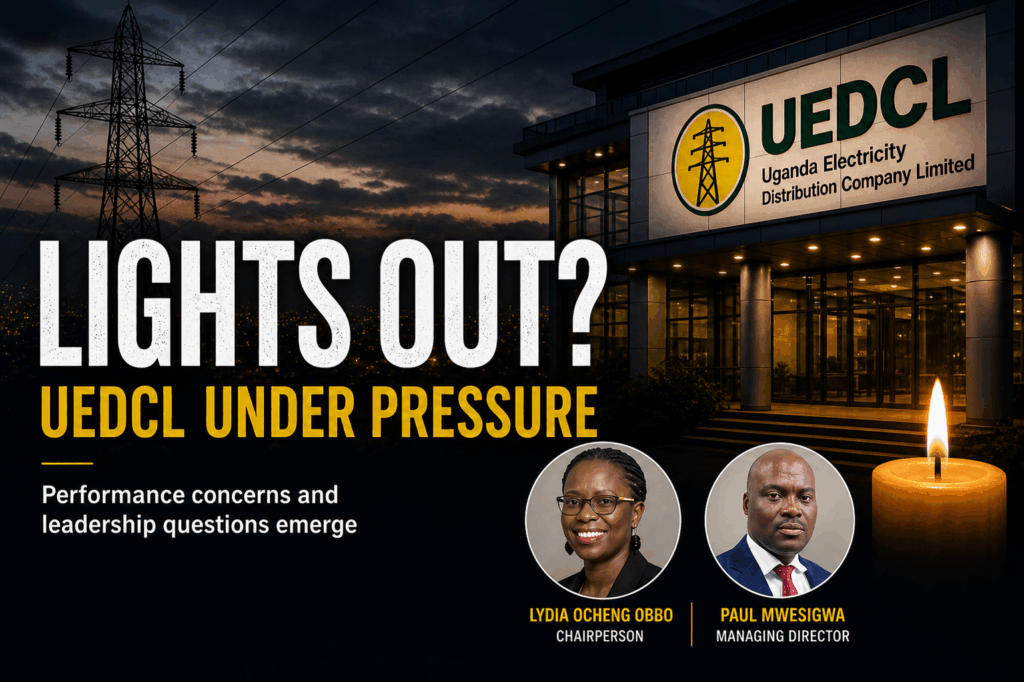
Uganda has taken back control of its electricity distribution system and the test has begun.
Following the exit of Umeme Limited, Uganda Electricity Distribution Company Limited now assumes full responsibility for power distribution.
This places the state utility at the center of one of the country’s most critical economic functions. Early signals, however, suggest a system adjusting under pressure, amid rising public concern and unconfirmed reports of leadership changes.
Business media reports have suggested a possible shake-up involving senior leadership at UEDCL, including claims of changes at Board and executive level. While there has been no formal confirmation from the Ministry of Energy and Mineral Development, the narrative has already gained traction in the public domain. At the same time, public sentiment is becoming increasingly vocal.
Complaints related to outages, load management, and service reliability are surfacing more frequently, with some Ugandans drawing comparisons with the previous distribution regime. Others are urging patience, noting that transitions of this scale often come with short-term disruption as systems stabilize and institutional alignment takes hold. Both realities now define the moment.
Electricity distribution is not just a utility function, it is a core economic enabler, it shapes industrial productivity, influences the cost of doing business, and signals reliability to investors. With the system now fully under State management, outcomes are more directly visible, and expectations are significantly higher.
There is also a quieter but significant shift. Under Umeme Limited, Ugandans had a direct stake in the electricity distribution business through the Uganda Securities Exchange, earning dividends and participating in its growth. That model has now changed. With distribution consolidated under UEDCL, value is no longer distributed through the market, but retained within the State. The question now is whether that value will be returned to citizens more effectively through improved service, reduced costs, and broader economic impact.
Beyond service delivery, the transition is raising deeper questions about control and governance. Electricity distribution represents a significant national asset, with implications for revenue flows, infrastructure development, and long-term economic planning. Increased public scrutiny, therefore, is both expected and warranted.
It is within this broader context that the reported leadership developments are being interpreted not simply as internal changes, but as part of a wider adjustment within the sector.
As previously argued by Andrew Mwenda, a prominent Ugandan journalist, political commentator, and media entrepreneur the real test was never ownership but efficiency, discipline, and governance. That test is now underway. .
UEDCL has inherited a complex operational environment and is now expected to deliver consistently under full public visibility. As systems stabilize, communication and clarity will play a critical role in maintaining confidence and managing expectations.
The shift to State-led distribution marks a significant structural change for Uganda’s economy. Its success will ultimately be measured not just by intent, but by performance over time.