
Uganda’s electricity transition has moved from policy to pressure. It offers a clear lesson. In large-scale public sector shifts, communication is not support. It is strategy.
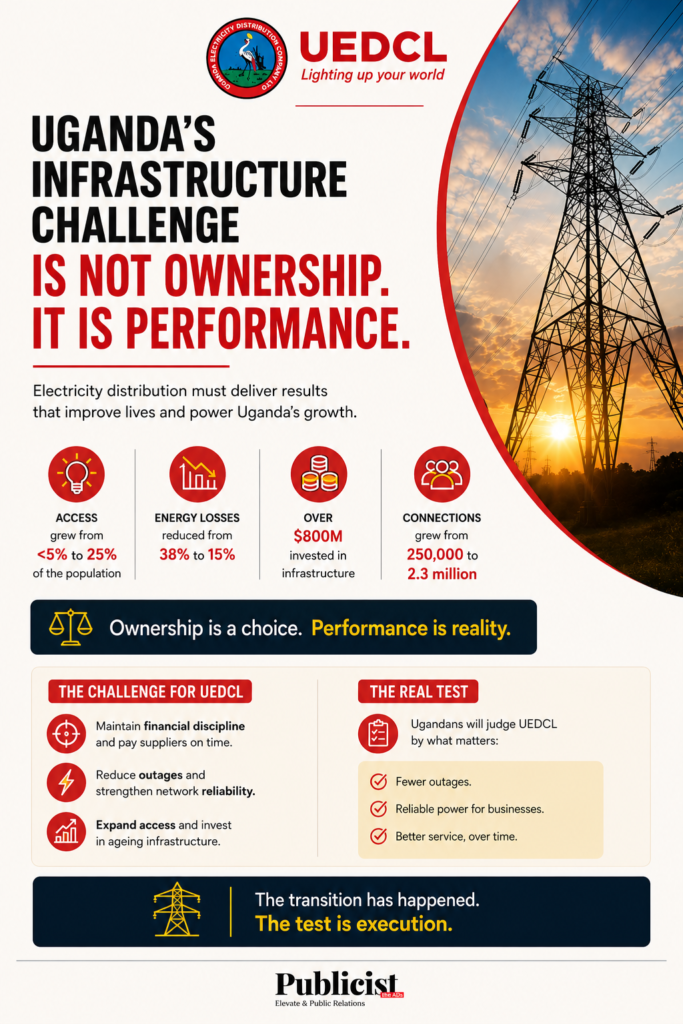
The move from Umeme Limited to Uganda Electricity Distribution Company Limited was always going to be complex. It involved a change in ownership model, a transfer of operational responsibility, and an immediate rise in public expectation. What has followed, rising scrutiny, public dissatisfaction, and leadership intervention confirmed by the Ministry of Energy and Mineral Development, is not unusual. It is what happens when execution meets visibility.
The real question is not whether challenges emerged. It is whether they were anticipated, framed, and managed.
At the point of transition, the conversation quickly shifted to performance. The comparison was simple. Is the new system better than the previous one? In reality, transitions of this scale require stabilisation before optimisation. Without a clearly communicated roadmap, early operational issues are easily interpreted as failure rather than part of a phased process.
Once service concerns begin to surface, the narrative forms quickly. In the absence of consistent, data-backed communication, perception moves faster than reality. Operations may be improving, but without visibility, confidence declines.
Leadership then becomes the story. Executives move from operational roles into national-facing positions almost overnight. That shift requires more than technical capability. It calls for message discipline, media readiness, and structured stakeholder engagement. When that alignment is delayed, pressure builds quietly before it becomes visible.
In transitions of this scale, leader reputation becomes inseparable from institutional performance. Public confidence is often formed early, and where communication is slow or inconsistent, perception can shift quickly. Protecting leadership credibility, therefore, is not a secondary task. It is central to maintaining trust during periods of change
There is also a structural shift that deserves attention. Under Umeme Limited, the electricity distribution business had a presence on the Uganda Securities Exchange, allowing institutional and individual investors to participate in its financial performance. That model has now changed. With distribution consolidated under UEDCL, value is retained within the State. The expectation that follows is clear. That value must be translated into improved service delivery, efficiency, and broader economic impactAcross sectors, transitions of this nature have shown that early alignment between leadership, stakeholders, and public messaging is critical in maintaining institutional confidence. Where communication is structured, proactive, and consistent, organisations are better able to navigate periods of change without erosion of trust.
In our experience supporting organisations through high-stakes transitions, the difference between stability and pressure often lies in how early communication is structured and sustained. Where leadership alignment, stakeholder engagement, and narrative control are treated as core elements of execution, institutions are better able to maintain confidence even as systems adjust.
At the height of the transition debate, Andrew Mwenda made a point that is still relevant. Ownership alone does not determine success. Efficiency, discipline, and governance do. What we are seeing now is that communication plays an equally important role.
Because in public sector transitions, performance is judged not only by outcomes, but by how those outcomes are explained and understood.
The lesson is straightforward.
Transitions of this magnitude require operational readiness, governance discipline, and sustained communication. Remove any one of these, and pressure builds quickly, often before it is visible.
The UEDCL experience is not a failure story. It is a live case study in managing scale, expectation, and scrutiny. And in moments like this, how you communicate is just as important as what you deliver