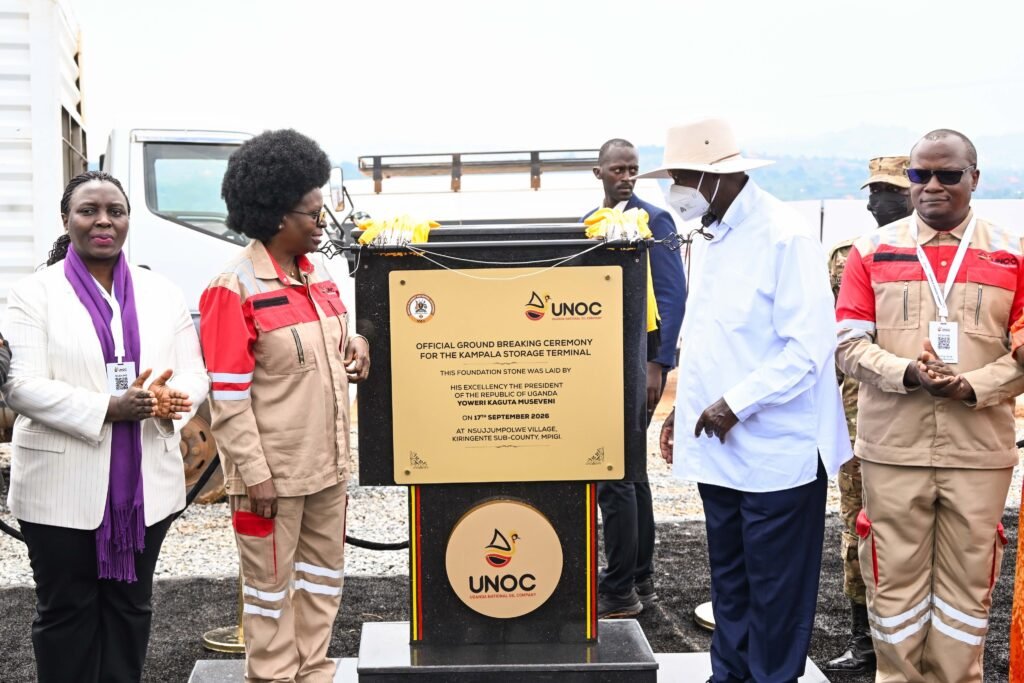

Uganda has issued a compelling call to global investors, confidently positioning itself as Africa’s next preferred destination for oil and gas investment. This confidence is anchored in a definitive timeline for the construction of a major national asset: the Uganda Oil Refinery.
Speaking at the African Energy Week (AEW): Invest in African Energies 2025 in Cape Town, South Africa, on Wednesday, Eng. Dr. Michael Nkambo Mugerwa, General Manager of the Uganda Refinery Holding Company (URHC), confirmed that the US$4 billion refinery facility is scheduled to begin operations in Q4 2029 or Q1 2030.
He noted, however, that the project is far more than just a facility; it is the key driver of a national strategy designed to capture the full value chain of Uganda’s petroleum resources, stimulate massive industrial growth, and secure regional energy supply.
The Refinery and Industrial Park
Dr. Mugerwa disclosed that the 60,000-barrel-per-day refinery, situated in Kabaale, Hoima District, was established following a crucial March 2025 agreement between the Uganda National Oil Company (UNOC) and the UAE-based investment firm Alpha MBM Investments.
According to Dr. Mugerwa, the project features an innovative and robust funding model that breaks down the total investment of US$4 billion with joint financing as follows;
The UNOC will contribute 40%, while Alpha MBM Investments provides the remaining 60%. This shared risk/reward structure demonstrates strong government commitment and private sector confidence.
Capturing the Full Value Chain
Dr. Mugerwa emphasised that the vision extends well beyond basic fuel, saying, “This project goes beyond fuel production; we are looking at petrochemicals, kerosene, fertilisers, and gas processing. The refinery is designed to capture the full value chain.”
This approach, he explained, not only maximises revenue from finite oil resources but also provides critical input materials like fertilisers for Uganda’s crucial agricultural sector.
Creating an Industrial Ecosystem
The refinery is the anchor for the accompanying Kabaale Industrial Park, which is already attracting significant commitment.
Initial Investment
The park itself is supported by US$3-4 billion in complementary investment, with the potential to attract an additional US$1-2 billion.
Investor Commitment
Approximately 15 investors have already committed to the park, ready to establish businesses that will create an ecosystem around the refinery.
Dr. Mugerwa highlighted that to support this massive complex, the government is rapidly developing supporting infrastructure, including high-voltage power (200 MW), water facilities, and extensive road networks.
Uganda’s Competitive Investment Edge
Panellists at the energy week stressed that Uganda’s appeal rests on its stability, strategic incentives, and regional connectivity.
Humphrey Asiimwe, CEO of the Uganda Chamber of Energy and Minerals, highlighted Uganda’s advantages, which are stability and demographics.
“There is peace, security, a young population and a stable currency,” he said, adding that, “The country is also ripe with investment incentives like key equipment for investors that benefits from 0% import tax.”
Asiimwe also revealed that Uganda serves as a vital springboard to neighbouring markets in Tanzania, Kenya, and the Democratic Republic of the Congo (DRC), guaranteeing strong demand for refined products.
Irene Batebe, Permanent Secretary of the Ministry of Energy and Mineral Development, underscored the commitment to national infrastructure, noting that US$5 billion has been committed to power infrastructure, including the expansion of the diversified energy portfolio to 10,000 MW (hydro, solar, and nuclear).
UNOC’s Strategic Upstream and Midstream Role
The National Oil Company is not merely a shareholder but an active participant across the entire sector. Philips Obita, the General Manager Upstream at UNOC, detailed the company’s strategic initiatives:
Midstream Participation
He revealed that UNOC holds commercial interests of up to 150,000 barrels and is an active partner in the East African Crude Oil Pipeline (EACOP) project.
Upstream Development
Obita noted that the company is advancing five exploration projects and is conducting geophysical services, with seismic studies scheduled for completion in November 2025.
National Capacity
Recognising that oil and gas are finite resources, Obita said the UNOC is heavily focused on developing local content, technology transfer, and capacity building to ensure Ugandans can independently manage future exploration and infrastructure.
The consensus from Cape Town is clear: with petroleum demand rising, infrastructure projects like the refinery and EACOP underway, and a politically stable and strategically positioned country, Uganda is making a powerful and well-articulated case for investment that promises substantial returns and regional energy security.