
The Government of Uganda has vowed to investigate a recent BBC documentary exposing a human trafficking ring allegedly targeting young Ugandan women in Dubai.
Speaking at the Uganda Media Centre on September 30, 2025, Hon. Esther Anyakun Davinia, Minister of State for Labour, Employment and Industrial Relations, strongly condemned the alleged exploitation and outlined the government’s dual commitment, which is protecting Ugandan citizens abroad and tackling the root causes of irregular migration.
BBC Allegations and Government Response
The Minister stated that if the reports of the human trafficking ring are true, as reported recently by the BBC, it is “regrettable that youthful Ugandans leave Uganda hoping for better opportunities and instead end up in horrible exploitative situations.”
She revealed that the government will work with the United Arab Emirates (UAE) authorities to ensure the alleged ringleader, Abbey Mwesigwa, is brought to justice.
Crucially, she noted that the Ministry is moving to delink formal labour externalisation from human trafficking.
Hon. Anyakun divulged that Mwesigwa is not licensed by the Ministry, and stressed that the victims mentioned in the documentary are highly suspected to be women who were trafficked by illegal agents or travelled on visit visas hoping to secure employment, not those who used the formal, regulated channels.
She stressed that a 2022 report from Uganda’s Mission in Abu Dhabi supports this view, revealing that none of the 452 irregular migrants repatriated at that time had travelled through a Ministry-licensed recruitment company.
Mass Youth Unemployment as Root Cause
According to Hon. Anyakun, the Ministry acknowledged that the “push and pull factors” driving migration cannot be wished away.
This is because Uganda’s job market struggles to absorb the 600,000–700,000 young people entering it annually.
She explained that the 2024 National Population and Housing Census revealed that a staggering 50.9% (5.3 million) of the youth are NEETs (Neither in Employment nor in Education or Training), making them highly vulnerable to manipulation and trafficking.
To mitigate this challenge, the Minister highlighted that the government initiated the Externalisation of Labour Programme in 2005 with two objectives:
To create a safe, formal, and regular pathway for Ugandans seeking work abroad.
To serve as a short-term window for addressing the immediate unemployment challenge.
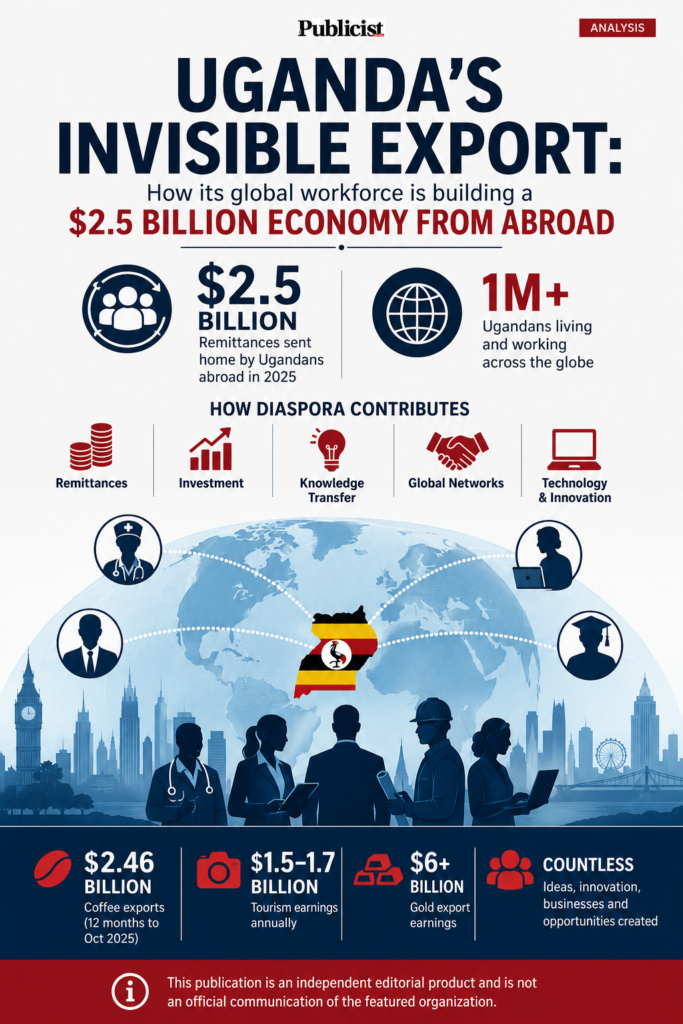
The program, she revealed, has created at least 280,000 employment opportunities between 2016 and 2024 and generated significant migrant worker remittances of about USD 1.3 billion last year.
Robust Mechanisms and Unfunded Challenges
The Minister also highlighted several measures taken to promote safe and orderly migration, including:
Revised Regulations (2021)
This includes increased penalties for unauthorised fees (up to five years’ imprisonment), restricted ownership of recruitment agencies to Ugandans, and a four-party employment contract making both Ugandan and foreign agencies jointly liable.
Digitalisation
The External Employment Management System (EEMIS) digitises worker clearance, allowing real-time information sharing to combat trafficking and speed up consular services.
Worker Support
A 24-hour Call Centre was established for distressed migrant workers to report complaints digitally.
Bilateral Labour Agreements (BLAs)
Agreements have been signed with Saudi Arabia, Jordan, Qatar, and the UAE (although the latter is not yet operational).
Despite these efforts, the Minister revealed that the program faces critical challenges, key among these being the lack of sufficient funding to regulate and enforce the highly risky programme.
Other challenges, according to the Minister, include delays in host-country judicial processes, inadequate legal aid, and the exploitation of workers by illegal Ugandan recruiters residing in host countries.
Call for Collective Action
The Minister concluded with a plea to all citizens: “The fight against human trafficking is a call for everyone.”
She urged all Ugandans seeking foreign employment to use the 256 officially licensed recruitment companies and reminded the public that solving the youth unemployment crisis and ensuring safe migration requires concerted efforts from the individual, family, community, and all levels of government.