Uganda is preparing to become an oil-producing nation, yet it still depends almost entirely on imported fuel to keep its economy moving.
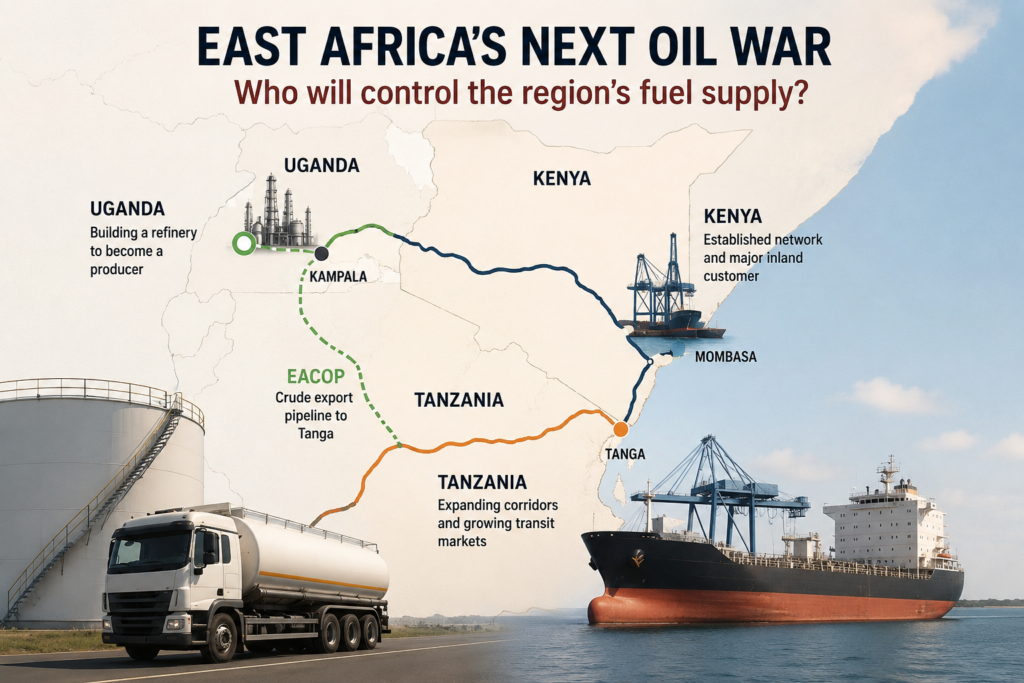
Every taxi ride, factory shipment, and cross-border truck movement relies on petroleum products entering through regional supply routes largely controlled beyond Uganda’s borders.
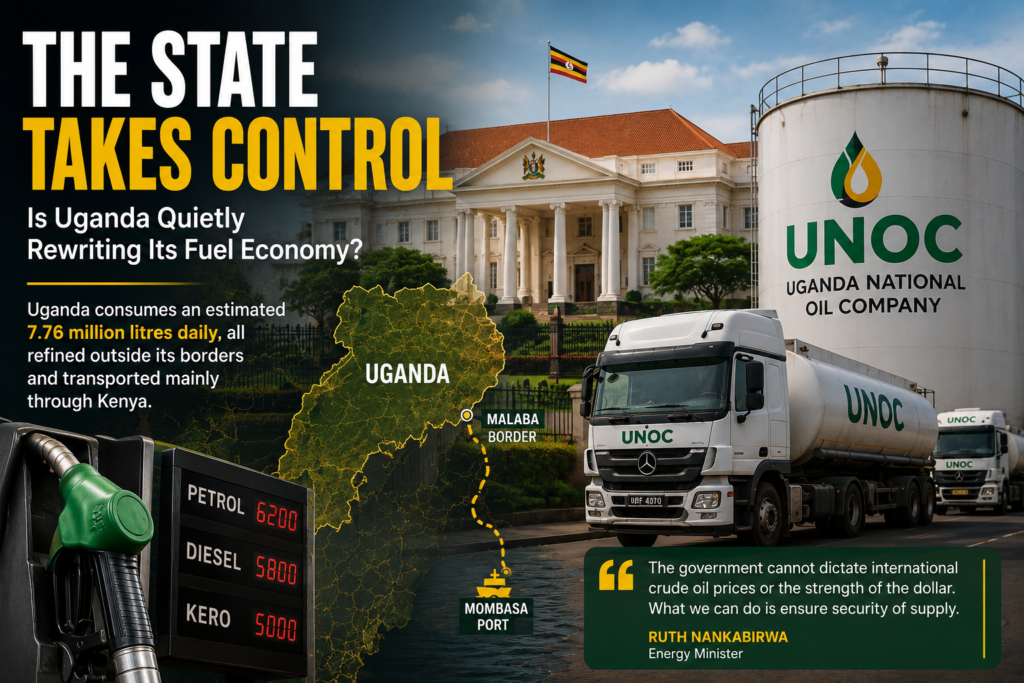
According to available data, the country consumes an estimated 7.76 million litres daily, all of it refined outside its borders and transported mainly through Kenya’s port and road network. It is one of the biggest contradictions shaping Uganda’s economic transition, and it is increasingly shaping the politics of energy.
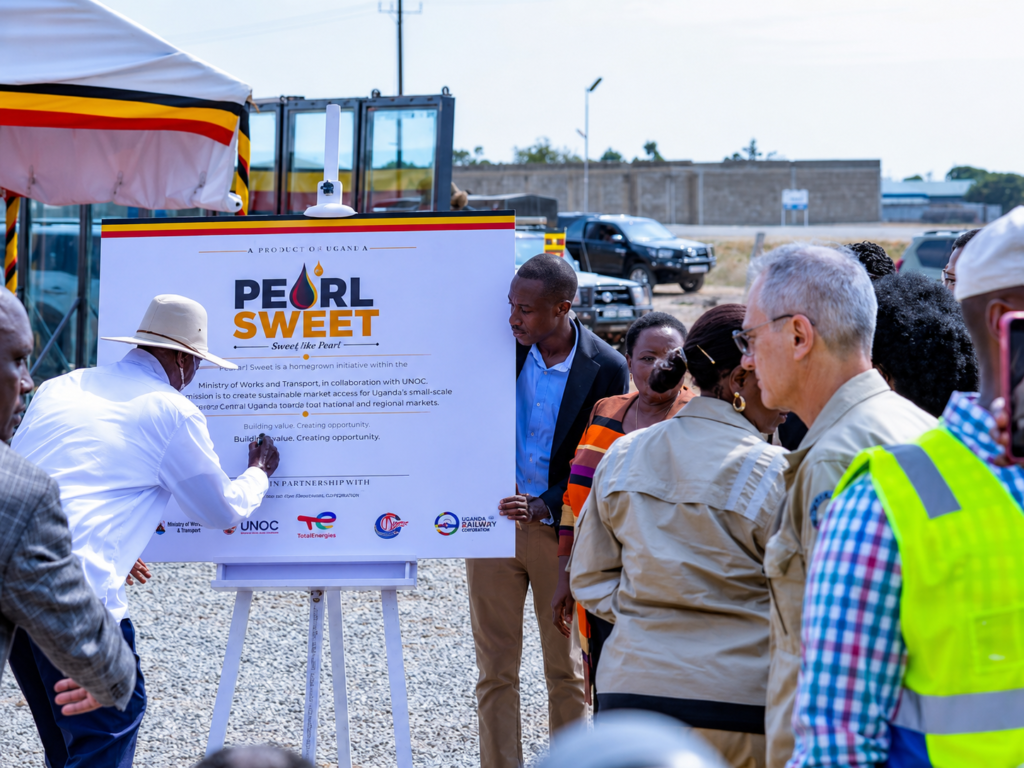
At the centre of this shift is the Uganda National Oil Company (UNOC), a state entity rapidly evolving from a future-focused investment vehicle into a strategic actor in Uganda’s current fuel economy. The question is now unavoidable: is Uganda shifting from a liberalised fuel market to a state-guided energy economy?
In Uganda, changes at the pump ripple immediately across the economy. Transport costs rise. Food distribution becomes more expensive. Business operating costs increase. Pump prices in Kampala have fluctuated between UGX 5,000 and UGX 6,200 per litre in recent years, driven less by global crude movements and more by exchange rate pressures and regional supply disruptions.
For years, Uganda’s downstream petroleum sector operated under a liberalised model where private oil marketing companies controlled importation and distribution. But that system carried a structural vulnerability: external dependency. Uganda remains heavily reliant on supply chains routed through Kenya’s port infrastructure. Any disruption, logistical delays at Mombasa, instability along transport corridors, or currency volatility, feeds directly into domestic fuel availability and pricing.
The state participated in the system. It did not control its exposure.
The introduction of the sole importation framework marked a structural turning point. Under this arrangement, UNOC now oversees bulk fuel procurement before distribution to oil marketing companies. Government argues this improves bargaining power, stabilises supply, and reduces fragmentation during external shocks.
The significance extends beyond procurement. UNOC is now embedded in refinery development, strategic fuel reserves, pipeline infrastructure, and petroleum investments under the East African Crude Oil Pipeline (EACOP) framework. With first oil expected, UNOC is no longer operating at the margins of Uganda’s energy sector. It is becoming central to how the country structures its entire energy system.
The recent discharge of nearly 100 million litres of fuel illustrated this new operational reality. UNOC’s Chief Corporate Affairs, Tony Otoa, described it plainly: “Discharge commenced on Tuesday 5th May and is progressing well. We expect the first trucks to cross Malaba within a few hours, which should start feeding into national stock before the close of the week.” Beyond its operational meaning, the statement reflects a shift, a state institution actively managing supply continuity in real time, not responding to market signals.
Within Uganda’s oil industry, the transition is generating both cautious optimism and concern. Some operators view coordinated importation as a stabilising force in a volatile regional environment. Others are watching the gradual concentration of roles within a single state-linked institution more carefully.
The issue is not state participation itself, governments across Africa maintain national oil companies because energy is considered strategically critical. Kenya has strengthened state coordination in fuel import aggregation. Ethiopia maintains strict state control driven by supply security concerns. Ghana’s GNPC continues expanding its role alongside private sector participation. Globally, Brazil’s Petrobras and Saudi Aramco demonstrate how national oil companies can become central instruments of economic strategy while still engaging open markets.
The question for Uganda is structural balance. Can market competition remain effective when one institution increasingly functions as importer, coordinator, infrastructure investor, and future refinery stakeholder simultaneously? Will smaller operators remain competitive over time? These are no longer theoretical questions, they are emerging operational realities.
Beneath these shifts is a broader policy direction: energy sovereignty, the ability of the state to maintain meaningful control not over oil underground, but over imports, storage, reserves, infrastructure, and supply security.
Energy Minister Ruth Nankabirwa has framed this distinction clearly. “The government cannot dictate international crude oil prices or the strength of the dollar,” she said. “What we can do is ensure security of supply.” The statement captures both constraint and intent. Uganda cannot move global markets. It can reduce its vulnerability to them.
This is particularly significant given that Uganda, even after first oil production begins, will remain dependent on imported refined petroleum for years due to limited domestic refining capacity. The current policy direction therefore represents gradual state consolidation over strategic energy systems, before commercial production reshapes the sector entirely.
Ultimately, this shift will not be judged by institutional design. It will be judged through lived economic experience. If supply stabilises and regional vulnerabilities reduce, the model will be seen to work. If volatility persists despite increased state coordination, questions about efficiency, transparency, and market distortion will intensify.
Uganda may not simply be restructuring how fuel is imported. It may be quietly redefining the relationship between the state, the market, and strategic economic power, before the full implications of that shift become visible.