The language used by many companies is changing. Where sustainability initiatives were once framed primarily as community outreach programmes, they are now being integrated into long-term business strategy.
NCBA Bank Uganda says its environmental efforts are anchored in its broader “Change the Story” Sustainability Strategy, which seeks to align business growth with social and environmental impact.
According to Martin Mwanje, Head of Strategy and Sustainability at NCBA Bank Uganda, the World Environment Day initiative reflects commitments that extend far beyond a single-day activation.
“The activity highlights the key commitments under our 2026–2030 Sustainability Strategy, including growing 100,000 trees by 2030 through strategic partnerships, supporting the communities in which we operate, and inspiring staff to make a difference through the ‘I Change the Story’ programme,” Mwanje said.
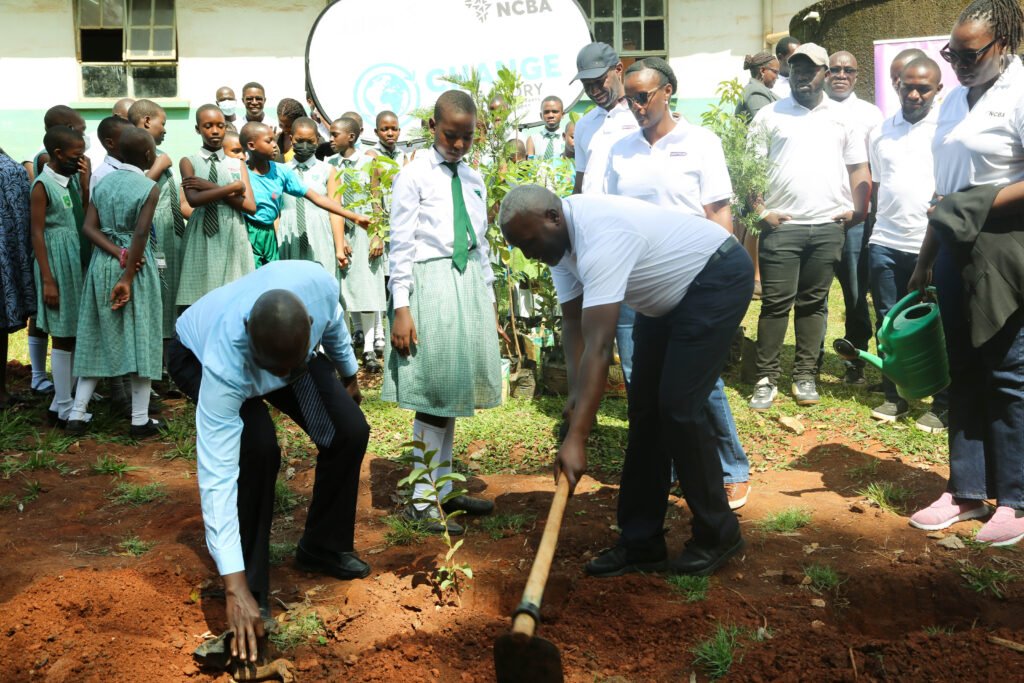
The bank’s ambitions are not limited to tree planting alone. The initiative at Nakasero Primary School combines environmental restoration with community development, reflecting a growing recognition that sustainability must deliver tangible benefits to the people it seeks to serve.
“As part of the World Environment Day celebrations, our immediate objective is to plant 500 trees and support the establishment of a grass field that pupils can use during their recreational time,” Mwanje added.
The remarks highlight how sustainability programmes are increasingly being designed to create long-term environmental and social value simultaneously. Rather than focusing solely on carbon reduction or conservation targets, companies are beginning to link environmental action with education, community wellbeing, and employee engagement.
Why Uganda’s Environmental Challenge Matters
In Uganda, this shift carries particular urgency. The country’s forest cover has declined from an estimated 24% in 1990 to about 12% today, driven by charcoal production, urban expansion, and agricultural pressure. Thousands of hectares continue to be lost annually, while rapid urbanisation in cities like Kampala is steadily shrinking green spaces.
The consequences are no longer abstract. Climate shocks are already affecting coffee production, food security, and water systems, exposing the fragility of livelihoods that depend heavily on natural ecosystems.
Against this backdrop, even initiatives such as planting 100,000 trees take on a wider significance. They sit within a broader struggle to restore ecological balance in a country where environmental degradation is increasingly tied to economic vulnerability.
The link between environmental sustainability and banking is also becoming harder to ignore.
Climate change is increasingly a balance-sheet issue. The same drought that affects a farmer’s harvest can disrupt loan repayments. The same floods that damage small businesses can weaken economic activity in entire communities. The same heat stress that reduces productivity can slow down entire local economies.
As a result, environmental risk is becoming financial risk. For banks, exposure to climate-related disruptions translates into higher credit risk, weakened asset performance, and reduced investment opportunities over time.
This is why sustainability is no longer just a concern for conservationists. It is becoming a core consideration for financial institutions whose long-term success depends on the resilience of the economies they finance.
NCBA’s approach also reflects a wider transformation across Africa’s financial sector.
Banks are increasingly financing renewable energy projects, expanding green lending portfolios, and embedding environmental, social, and governance (ESG) standards into their reporting frameworks. Investors are also placing growing emphasis on sustainability performance as a measure of long-term viability.
In this sense, NCBA’s tree-planting initiative is not an isolated gesture. It sits within a broader shift where African banking is slowly redefining what responsible growth looks like in a climate-constrained world.
For NCBA Bank Uganda, the “Change the Story” strategy signals a move beyond compliance-driven sustainability towards more integrated, long-term impact thinking.
The initiative at Nakasero Primary School reflects this approach, combining environmental restoration with community investment and employee engagement.
But it also points to something larger.
For decades, banks measured success through deposits, loans, and profits. Increasingly, they are also being asked to measure their contribution to environmental resilience and community wellbeing.
The trees planted at Nakasero Primary School may not transform Uganda’s environmental future on their own. But they represent a growing recognition that in a climate-constrained world, the institutions that finance development may also have to help sustain it.
The question is no longer whether climate change affects business. The question is how businesses choose to respond.