Across Uganda, a quiet shift is redefining the nature of work. Increasingly, people are earning livelihoods as freelancers, consultants, digital traders, content creators, software developers and independent service providers. Many operate without registered companies, formal payrolls or conventional business structures, yet they generate consistent income, employ others on a project basis and contribute meaningfully to the economy.
These are Uganda’s solopreneurs, and they represent far more than a growing informal workforce. They are evidence of a structural transformation in how economic value is created.
For decades, the firm has been treated as the basic unit of production. Businesses hired employees, generated revenue, accumulated assets and sought financing to expand. Banks, regulators and credit systems evolved around that model, assessing borrowers through financial statements, collateral and predictable cash flows.
That framework is becoming increasingly out of step with reality.
Today, technology is allowing individuals to perform functions that once required entire organisations. A graphic designer can serve clients across continents from a laptop in Kampala. A software developer can earn foreign income through digital platforms. A consultant can build a profitable practice without renting office space or employing permanent staff. Artificial intelligence is accelerating this shift by lowering the cost of delivering professional services and increasing the productivity of individual workers.
”Uganda’s fastest-growing workforce is increasingly made up of individuals rather than firms. Yet banks continue to lend as though businesses, not people, remain the primary engines of production. As work becomes more digital and decentralised, financial institutions that redesign their credit models will be better positioned to capture one of the country’s largest untapped lending markets”
The result is an economy where businesses increasingly resemble people rather than companies.
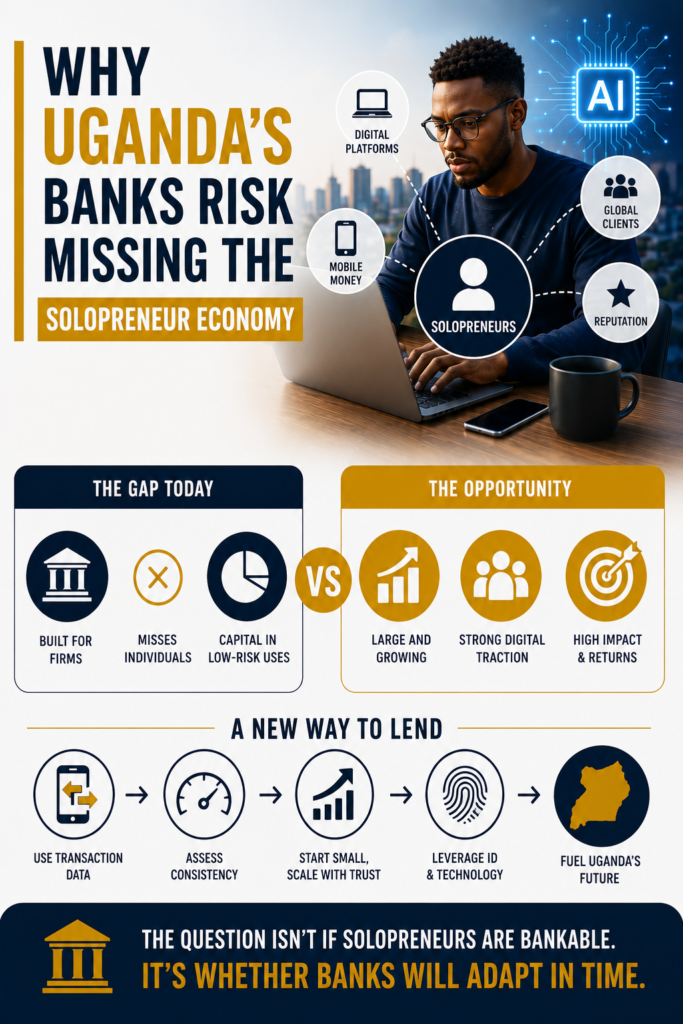
Uganda’s banking sector, however, has been slower to adapt. Despite remaining liquid and profitable, much of its lending continues to favour government securities and established corporate borrowers. Meanwhile, thousands of economically active individuals with reliable income streams remain outside the formal credit market.
This is often interpreted as a problem of informality. It is more accurately a problem of financial architecture.
The issue is not that banks lack capital to lend. It is that the systems used to evaluate creditworthiness were designed for an economy where employment was formal, businesses owned physical assets and financial records were produced through audited accounts.
Most solopreneurs fit none of these categories.
Their businesses are asset-light. Their income fluctuates across projects. Payments arrive through mobile money, digital wallets, bank transfers and online platforms. Their commercial reputation is reflected in repeat clients, platform ratings and transaction histories rather than balance sheets.
Viewed through conventional banking models, this information appears fragmented. Viewed through modern data analytics, it provides a continuous picture of economic activity.
This distinction matters because financial data has changed. Mobile money has evolved into one of Uganda’s most important financial infrastructures, recording millions of transactions every day. Digital platforms now connect service providers with clients beyond geographical boundaries. Payment histories increasingly reveal the consistency of income, while digital reputations often provide stronger indicators of business reliability than traditional documentation.
The challenge, therefore, is not the absence of information. It is the inability of many financial systems to interpret new forms of information.
Banks are not overlooking this market simply because they resist innovation. Their incentives have been shaped by regulation, risk management and legacy technology. Credit models remain calibrated around salaried employment, collateral and established SMEs because those have historically produced predictable lending outcomes. Experimentation carries costs, while government securities continue to offer attractive, low-risk returns.
Yet markets rarely remain static.
As traditional institutions maintain conservative lending practices, fintech companies have begun filling the gap. By analysing mobile money flows, transaction behaviour and alternative financial data, they are extending credit to borrowers who would rarely qualify under conventional banking criteria.
The implications extend beyond financial inclusion. They raise important questions about the future role of banks in retail lending.
If credit discovery increasingly happens through digital platforms rather than bank branches, financial institutions risk losing relevance in one of the fastest-growing segments of the economy. Their competitive challenge is no longer simply attracting deposits or financing established businesses. It is understanding economic activity that no longer fits traditional organisational structures.
That does not require abandoning prudent lending standards. It requires modernising how risk itself is measured.
Transaction-based credit assessment offers one pathway. Rather than relying primarily on collateral or fixed salaries, lenders can evaluate the consistency of digital earnings, mobile money inflows and repayment behaviour over time. Small revolving credit facilities that expand with demonstrated repayment discipline may prove better suited to independent professionals than conventional loan products designed around fixed employment.
As open finance, digital identity systems and artificial intelligence continue to mature, these approaches will become increasingly practical.
For banks, this is not merely an inclusion agenda. It is a commercial opportunity.
Financing solopreneurs creates pathways for future SME relationships, broadens deposit mobilisation as informal income becomes increasingly formalised and diversifies loan portfolios beyond heavy exposure to sovereign debt and a relatively small pool of large corporate borrowers. More importantly, it allows banks to participate in a segment of the economy that is expanding not because of policy intervention, but because technology is fundamentally changing how work is organised.
The rise of Uganda’s solopreneur economy is therefore more than a labour market trend. It reflects a deeper restructuring of production itself.
Individuals are becoming businesses. Digital platforms are replacing physical offices. Reputation is becoming as commercially valuable as collateral. Income is increasingly measured through transactions rather than payslips.
Yet much of the financial system continues to evaluate borrowers using assumptions rooted in an earlier economy.
The longer that gap persists, the greater the opportunity for new competitors to redefine how credit is created and distributed. The question is no longer whether Uganda’s solopreneurs are bankable.
It is whether banking systems designed for an economy of firms can adapt quickly enough to remain competitive in an economy increasingly powered by individuals.
Editorial Note: Publicist East Africa produces research-driven analysis, executive thought leadership and strategic communications for organisations shaping East Africa’s economic future.