Every generation has produced countries that fundamentally rewrote the rules of economic development. Japan rebuilt itself from the devastation of war into an industrial giant. South Korea rose from poverty to become a global technology powerhouse. Singapore transformed a small island with few natural resources into one of the world’s most competitive economies. China became the factory of the world. More recently, Vietnam has demonstrated how a developing country can rapidly industrialise and integrate into global value chains.
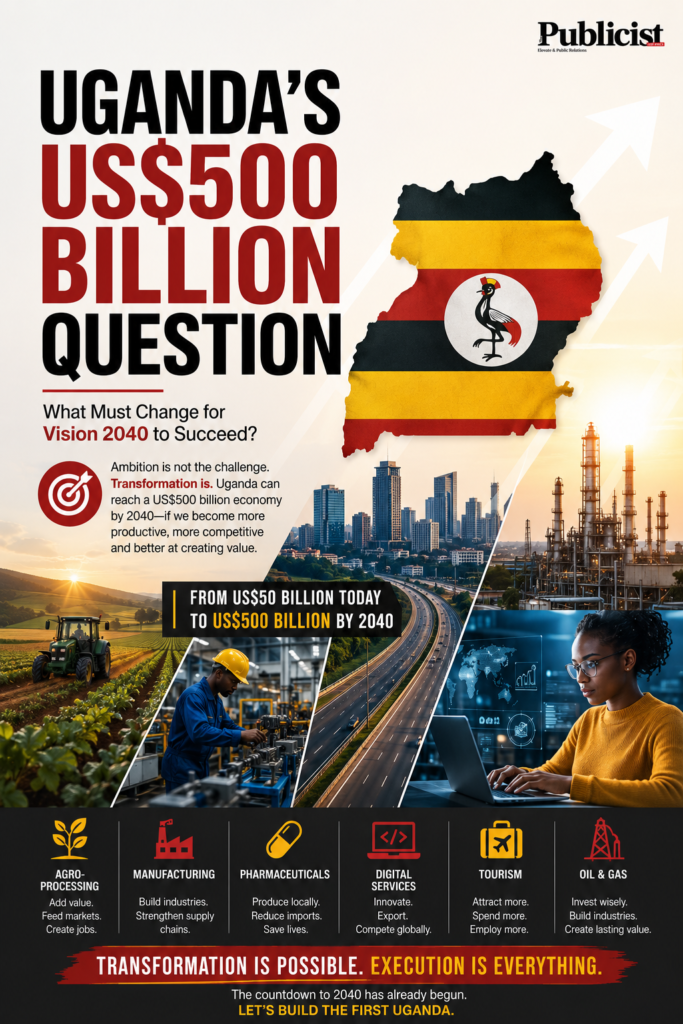
Uganda has set itself an equally ambitious destination. Through Vision 2040, it aims to expand the economy from roughly US$50 billion today to US$500 billion by 2040. It is a bold target that reflects confidence in the country’s long-term potential.
The real question, however, is not whether Uganda’s ambition is too large. It is whether Uganda is prepared to make the structural changes that every successful economy has had to make. History is remarkably consistent on this point. Countries do not become wealthy because they dream bigger. They become wealthy because they become more productive, more competitive and better at creating value.
That is the central challenge facing Uganda.
The journey to a US$500 billion economy will not be determined by the number of policies announced or infrastructure projects commissioned. It will depend on whether Uganda can build an economy that consistently produces goods and services the world wants to buy, supports globally competitive businesses and creates productive jobs for millions of its young people.
Vietnam offers an important lesson, not because Uganda should copy its model, but because it demonstrates what disciplined execution can achieve. Like Uganda, Vietnam was once largely dependent on agriculture, had a young population and faced serious infrastructure constraints. Four decades ago, it ranked among the world’s poorest nations.
Its transformation did not happen overnight or because of a single reform. It resulted from decades of consistent investment in productivity, industrialisation, exports, skills and competitiveness. Those are not uniquely Vietnamese principles. They are the same foundations that underpinned the rise of South Korea, Singapore and China.
The lesson for Uganda is simple: economic transformation is ultimately about producing more value from the same resources.
That requires moving labour, capital and investment from low-productivity activities into higher-value sectors. Uganda cannot build a US$500 billion economy if a large share of its workforce remains trapped in subsistence agriculture or informal enterprises with limited productivity. Growth will increasingly come from expanding agro-processing, manufacturing, pharmaceuticals, business services, digital technology, tourism and other industries capable of generating higher incomes and stronger export earnings.
This shift is already beginning, but it must accelerate.
Agriculture illustrates both Uganda’s greatest strength and its greatest missed opportunity. The country is one of Africa’s leading producers of coffee, maize, beans, fruits and livestock products, yet much of this output is exported with minimal processing. Coffee remains Uganda’s largest agricultural export, but far greater value lies in roasting, packaging, branding and manufacturing finished products rather than exporting raw beans.
The same principle applies across agriculture. Processing dairy products instead of exporting raw milk, manufacturing fruit concentrates instead of exporting fresh produce, producing textiles from locally grown cotton and developing food-processing industries would generate significantly more income, create more skilled employment and strengthen domestic supply chains.
The challenge is therefore not simply to produce more. It is to produce smarter.
The same logic extends beyond agriculture.
Uganda’s emerging pharmaceutical industry demonstrates how local manufacturing can reduce imports while creating higher-value industrial capabilities. Digital services are opening opportunities for software developers, fintech companies and business process outsourcing firms to compete beyond Uganda’s borders. Tourism has the potential to evolve from wildlife safaris into a broader visitor economy built around conferences, culture, sports, health and creative industries. Oil and gas, if managed strategically, should become not merely a source of government revenue but a catalyst for engineering, fabrication, logistics, research and specialised professional services.
The critical question is whether these sectors remain isolated success stories or become interconnected industries that reinforce one another.
That is where competitiveness becomes more important than investment alone.
Building industrial parks, roads and power plants is necessary, but infrastructure by itself does not create globally competitive industries. Investors compare countries based on production costs, logistics, regulation, skills, access to markets and policy certainty. Factories locate where supply chains function efficiently. Exporters thrive where customs systems are predictable. Technology companies expand where digital infrastructure and skilled talent are readily available.
Uganda has made important investments in transport corridors, electricity generation and industrial zones. The next stage is ensuring those investments translate into complete industrial ecosystems where local suppliers, manufacturers, researchers, financiers and service providers can all participate in regional and global value chains.
This requires a different way of thinking about development.
Too often, success is measured by the number of factories opened, roads constructed or investment agreements signed. Those metrics matter, but they are inputs rather than outcomes. The real measure of success is whether Ugandan firms become more productive, more innovative and more competitive internationally.
Competitiveness also depends on people.
No country has sustained high economic growth without investing heavily in human capital. South Korea transformed education into an economic strategy. Singapore aligned skills development with the needs of industry. Vietnam expanded technical and vocational education to support manufacturing growth.
Uganda’s youthful population gives it a demographic advantage, but demographics alone do not create prosperity. A rapidly growing workforce becomes an economic dividend only when it possesses the skills demanded by a modern economy.
Engineers, technicians, scientists, software developers, AI specialists, entrepreneurs, researchers and skilled artisans will be just as important to Vision 2040 as roads, railways and industrial parks. Human capital is not a social programme. It is productive infrastructure.
Equally important are the institutions that shape business confidence.
Businesses invest where regulations are consistent, contracts are enforced, taxes are predictable and public institutions function efficiently. Long-term investment depends as much on confidence as it does on incentives. Uganda’s competitiveness will increasingly be determined not only by physical infrastructure but also by the quality of governance, regulatory certainty and the ease with which businesses can innovate, expand and export.
This is particularly important as global supply chains continue to evolve.
Companies are diversifying manufacturing locations. The African Continental Free Trade Area is creating access to a continental market of more than one billion consumers. Artificial intelligence and digital technologies are reshaping production, services and trade. Uganda’s strategic location, youthful population, expanding infrastructure and natural resources position it to benefit from these shifts—but only if it becomes more competitive than alternative investment destinations.
Potential has never been Uganda’s problem.
Execution has.
That is perhaps the most important lesson from every successful development story. Countries rarely fail because they lack opportunities. They fail because reforms lose momentum, institutions fail to adapt and difficult economic decisions are postponed.
Vision 2040 therefore demands more than optimism. It demands discipline.
It requires policymakers to prioritise productivity over short-term politics, regulators to create a predictable business environment, universities to produce skills aligned with future industries, financial institutions to channel capital into productive enterprises and the private sector to invest beyond trading into innovation, manufacturing and export-oriented businesses.
Most importantly, it requires Uganda to judge success differently.
The true measure of a US$500 billion economy will not simply be a larger GDP figure. It will be whether Ugandan companies compete confidently in international markets; whether farmers become agribusiness entrepreneurs rather than commodity producers; whether manufacturers export finished products instead of raw materials; whether technology firms build solutions for regional and global customers; and whether millions of young Ugandans find productive, well-paying jobs in competitive industries.
Uganda does not need to become another Vietnam, Singapore or South Korea. It must become the first Uganda that fully unlocks its own comparative advantages.
That transformation will not happen automatically, nor will it be delivered by ambition alone. It will require difficult choices, relentless execution and an unwavering commitment to competitiveness over complacency.
The countdown to 2040 has already begun. The question is no longer whether Uganda can imagine a US$500 billion economy. The question is whether government, business, investors and the private sector are willing to make the decisions that such an economy demands.
History suggests that countries are transformed not by the visions they write, but by the reforms they sustain. Vision 2040 will ultimately be judged not by the scale of its ambition, but by whether Uganda has the courage to execute it.