“To achieve growth from 50–60 billion dollars to 500 billion dollars is now extremely easy. We already have the roads and infrastructure in place; all we need is funding,” Tanna said.
For more than two decades, Uganda has pursued a strategy built around creating the physical foundations of economic transformation. Billions of shillings have been invested in roads, electricity generation, telecommunications networks, industrial parks and logistics infrastructure, driven by a simple assumption: once the country removed major infrastructure bottlenecks, investment would follow, industries would expand and economic growth would accelerate.
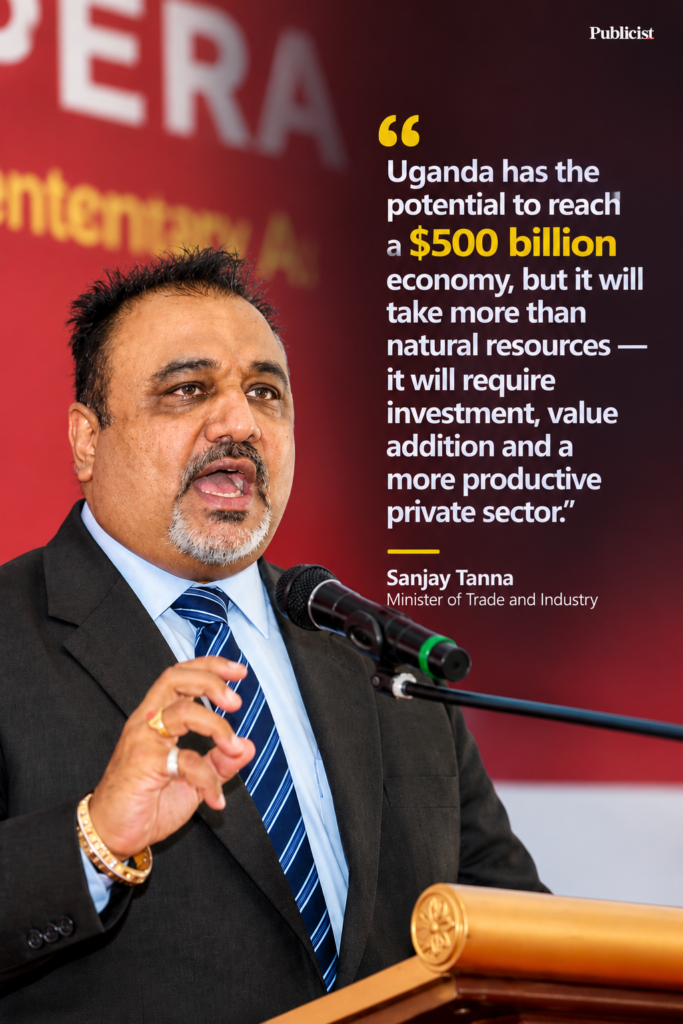
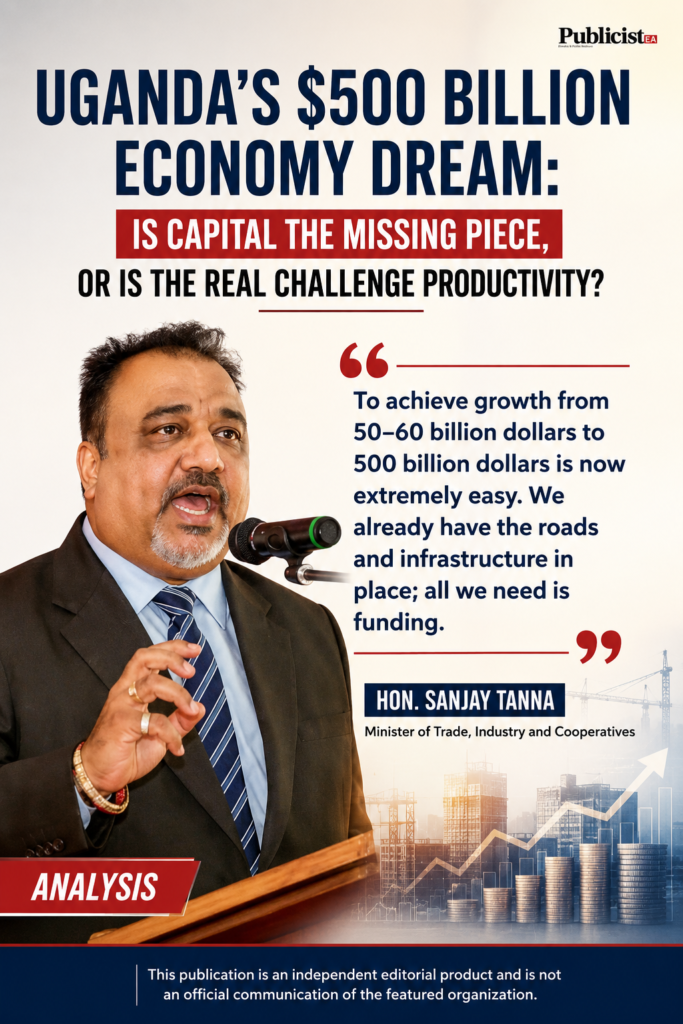
Trade Minister Hon. Sanjay Tanna recently argued that Uganda’s ambition of growing its economy from its current size of about US$50–60 billion to US$500 billion is within reach because many of the basic foundations required for growth are already in place.
“To achieve growth from 50–60 billion dollars to 500 billion dollars is now extremely easy. We already have the roads and infrastructure in place; all we need is funding,” Tanna said.
The statement reflects a growing confidence among policymakers that Uganda has moved beyond the first stage of development, where countries must build basic infrastructure, and is now entering the more complex stage of transforming those assets into economic output.
But it also raises a fundamental question: Is capital really the missing piece, or does Uganda face a deeper structural challenge?
A US$500 billion economy would represent a historic transformation. It would require Uganda’s economy to expand nearly tenfold, placing it among Africa’s largest economic powerhouses. While such growth may appear ambitious, global history shows that countries can achieve extraordinary economic expansion within a generation.
South Korea transformed from a war-damaged economy into a global technology leader. China became the world’s manufacturing centre. Vietnam moved from one of Asia’s poorest economies into one of the fastest-growing industrial exporters. Rwanda has demonstrated how strategic reforms and investment attraction can accelerate economic progress.
However, none of these transformations happened because countries simply built roads, power plants or industrial zones. Infrastructure created the platform, but industrial strategy, productivity growth, innovation, skills development and export competitiveness created the wealth.
For Uganda, therefore, the central challenge is not whether the country can attract money. It is whether the economy has enough productive opportunities capable of turning investment into sustainable growth.
Infrastructure is essential for economic development, but it does not automatically generate prosperity. A highway reduces transport costs, but it does not create exports. Electricity enables production, but it does not create competitive industries. Digital connectivity improves access to information, but it does not automatically produce innovation.
The economic value of infrastructure depends on what businesses, entrepreneurs and investors do with it.
Uganda’s Kampala-Entebbe Expressway provides an example. The road has improved connectivity between Kampala and the country’s main international gateway, reducing travel time and improving logistics. But its broader economic impact depends on whether new businesses, tourism investments, logistics companies and industrial activity emerge around that connectivity.
Similarly, industrial parks can become powerful engines of growth, but only if they attract manufacturers that produce goods, create jobs and compete in regional and international markets.
China’s industrial rise was not achieved simply by constructing ports and highways. Those investments were combined with manufacturing policies, export incentives, technology transfer, workforce development and a deliberate strategy to integrate into global supply chains.
Vietnam followed a similar path by using infrastructure as a foundation for export-oriented manufacturing. The lesson for Uganda is clear: infrastructure enables growth, but productive industries create it.
Uganda’s businesses have repeatedly identified access to affordable and long-term financing as one of the biggest barriers to expansion.
Many companies remain small, informal and unable to scale. not because entrepreneurs lack ideas or ambition, but because they struggle to access the patient capital required to invest in machinery, technology, skilled workers and market expansion.
Building a US$500 billion economy will require a financial system capable of moving capital from savings into productive investment. This means strengthening domestic capital markets, increasing private-sector lending, expanding access to venture capital and creating financial instruments that support long-term enterprise growth.
Uganda’s pension sector also presents a significant opportunity. Long-term institutional investors hold substantial resources that could potentially support infrastructure, manufacturing, housing and strategic industries if appropriate investment frameworks are developed.
The diaspora represents another underutilised source of capital. Ugandans abroad already contribute billions of dollars through remittances, but much of this money supports household consumption rather than productive investment. Creating credible investment opportunities could help redirect a portion of these funds into businesses, industries and national development projects.
Foreign investment will also remain important, but the focus must increasingly shift from attracting capital alone to attracting the right kind of capital. investment that builds factories, develops skills, transfers technology and strengthens Uganda’s position in global value chains.
Because money by itself does not create transformation. How effectively it is deployed determines whether it produces growth or simply increases consumption.
The foundation of any wealthy economy is productivity. Countries become prosperous when workers, companies and industries consistently produce more value. Economic growth comes not merely from spending more money, but from producing more goods and services that can compete locally and globally.
Uganda’s challenge is therefore not simply increasing the size of the economy. It is increasing the productive capacity of the economy. Agriculture demonstrates this challenge clearly.
Uganda has millions of farmers, favourable climate conditions and globally competitive products such as coffee. The country has become one of Africa’s leading coffee exporters, earning billions of dollars annually.
Yet much of the highest value in the coffee chain is created elsewhere. The largest profits often come from processing, branding, packaging and retail, stages where Uganda captures a smaller share.
The same applies to minerals. Natural resources create opportunities, but countries that achieve lasting prosperity do not simply extract and export raw materials. They build industries around refining, processing and manufacturing.
The difference between a resource-rich country and an industrial economy is the ability to capture value beyond the raw commodity.
Uganda’s greatest economic asset may not be its infrastructure or natural resources, but its people. With one of the youngest populations in the world, Uganda has the potential to benefit from a demographic dividend. A skilled and productive workforce can drive manufacturing, technology, creative industries and modern services.
However, population growth alone does not guarantee prosperity.
A young population becomes an economic advantage only when people have the skills, opportunities and productive jobs required to contribute to economic growth.
The future economy will demand workers who can operate advanced technologies, manage digital systems, build businesses and participate in global value chains. Investment in education, technical training, digital skills and entrepreneurship will therefore be central to achieving the country’s long-term ambitions. Even where capital exists, investors require confidence before committing resources.
Investment decisions depend not only on infrastructure but also on the broader economic environment, including regulatory stability, taxation policies, contract enforcement, governance standards and the ease of doing business.
A road can connect markets, but investor confidence determines whether companies build factories along that road. A power plant can increase electricity supply, but businesses must believe they can operate in a predictable environment before making long-term investments. Economic transformation requires trust between government and the private sector.
Uganda’s geographical position gives it a major advantage. Located at the centre of East Africa, the country has access to a regional market of hundreds of millions of consumers. This creates opportunities in manufacturing, logistics, agriculture processing, energy and services. But geography alone does not guarantee success. Many countries have strategic locations but fail to convert them into economic power because they do not develop competitive industries.
Uganda’s opportunity is to move from being primarily a consumer market for imported goods to becoming a production hub that supplies the region and the global economy.
Uganda’s US$500 billion economy ambition is bold, but economic history shows that transformational growth is possible. However, the journey will not be achieved through capital alone.
Hon. Sanjay Tanna is correct that infrastructure investment has created an important foundation. Uganda has spent years building the physical systems needed for a modern economy. But the next phase requires a different kind of transformation. The country must build industries that create value, businesses that compete globally, workers with modern skills and institutions that support long-term investment. The question facing Uganda is no longer whether it can build roads, power plants or industrial parks. The bigger question is whether it can build an economy productive enough to make those investments generate exponential returns.
A US$500 billion economy will not be created by the amount of money Uganda attracts. It will be created by how effectively that money is converted into factories, exports, innovation, jobs and higher productivity. The infrastructure foundation may already be in place. Now Uganda must build the productive engine capable of carrying the economy forward.